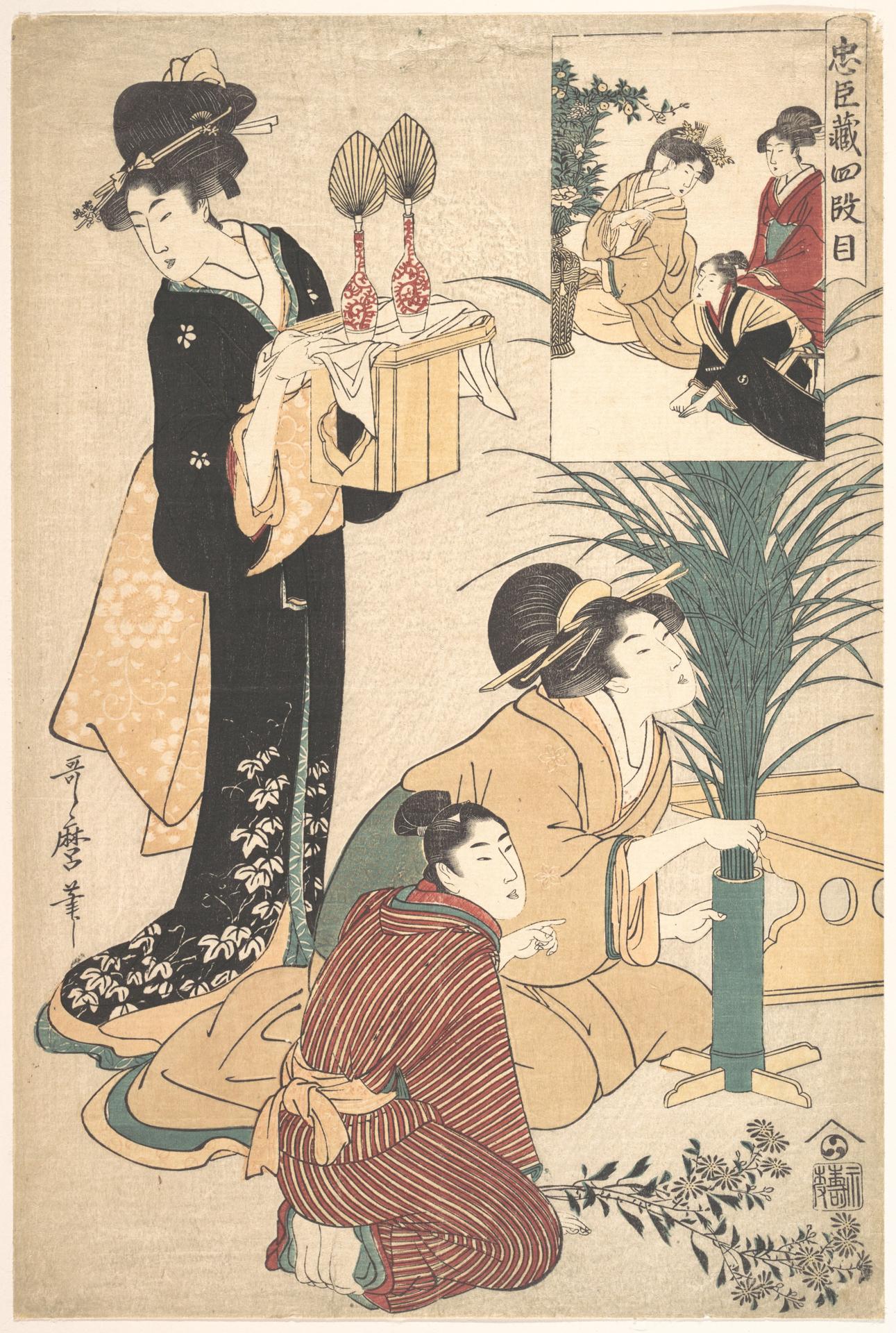
A Woman and a Man Arranging Flowers for the Tsukimi (Moon Festival)
Original title: A Woman and a Man Arranging Flowers for the Tsukimi (Moon Festival)
kurzbeschreibung
A colour woodblock print from 1802 by Kitagawa Utamaro presents a couple arranging flowers for Tsukimi, the moon festival. The woman wears a yellow kimono with a black obi, while the man kneels before a vase. Printed with ink and colour on paper, the sheet belongs to the Japanese ukiyo-e genre.
Description
The woman holds out a box of flowers, and the kneeling man busies himself with a flower vase. A smaller picture set into the background shows four women preparing flowers for the festival. Blues, greens, browns and reds govern the palette, and even light draws out the details of clothing and arrangements. Clean lines and crisp contours define the style typical of traditional Japanese woodblock prints.
Context
The sheet dates from 1802, late in the Edo period, when Utamaro ranked among the leading ukiyo-e artists. Tsukimi, celebrated in autumn, was a favourite subject in Japanese art and daily life. Utamaro is known for his portrayals of women and scenes of everyday life, often showing how townspeople spent their leisure. This print belongs to a series or album of seasonal festivals and conveys the cultural weight of the moon-festival tradition.
Impact
A calm arrangement and harmonious colouring give the scene balance and a peaceful air. Fine lines and the detailed rendering of textiles and flowers lend the sheet an elegant, almost ceremonial mood. The inset picture in the background adds narrative depth and draws the viewer into the festival preparations.
Technique
Several carved woodblocks, one for each colour, were printed in succession with ink and colour on paper, the method typical of ukiyo-e. Precise contours and flat areas of colour attest to the high craftsmanship of printmaking in nineteenth-century Japan.
AI-generated description text
Source: Metropolitan Museum of Art · Public Domain (CC0 1.0)