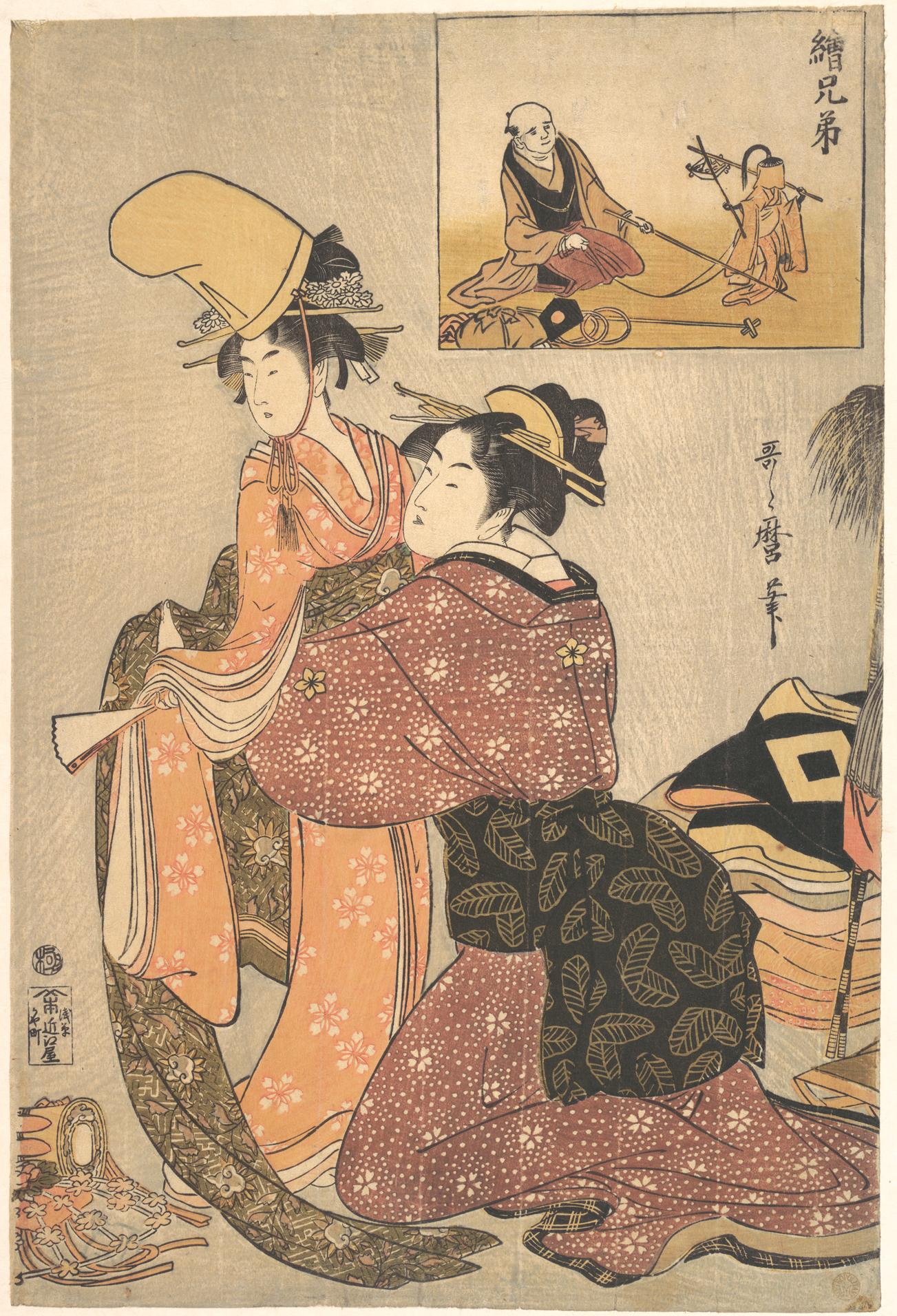
A Woman Dressing a Girl for the Kabuki Dance “Musume Dojōji,” with “Brother Picture” (E-kyōdai) of a Monkey Trainer
Original title: A Woman Dressing a Girl for a the Kabuki Dance “Musume Dojōji,” with “Brother Picture” (E-kyōdai) of a Monkey Trainer
kurzbeschreibung
Kitagawa Utamaro made this woodblock print around 1795–96, showing two women in traditional dress preparing for a Kabuki performance. The print is in the e-kyōdai format, with ink and color on paper. In the upper right corner, a smaller companion image depicts a monkey trainer.
Description
Two seated women in Japanese attire dominate the image. The one on the left wears an orange kimono with a floral pattern and a yellow head covering; the one on the right wears a brown kimono with a floral pattern and a black head covering adorned with a leaf motif. The left figure holds a fan. A smaller woodblock print is inserted at the upper right, showing a man in traditional clothing with a long stick. Warm tones—orange, brown, and gold—define the color palette.
Context
The print dates from the Edo period, an era of cultural flourishing alongside a strict social order in Japan. Utamaro was among the leading masters of ukiyo-e and devoted himself primarily to depictions of women. The Kabuki dance 'Musume Dōjōji' was a popular stage piece often captured in prints. The e-kyōdai format, which combines a main motif with a smaller companion image, was widespread at the time.
Impact
The scene feels quiet and intimate because the figures are shown in everyday preparation. Warm colors and clear lines give the print a harmonious, elegant presence. The monkey trainer as a secondary motif adds a contrasting, almost cheerful note.
Technique
The woodblock print was printed with ink and color on paper. The e-kyōdai format pairs a larger main image with a smaller secondary image. Ukiyo-e woodblock printing allowed for fine lines and precise patterns, which stand out clearly on the kimonos.
AI-generated description text
Source: Metropolitan Museum of Art · Public Domain (CC0 1.0)