Draught Horse
Original title: Draught Horse
kurzbeschreibung
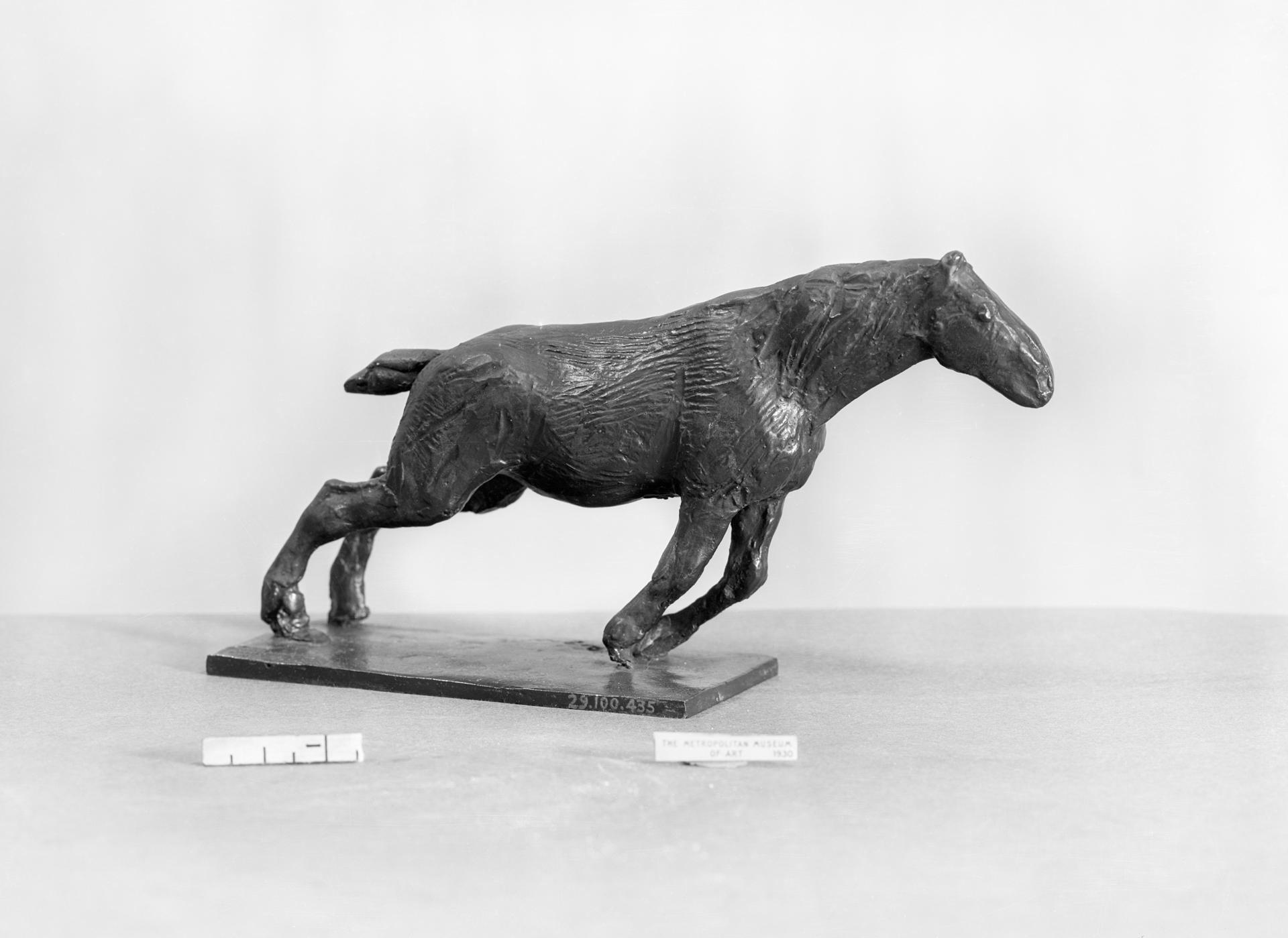
Edgar Degas probably modeled Zugpferd before 1881, but the bronze cast was not made until 1920. The work shows a single horse from the side, captured in a galloping motion and placed on a square base.
Description
The horse's hind legs are stretched far back, the front legs only slightly bent; the head turns a little to the right, reinforcing the impression of forward drive. The view remains strictly in profile. On the square base are a serial number and a reference to the Metropolitan Museum of Art. Because the photograph is black and white, the sculptural modeling and the surface traces of the bronze cast stand out more clearly.
Context
The work dates from a period when Degas was intensely occupied with the horse as a subject—probably before 1881. The 1920 cast was made posthumously and belongs to a later reproduction of his wax models. Movement was a central theme for the artist; he studied it in horses as well as in dancers and in a variety of media.
Impact
From the extended posture of the hind legs and the slight bending of the front legs arises a feeling of tension and drive. Reduced to pure bronze form, the horse appears timeless and powerful, without allowing the viewer to maintain distance.
Technique
It was cast in bronze, a material that stands for durability and fine detail reproduction. The 1920 cast is probably based on a wax model by Degas, which allowed the surface structure to be faithfully transmitted.
AI-generated description text
Source: Metropolitan Museum of Art · Public Domain (CC0 1.0)