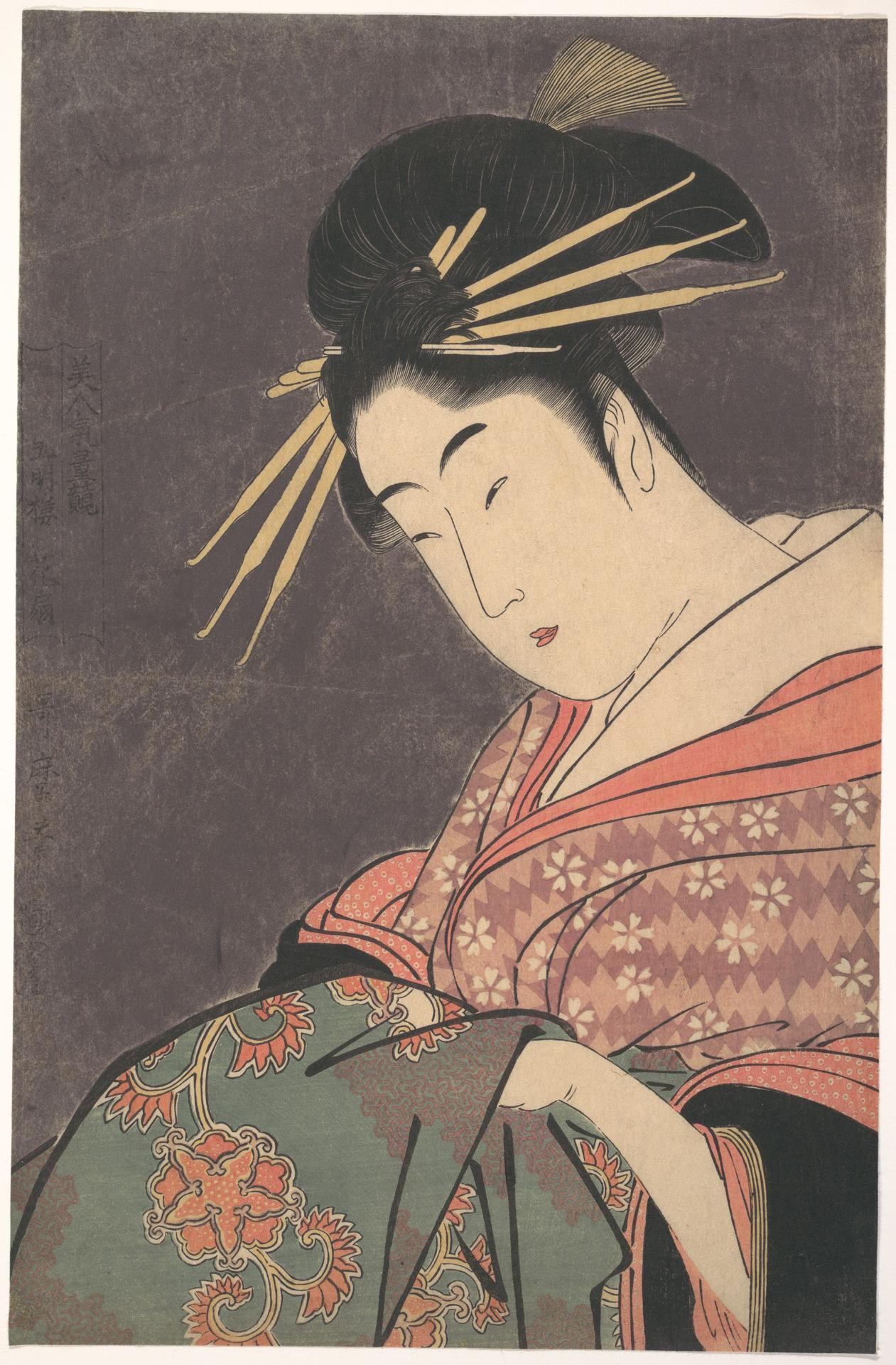
Hanaōgi of the Gomeirō, from the series Comparing the Charms of Beauties (Bijin kiryō kurabe: Gomeirō Hanaōgi)
Original title: “Hanaōgi of the Gomeirō,” from the series Comparing the Charms of Beauties (Bijin kiryō kurabe: Gomeirō Hanaōgi)
kurzbeschreibung
Kitagawa Utamaro made this print around 1794–95. It shows a young woman in a kimono patterned with flowers. The work is a colour woodblock print on paper, ōban size, measuring 37.9 × 24.6 cm. The sitter is Hanaōgi, a celebrated courtesan of the Gomeirō in Edo.
Description
Her hair is piled high and set with gold ornaments, and blossoms cover the kimono. Her lowered gaze gives her a thoughtful, reflective air. Against the dark ground the figure stands out clearly; dark tones dominate the palette, lightened by touches of red and gold. A muted light falls across the sheet and traces the outlines of the kimono and the texture of its fabric. Crisply drawn lines separate the areas of colour cleanly from one another.
Context
When Utamaro made this print, Japanese woodblock printing had reached its high point in the late Edo period. The series Bijin kiryō kurabe set the charms of well-known beauties of the Yoshiwara pleasure quarter side by side. Hanaōgi is no invented figure — her name appears in records of her own time. Utamaro was regarded as a chronicler of women from the urban milieu, whom he portrayed with great psychological depth.
Impact
Calm and intimacy shape the impression, for the figure seems withdrawn into herself, and the viewer is drawn, as it were, into her private sphere. The dark ground together with the bright accents creates an elegant, almost noble mood. Delicately drawn lines and a balanced colour scheme give the image a timeless aesthetic quality.
Technique
The sheet was produced as a nishiki-e, a woodblock print in ink and colours on paper, in several successive printing passes. Each area of colour required its own wooden block, which demanded a precise separation of colours. Sharp contours and clearly bounded areas are characteristic of ukiyo-e: the artist transferred his drawing to the block, and the printer then applied the colours.
AI-generated description text
Source: Metropolitan Museum of Art · Public Domain (CC0 1.0)