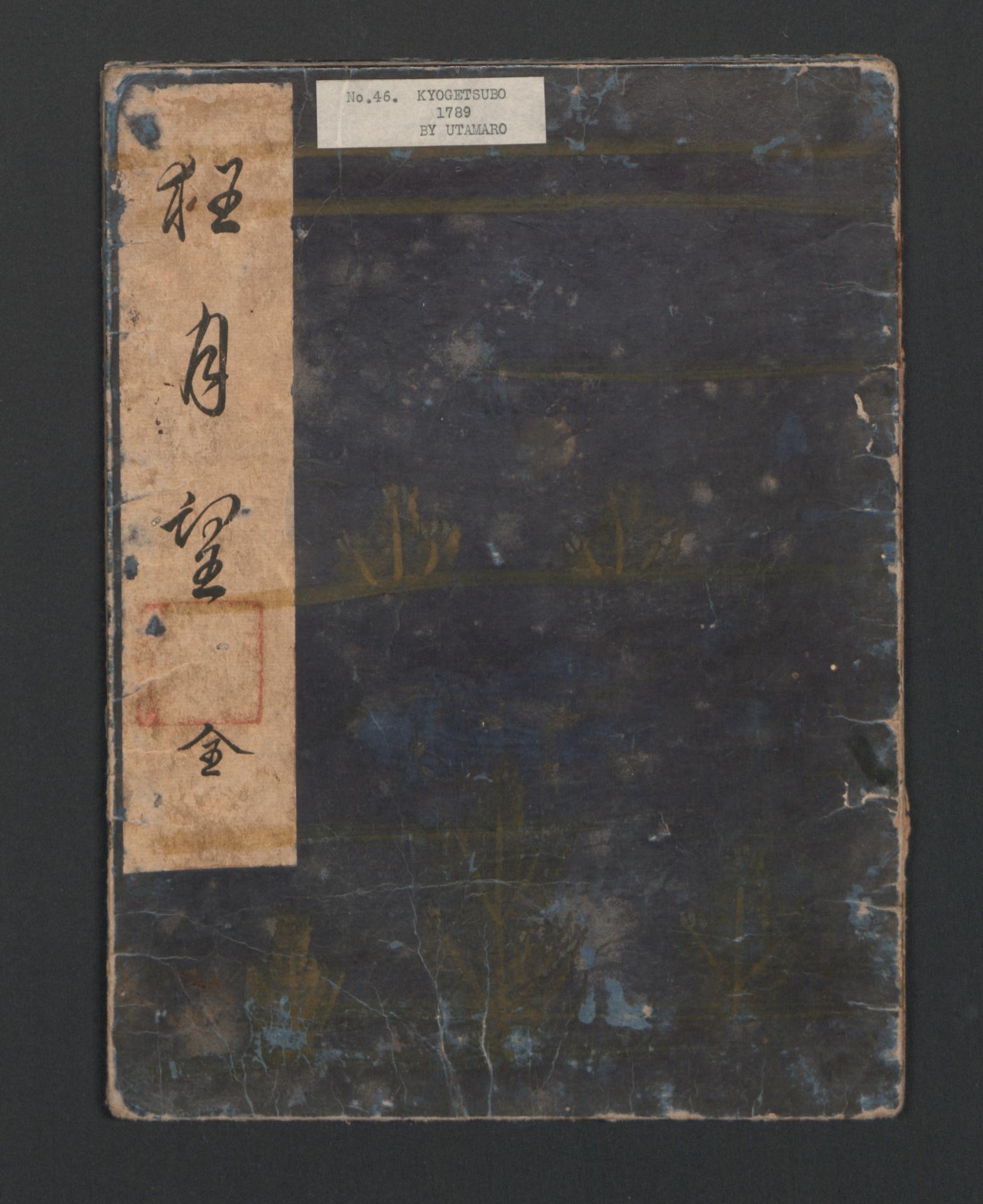
The Moon-Mad Monk, or Crazy Gazing at the Moon (Kyōgetsubō)
Original title: The Moon-Mad Monk, or Crazy Gazing at the Moon (Kyōgetsubō 狂月坊)
kurzbeschreibung
This page comes from a woodblock-printed book by Kitagawa Utamaro and is dated to the eighth month of 1789. It is a polychrome woodblock print, printed with ink and color on paper. The title 'Kyōgetsubō' appears, and the surface is densely covered with Chinese characters; no figures are present.
Description
A deep blue dominates the overall impression of the sheet, pointing to a traditional color scheme. In the upper left, a narrow beige strip carries Chinese characters, likely a title or book name. Traditional characters are scattered across the entire page, varying in size and orientation. Cracks and smudges bring out the object's age. A small white label at the top reads 'No.46. KYOGETSUBO 1789 BY UTAMARO'.
Context
Utamaro made this sheet in 1789, a phase in which he had come to prominence with depictions of women and new woodblock techniques. The book from which the page is taken belongs to a series dealing with the moon and its associated legends. Blue was popular in the Edo period after Prussian blue was introduced from Europe. The date '1789, eighth month' places the work in the late Edo period, a heyday of ukiyo-e.
Impact
Calm and meditative, the page meets the viewer, sustained by the dark blue and the dense sequence of characters. Traces of age give the sheet a historical aura and bring the time of its making close. Because no figures distract, the gaze rests entirely on the typography and the aesthetics of calligraphy.
Technique
Printing was done by woodblock, transferring water-based pigments onto paper. The polychromy suggests multiple blocks, each covering its own color area. Ink and color on paper correspond to the common practice of eighteenth-century Japanese woodblock books.
AI-generated description text
Source: Metropolitan Museum of Art · Public Domain (CC0 1.0)