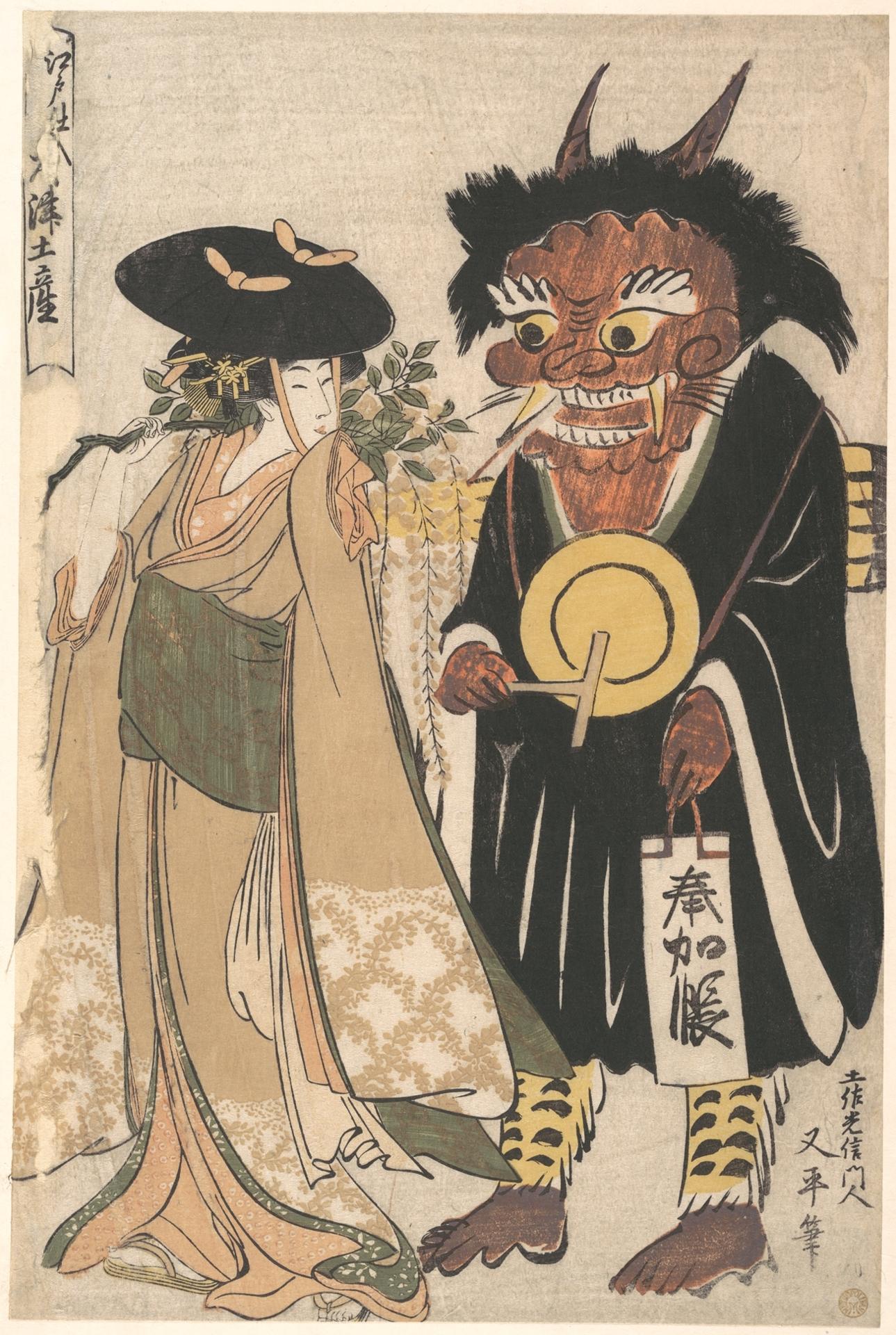
Wisteria Maiden with an Ōtsu Demon Dressed as an Itinerant Monk, from the series Souvenir Paintings from Ōtsu, Stocked in Edo (Edo Shi-ire Ōtsu Miyage)
Original title: Wisteria Maiden with an Ōtsu Demon Dressed as an Itinerant Monk, from the series Souvenir Paintings from Ōtsu, Stocked in Edo (Edo Shi-ire Ōtsu Miyage)
kurzbeschreibung
A woman in traditional dress meets a demon dressed in the robe of a wandering monk in this color woodblock print by Kitagawa Utamaro, made around 1802–3. The encounter belongs to the series Souvenir Pictures of Ōtsu, which circulated in Edo. Ink and color on paper.
Description
The woman stands in a long cream kimono with a green obi, her black hat adorned with flowers. Her gaze drifts calmly to the side. Opposite her appears a horned demon in a black, long-sleeved garment with white sleeves. His right hand holds a yellow disc, his left a placard with Chinese characters. Earth tones dominate the palette, accented with green and yellow; the demon's feet show yellow-and-black patterns.
Context
Utamaro's series emerged around 1802–3, when images of Ōtsu were in demand as souvenirs and traded in Edo. The figure of the demon disguised as a monk refers to a popular pictorial tradition from Ōtsu that often offered humorous or moralizing scenes. Utamaro, otherwise known for his portrayals of women, here translated folk belief into the refined form of the color woodblock print.
Impact
Delicate femininity and a grotesque demon stand in ironic contrast. The clear layout and muted colors feel balanced, while the demon's distorted features provoke a quiet unease.
Technique
A multicolor woodblock print (nishiki-e) with ink and opaque colors on paper. The contours are precisely cut, the color areas evenly printed. Details such as the characters and patterns were created through fine lines.
AI-generated description text
Source: Metropolitan Museum of Art · Public Domain (CC0 1.0)