Yamauba and Kintarō
Original title: Yamauba and Kintarō
kurzbeschreibung
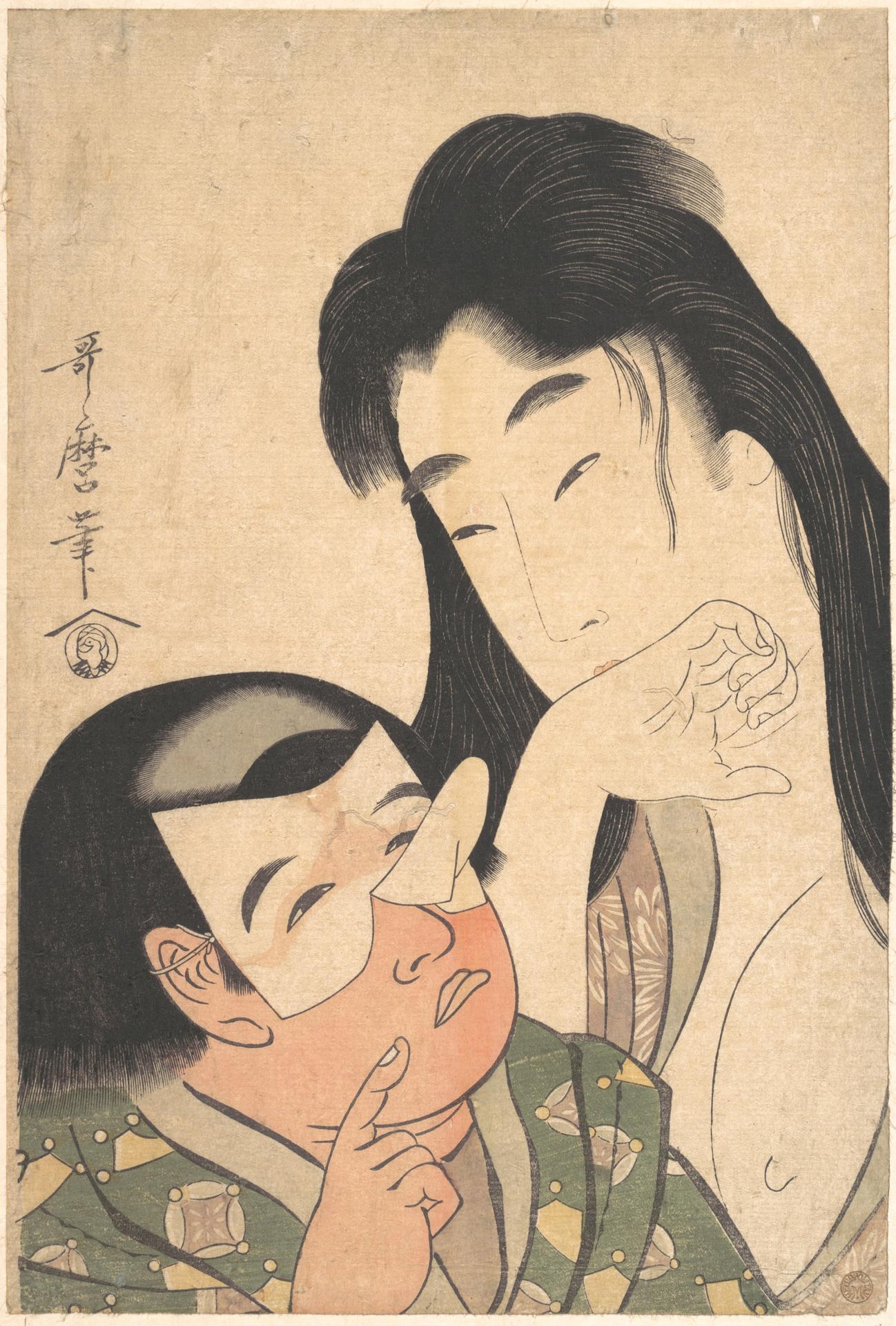
Kitagawa Utamaro made this color woodblock print, Yamauba and Kintarō, around 1795. It presents the mountain nymph Yamauba together with her son Kintarō. The sheet is a nishiki-e, a multicolor print with ink and color on paper, and it draws the two figures into a close, familiar intimacy.
Description
Two figures shape the layout. In back, a person with long black hair and traditional Japanese clothing tilts her head slightly to the side, eyes closed. In front stands a figure with short dark hair in a green robe patterned in yellow and white; one hand gently holds the cheek of the figure behind. The touch feels tender and familiar. Grays and browns dominate the palette, with accents of green and white. Soft light falls on faces and hair, while crisp outlines and flat color areas are true to the woodblock style.
Context
Utamaro worked during the Edo period, when Japanese color woodblock printing flourished. The pair Yamauba and Kintarō comes from Japanese mythology and was a popular motif in the eighteenth century because it joined maternal care with closeness to nature. Utamaro often devoted himself to women and mothers, showing intimate scenes of daily life or legendary figures in emotional moments. This print belongs to a series treating the relationship between mother and child.
Impact
The scene feels calm and emotionally charged through the gentle touch and the closed eyes of the rear figure. Muted tones and a spare arrangement direct the gaze to expression and gesture, conveying quiet intimacy. The viewer is drawn into the close pairing without the figures returning the look—an intimacy at a distance.
Technique
This sheet is a nishiki-e, a multicolor woodblock print for which several color blocks produce fine gradations and details. It was printed with ink and colors on paper; sharp contours and clear color areas are characteristic of Utamaro’s style. At about 38.4 × 22.5 cm, the format corresponds to the vertical ōban, as was usual for such single-figure depictions.
AI-generated description text
Source: Metropolitan Museum of Art · Public Domain (CC0 1.0)