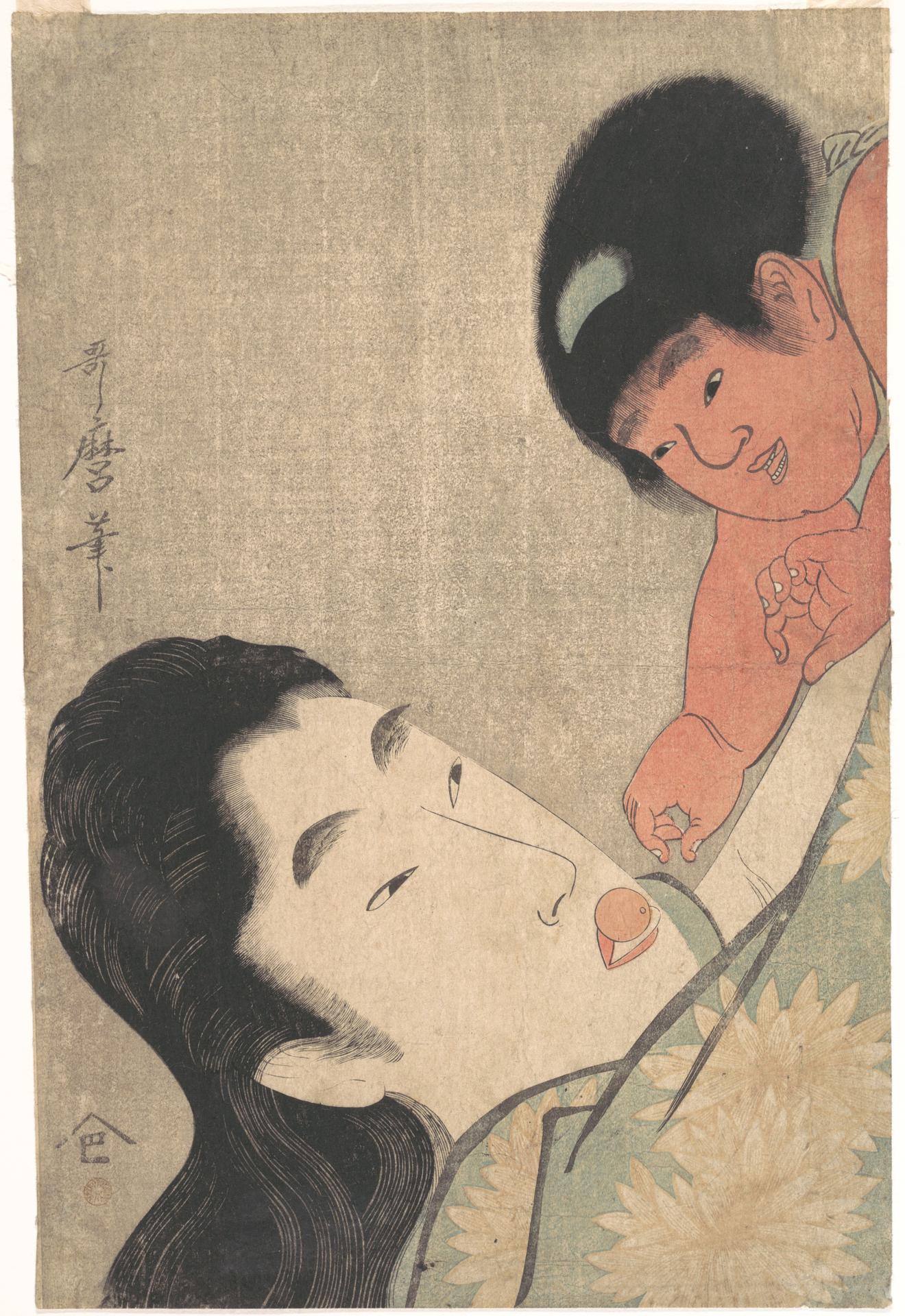
Yamauba and Kintarō Playing with a Cherry
Original title: Yamauba and Kintarō Playing with a Cherry
kurzbeschreibung
Kitagawa Utamaro's color woodblock print from around 1795 presents the mountain woman Yamauba with the boy Kintarō. Executed as a vertical ōban nishiki-e in ink and color on paper, the sheet belongs to a series of portraits that often take up both figures in Japanese art.
Description
A woman with long black hair in traditional Japanese clothing stands at the front, her gaze lifted and a smile on her face. On her shoulder crouches a child with short black hair; he holds a small object and looks downward. Flowers fill the rear area. The tones remain mostly muted, with red and blue providing accents. Even light lies across the surface without strong shadows; clear lines and flat areas of color define the style.
Context
The print was made during the Edo period, when multicolor woodblock printing (nishiki-e) had become established. With Yamauba and Kintarō, Utamaro takes up a subject that was alive in popular culture and on the Kabuki stage. The sheet belongs to a series of images of famous women and children that the artist created in the 1790s. Today it is held at the Metropolitan Museum of Art in New York.
Impact
The togetherness of the smiling woman and the playing child appears cheerful and familiar. Calm colors and clear outlines give the sheet a harmonious, almost idyllic mood. The gazes of the two figures meet and create closeness.
Technique
Several woodblocks were used for color printing, one for each color. Watercolors were applied to paper, with the contours fixed beforehand in black lines. This allowed fine details and a broad color palette, as are characteristic of Utamaro's prints of the 1790s.
AI-generated description text
Source: Metropolitan Museum of Art · Public Domain (CC0 1.0)