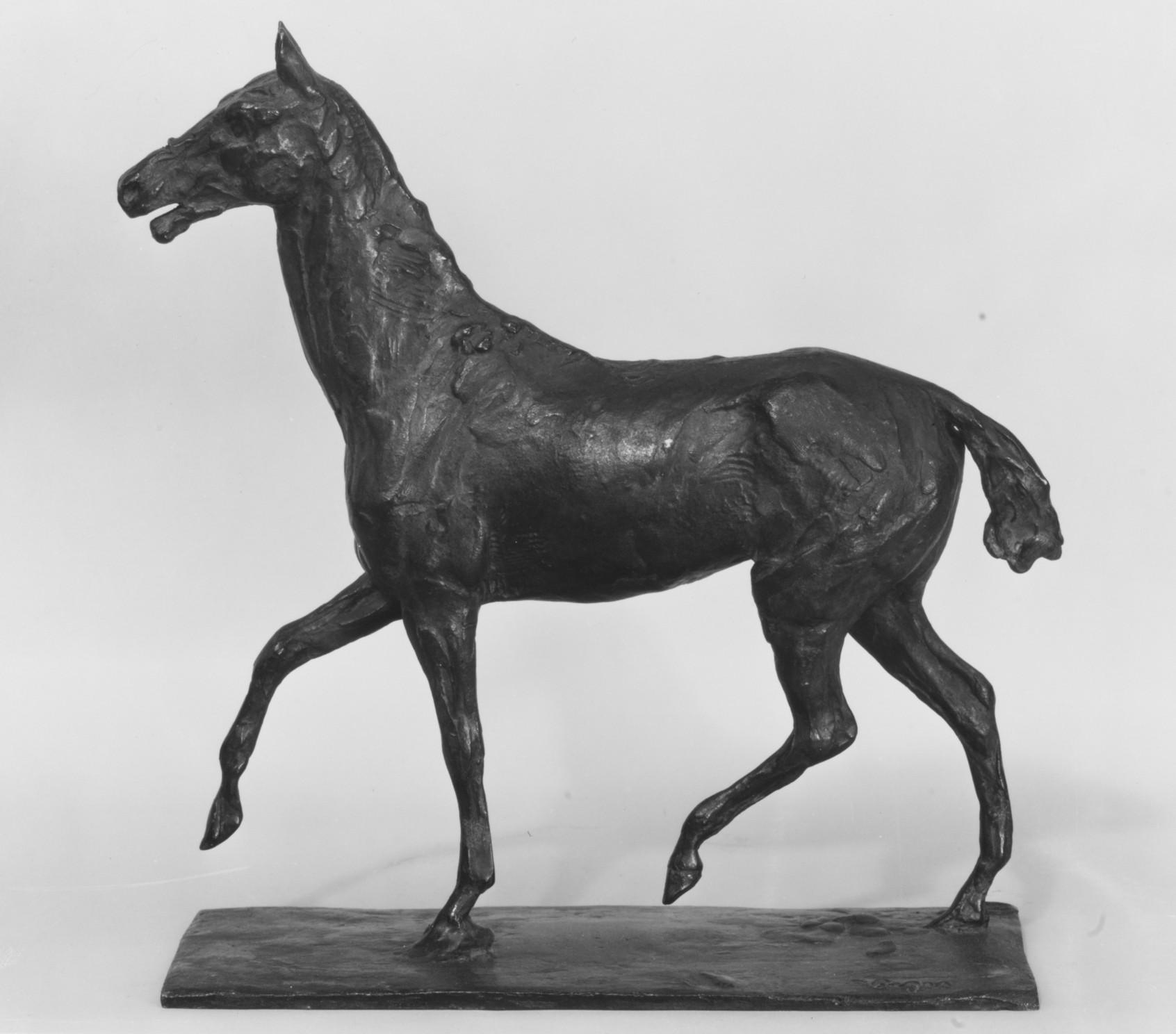
Horse Walking (modeled before 1885, cast in 1920)
Original title: Horse Walking
kurzbeschreibung
Edgar Degas modeled the "Walking Horse" before 1885, and in 1920, after his death, it was cast in bronze. The sculpture captures a moment when the animal balances on one hind leg and lifts its front legs, a symbol of movement and power.
Description
A horse braces itself on a single hind leg while its front legs hover above the ground. The curved contours of its body convey dynamism and strength. Mane and tail fall in the same direction as the head. The bronze appears monochrome, with slight irregularities that bring out the musculature. A neutral, single-colored background focuses attention on the figure.
Context
Degas created this sculpture before 1885, during a period when he was intensely occupied with rendering movement, in horses as well as dancers. The casting took place only in 1920, after the artist's death, suggesting that the bronzes were made from his wax models. Degas experimented with various materials and techniques to capture dynamism, as also seen in his paintings and drawings.
Impact
The dynamic pose and emphasized contour lines give the sculpture expressiveness and vitality. The concentration on essentials and clear structure direct the eye straight to the horse's power and elegance. The uniform bronze color and fine textures lend the work a calm yet powerful presence.
Technique
Bronze, valued for its durability and fidelity to detail, forms the basis. The surface shows slight structures that arise during casting and emphasize the horse's anatomy. At 22.5 x 22.2 x 9.2 cm, the sculpture is small in format and invites closer inspection.
AI-generated description text
Source: Metropolitan Museum of Art · Public Domain (CC0 1.0)