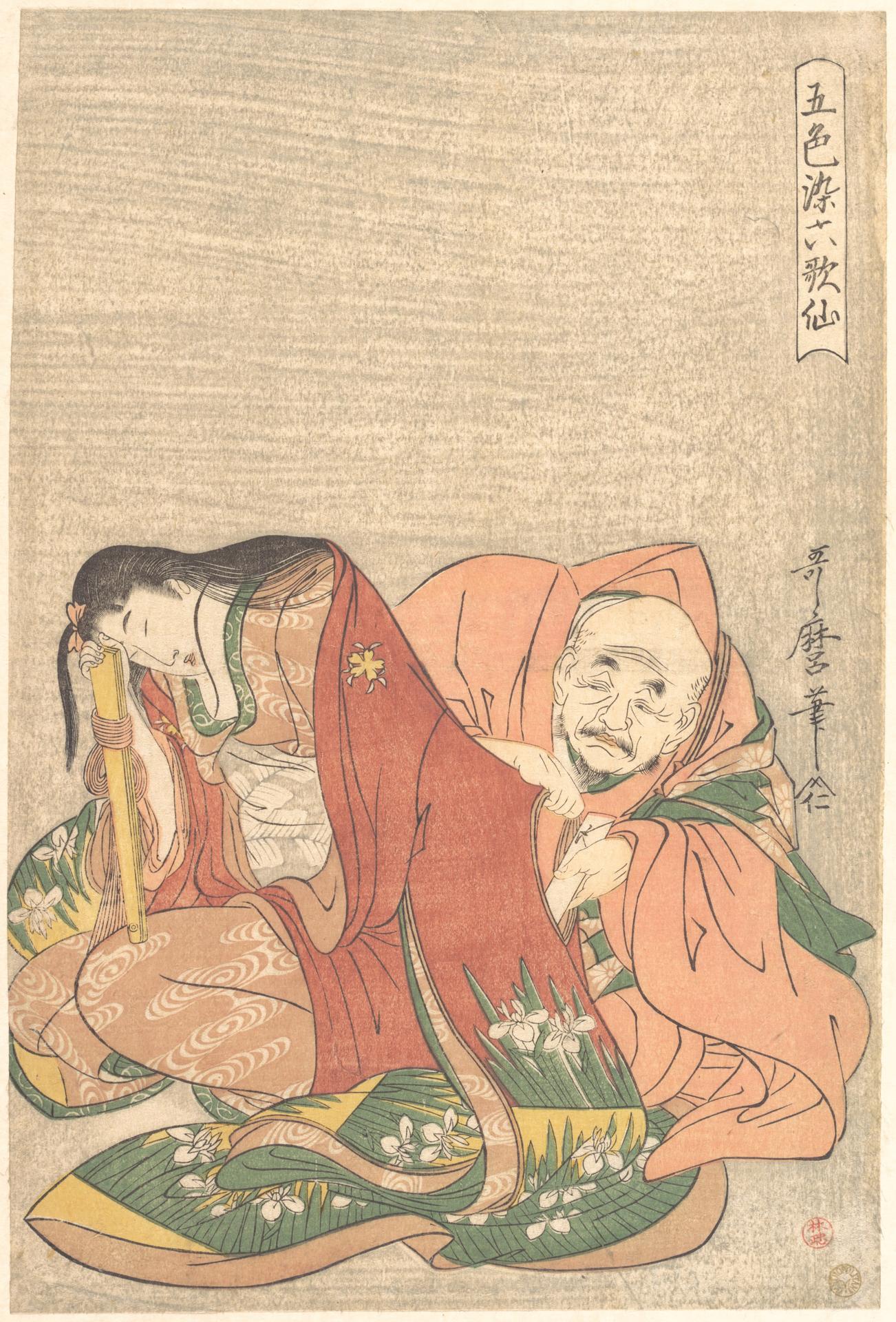
The Poet Sōjō Henjō (816–890) Slipping a Letter into a Woman’s Sleeve, from the series Five Colors of Love for the Six Poetic Immortals (Goshiki-zome rokkasen)
Original title: “The Poet Sōjō Henjō (816–890) Slipping a Letter into a Woman’s Sleeve,” from the series Five Colors of Love for the Six Poetic Immortals (Goshiki-zome rokkasen)
kurzbeschreibung
Unlike many prints from the Rokkasen series, this woodblock print by Kitagawa Utamaro from around 1798 does not show the poet Sōjō Henjō alone but in an exchange with a younger woman. The subject comes from the series Five Colors of Love for the Six Poetic Immortals. It is executed in ink and color on paper, and the sheet measures approximately 32.1 × 21.6 cm.
Description
Two figures appear: an older man in an orange robe with green accents sits on the ground holding a piece of paper; opposite him kneels a younger woman in a red-and-white robe with a green scarf, a staff in her hand, as if she were about to call out or reproach him. The background consists solely of a flat ground with floral motifs. Earthy tones dominate the color scheme, broken by red and green accents; the light falls evenly across the image without harsh shadows.
Context
Around 1798 Utamaro created this series, in which he showed the six classical Japanese poets (Rokkasen) in scenes of earthly love. Sōjō Henjō was a ninth-century Buddhist monk and poet known for his love poems. In this way the series links the traditional iconography of the poets with the contemporary pleasure district of Edo. In the late eighteenth century such images were popular with a wealthy urban audience.
Impact
The dialogue between the two feels intimate yet held at a distance: their posture and gaze create a quiet tension between them. Clear outlines and restrained colors give the print a calm, refined air characteristic of Utamaro's art.
Technique
The print was made in the nishiki-e technique, in which several wooden blocks carry the individual colors. The outlines were printed in black ink, followed by the colors in fine gradations. Paper and water-based inks allowed delicate details and a soft application of color.
AI-generated description text
Source: Metropolitan Museum of Art · Public Domain (CC0 1.0)