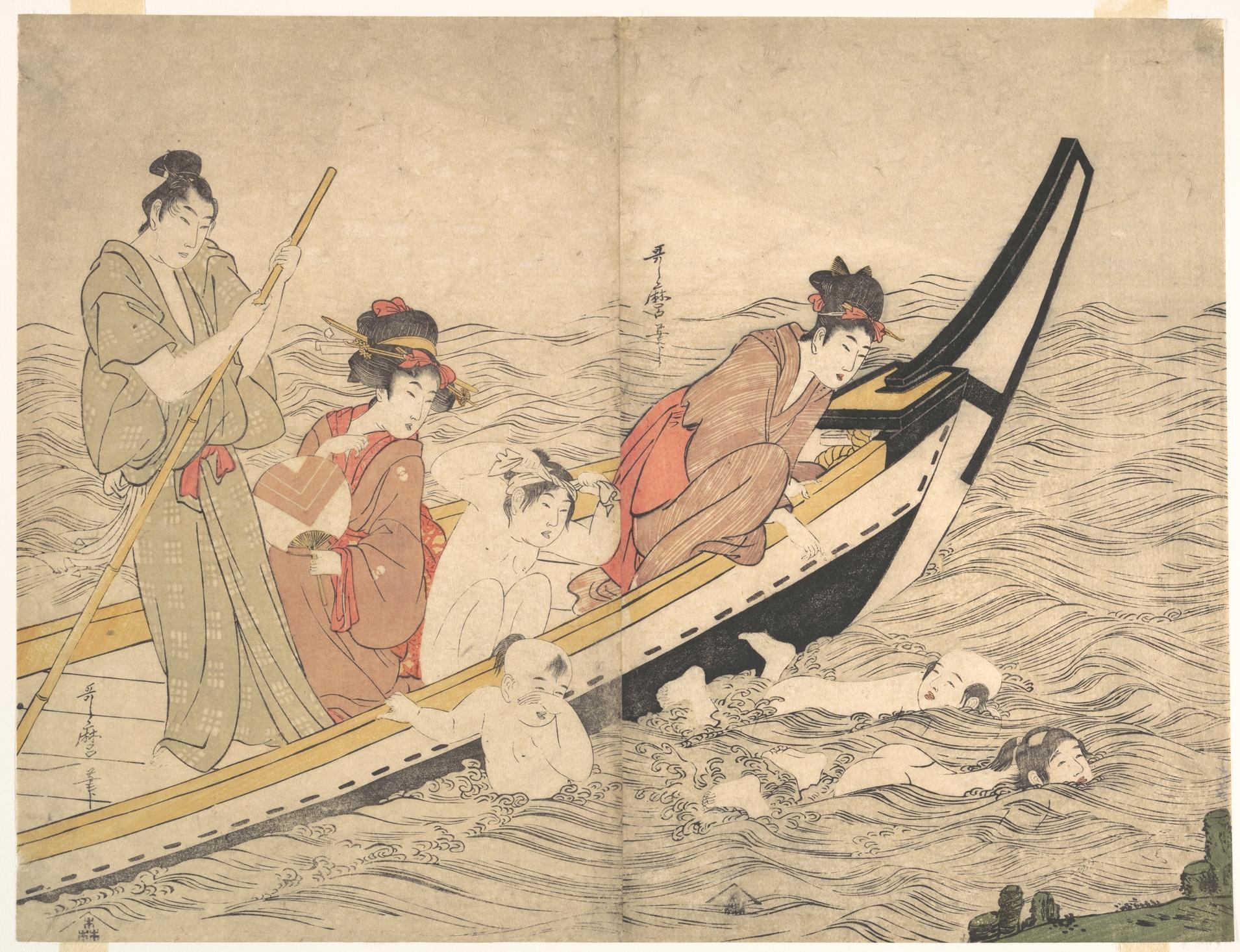
Boating Party with Children Swimming
Original title: Boating Party with Children Swimming
kurzbeschreibung
Two woodblock prints in ink and color on paper, joined by Kitagawa Utamaro in the late 18th century as a diptych, present a boat outing with children swimming. What the sheets capture is an everyday scene on the water, the kind that shaped city life in those years.
Description
On the water a boat moves, carrying three figures in traditional dress; one of them holds the rudder at the stern. In the foreground two children are seen swimming. The arrangement feels balanced: the boat occupies the middle, the swimmers stagger before it. Wavy lines run across the ground with rich detail and lively movement. Earth tones dominate the color, with red and brown accents leaving traces within.
Context
Utamaro is counted among the most important figures of Japanese woodblock printing of the Edo period; he became famous for pictures of women and scenes of everyday life. When this diptych was made, ukiyo-e prints were widely circulated in Japan and often took up the leisure of the urban population. Boat rides and amusements on the water were popular motifs and reflect the culture of leisure in that society.
Impact
The calm gliding of the boat and the lively bustle of the swimmers meet and create a tension that finally resolves into harmony. The carefully worked waves and the clear outlines of the figures give the sheet a narrative pull that draws the viewer's gaze into the scene.
Technique
Printing was done by woodblock, transferring ink and color to paper. Each tone requires its own block, cut beforehand; the color sits on the block and passes from there to the paper. Precise contours and clearly defined areas of color, typical of Japanese color woodblock printing, stand out distinctly.
AI-generated description text
Source: Metropolitan Museum of Art · Public Domain (CC0 1.0)