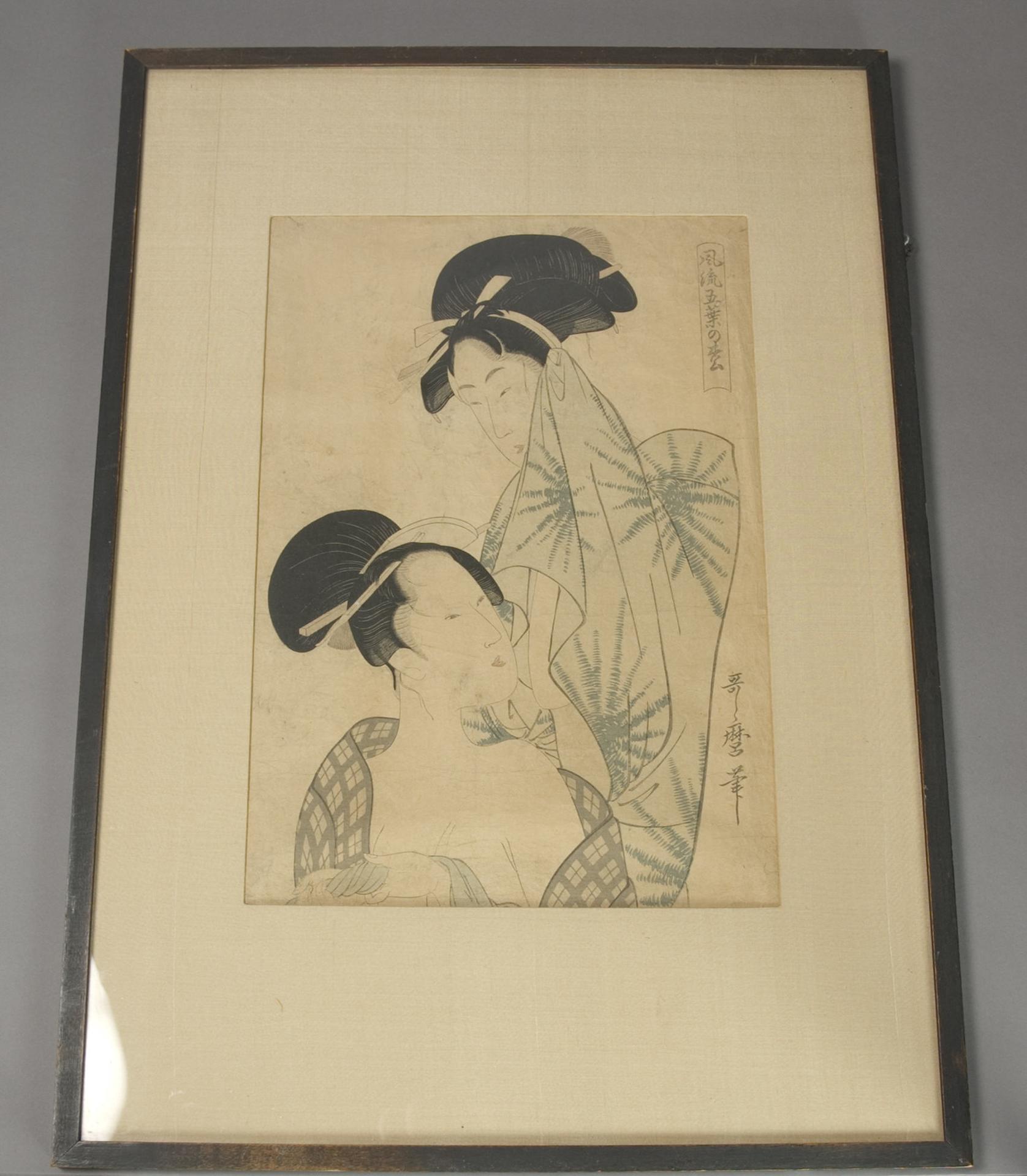
Two women after Bath, from the series Elegant Pines of Fivefold Needles (Furyu goyo no matsu)
Original title: Two women after Bath, from the series Elegant Pines of Fivefold Needles (Furyu goyo no matsu)
kurzbeschreibung
Kitagawa Utamaro's colour woodblock print "Two Women after the Bath," made around 1800, belongs to the series "Fūryū goyō no matsu." It captures two women tending to themselves once bathing is done. Mineral pigments and ink on paper, printed from woodblocks.
Description
One woman sits in front, drying her hair with a cloth; the second stands behind her, a towel also in hand. Both wear traditional Japanese dress, their hair arranged in elaborate upswept styles. Green, stylised palm fronds fill the background, while the rest of the palette stays largely in shades of grey. The two figures are placed centrally, and light falls evenly across the surface.
Context
Utamaro assembled this series around 1800, at the height of ukiyo-e, the golden age of Japanese colour woodblock printing. Women going about their everyday tasks were a staple subject in the Edo period. The title "Fūryū goyō no matsu," or "The Elegant Pines with Fivefold Needles," refers to a well-known variety of pine; the series probably gathers scenes from the lives of courtesans or women of rank. Utamaro was known as a sensitive, painstaking observer of female beauty.
Impact
Muted colours and the balanced arrangement of the two women give the print a quiet, intimate mood. The flatness typical of ukiyo-e and the stylised backdrop produce a decorative effect that still feels natural.
Technique
The sheet was produced in the nishiki-e manner: colours are applied to wooden printing blocks and transferred to the paper in several passes, using mineral pigments and ink. Precise lines and flat areas of colour define the Japanese colour woodblock print of that era.
AI-generated description text
Source: Metropolitan Museum of Art · Public Domain (CC0 1.0)