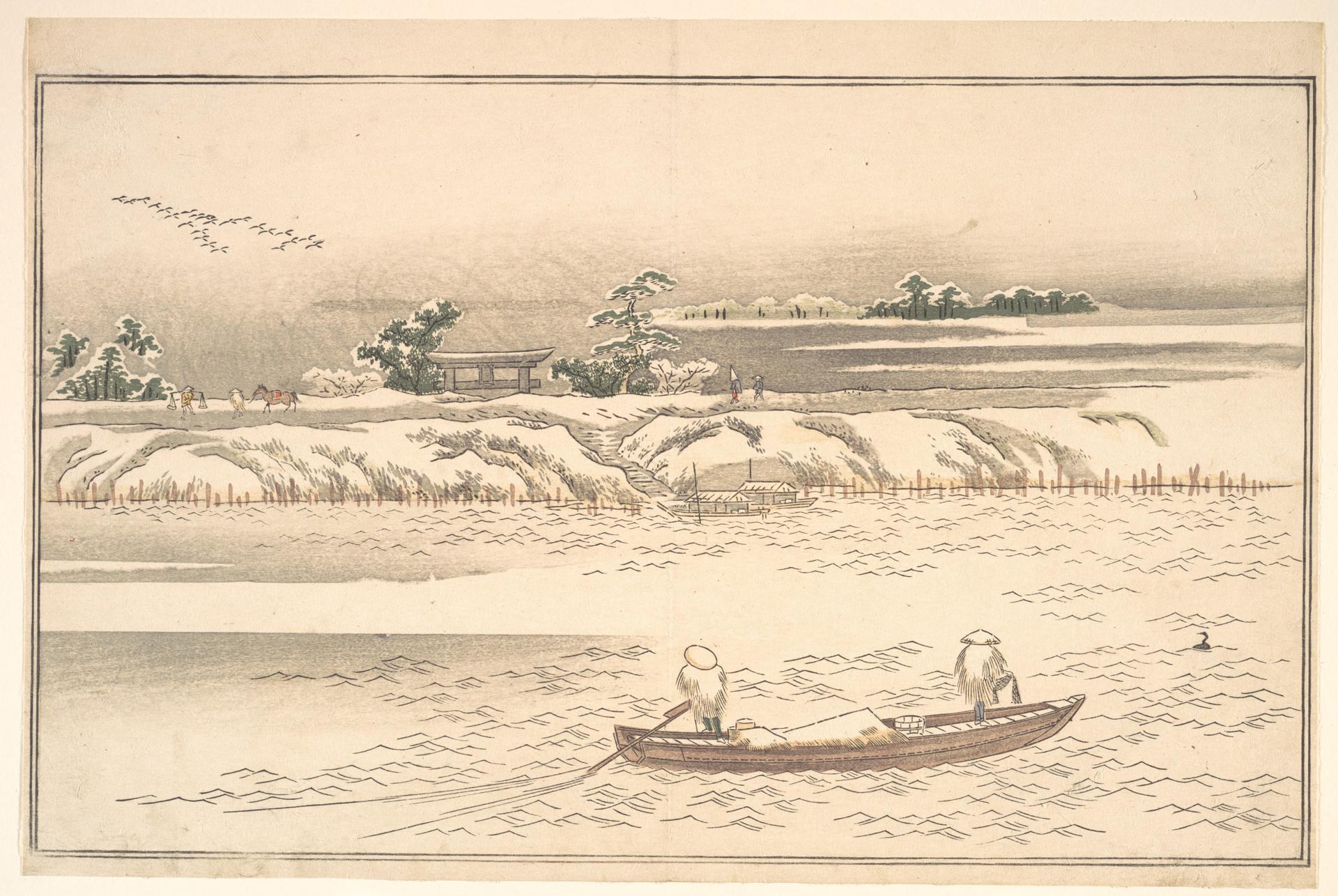
Book of Ehon Ginsekai (The World in Silver) (1754–1806, Met-Objekt 4494)
Original title: Book of Ehon Ginsekai (The World in Silver)
kurzbeschreibung
This print comes from Kitagawa Utamaro's illustrated book Ehon Ginsekai (The World in Silver) and is dated between 1754 and 1806. It depicts a winter river landscape in which two people travel by boat, while snow-covered hills and trees shape the surroundings. The work is executed as a woodblock print with ink and color on paper.
Description
In a horizontal format, the eye first opens onto a river whose surface is traced with fine wavy lines. Two figures in traditional Japanese clothing sit in a boat; one of them holds a paddle. Beyond the water, more people move along a path, and a gate structure can be made out. Gray and white tones dominate the subdued palette, with the snow cover and the figures' garments standing out clearly. Diffuse light lies over the scene and underscores its wintry character.
Context
The late Edo period saw a flowering of Japanese woodblock printing. Kitagawa Utamaro ranks among the important artists of this era and is known above all for his portrayals of women and scenes of everyday life. Ehon Ginsekai was conceived as an illustrated book for a broad public. Prints of this kind belonged to the urban popular culture of Edo, present-day Tokyo.
Impact
The restrained coloring and calm layout of the image create a quiet, almost meditative mood. Through the diffuse light and snow-covered forms, the winter landscape feels at once familiar and remote. Viewers are led toward a quiet, contemplative way of seeing.
Technique
A woodblock process was used for this print, in which colors are printed with ink on paper. Full-color woodblock printing (nishiki-e) allowed for fine gradations and an accurate rendering of the subdued tones. The wavy lines and soft snow areas attest to the printer's high level of craftsmanship.
AI-generated description text
Source: Metropolitan Museum of Art · Public Domain (CC0 1.0)