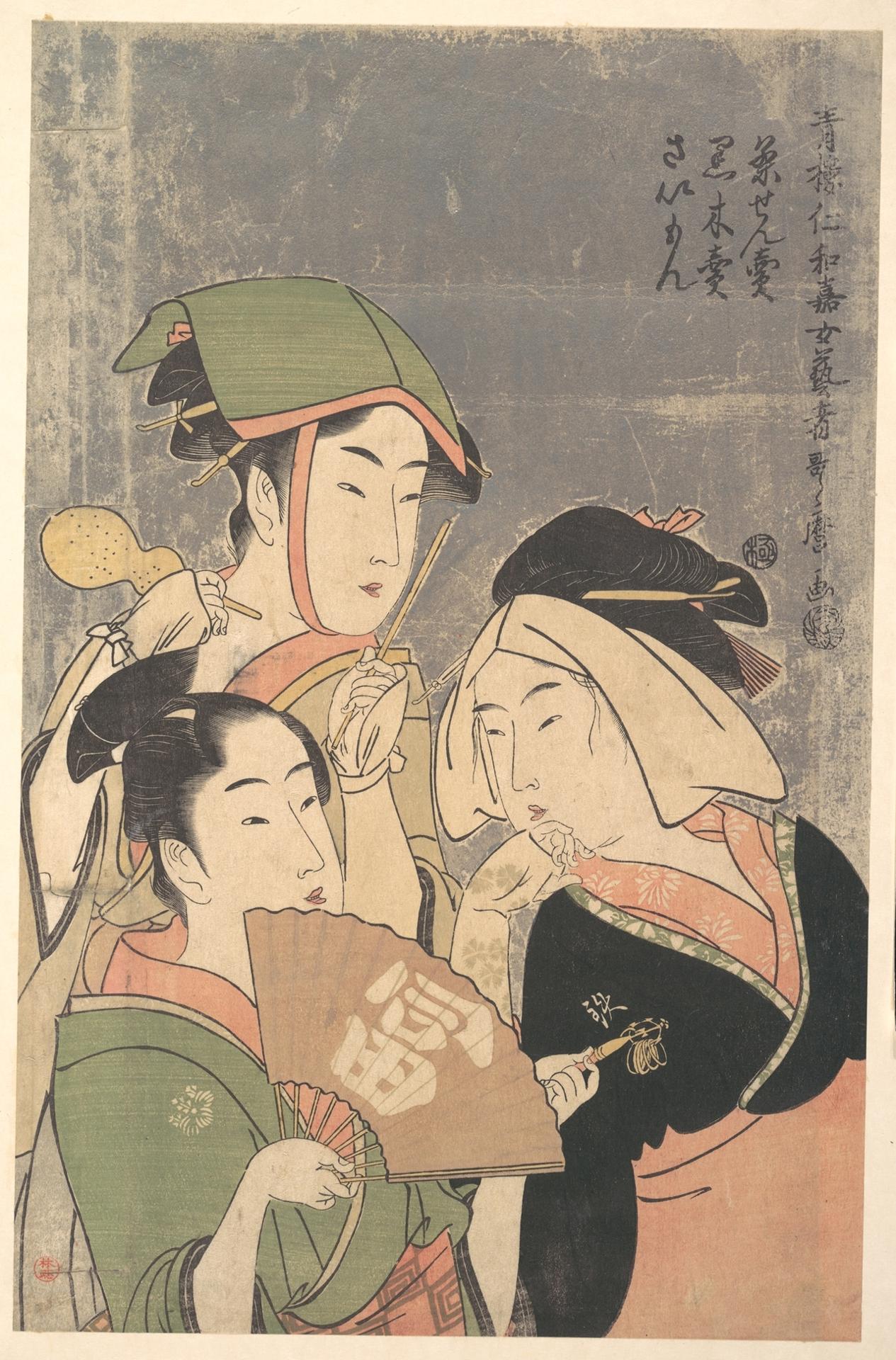
Three Niwaka Performers, Chasenuri, Kurokiri, and Saimon (Tea-whisk Seller, Firewood Seller, Shrine Festival Performer), from the “Geisha of the Yoshiwara Niwaka Festival” (Seiro Niwaka Onna Geisha)
Original title: Three Niwaka Performers, Chasenuri, Kurokiri, and Saimon (Tea-whisk Seller, Firewood Seller, Shrine Festival Perfomer), from the “Geisha of the Yoshiwara Niwaka Festival” (Seiro Niwaka Onna Geisha)
kurzbeschreibung
Kitagawa Utamaro made this colour woodblock print on paper around 1794. It shows three women in traditional Japanese dress performing as Niwaka festival players in the Yoshiwara district. Each figure carries objects that identify her role: a tea-whisk seller, a wood merchant, and a shrine-festival performer.
Description
Three women stand upright side by side. The foremost figure holds a fan and wears a green obi. The middle woman is covered by a green cap and holds a staff that can be read as a tool. The woman on the right wears a black cap and carries a staff with a brush-like tip. Their faces are highlighted in pale colour, as is typical of ukiyo-e prints. A uniformly dark ground throws the figures into strong relief. On the right are Japanese characters giving the title or the artist's name.
Context
Utamaro created this series in the late Edo period, when the Niwaka festival in the pleasure quarter of Yoshiwara was popular. The festival was known for improvised theatrical performances and parodies given by geishas and courtesans. The prints in this series recorded the fashions and roles of the participants. Utamaro was famous for his portrayals of women, especially the beauties of the pleasure district.
Impact
The restrained palette and dark ground create a concentrated, almost intimate atmosphere. Clear lines and the precise rendering of the costumes give the sheet a calm, elegant effect. Through their upright posture and symbolic props, the figures appear at once lively and stylised.
Technique
The work is executed as a woodblock print (nishiki-e) with ink and colours on paper. The colours were applied in several printing passes, with fine black lines defining the contours. The dark background was probably produced by a special technique called 'tsubushi', in which a uniform area is printed without texture.
AI-generated description text
Source: Metropolitan Museum of Art · Public Domain (CC0 1.0)