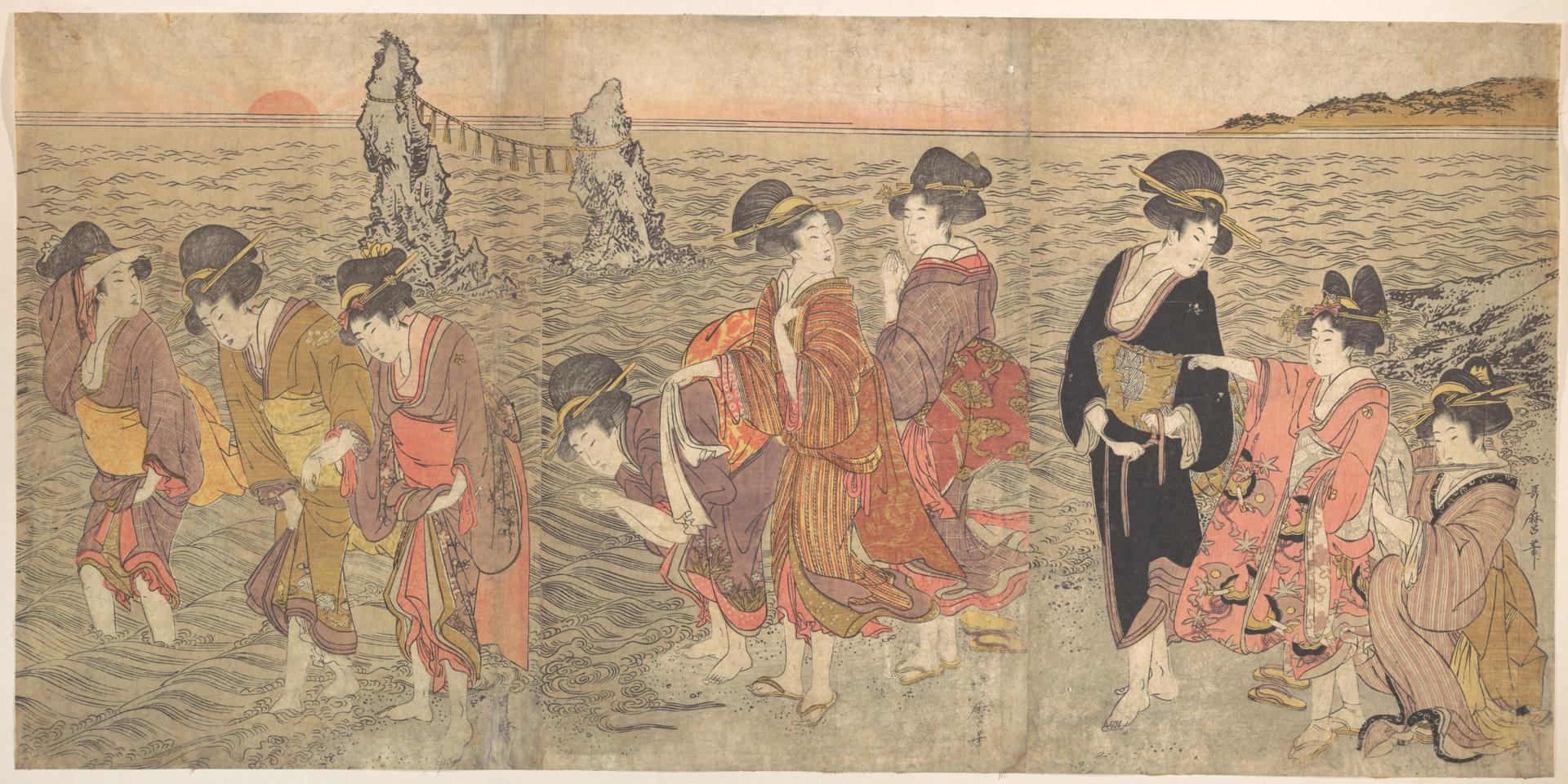
Women Worshipping the Rising Sun between the Twin Rocks at Ise (Triptych of woodblock prints; ink and color on paper, Met-Objekt 4484)
Original title: Women Worshipping the Rising Sun between the Twin Rocks at Ise
kurzbeschreibung
Kitagawa Utamaro’s triptych shows a group of women on the shore at Ise, turned toward the rising sun. They wear traditional Japanese dress—kimonos and hair ornaments—and behind them rise the two famous Ise rocks. The work is a colour woodblock print on paper from the late eighteenth century.
Description
Women in various poses animate the image: some stand upright, others lean slightly forward as if to receive the sunlight. Their kimonos show earthy tones with red and gold accents. Two striking rocks form the backdrop, linked by a bridge over the sea. Wave lines pattern the water’s surface, and the sky is held in warm colours, suggesting sunrise. The print reveals sharp contours and detailed lines that emphasise both the texture of the garments and the structure of the rocks.
Context
Utamaro ranks among the leading masters of ukiyo-e in eighteenth-century Japan and is known above all for his portrayals of women. The twin rocks of Ise (Meoto Iwa) appear frequently in Japanese art and stand for the union of deities in Shinto. The women’s veneration of the rising sun points to religious practice and to the role of the sun in Japanese mythology. The triptych format was often used in ukiyo-e to capture wide landscapes or ceremonial scenes.
Impact
The symmetrical arrangement of the rocks and the figures oriented toward the sun evoke a quiet, devotional mood. Warm tones and the delicate lines of the woodblock give the scene something ceremonial, yet also familiar.
Technique
This triptych was produced as woodblock prints with ink and colour on paper. Colours were applied from separate printing blocks, so contours remained sharp and lines detailed. Earthy tones with red and gold accents match the colour woodblock practice of the Edo period.
AI-generated description text
Source: Metropolitan Museum of Art · Public Domain (CC0 1.0)