Parting of Lovers: Courtesan and Her Lover
Original title: Parting of Lovers: Courtesan and Her Lover
kurzbeschreibung
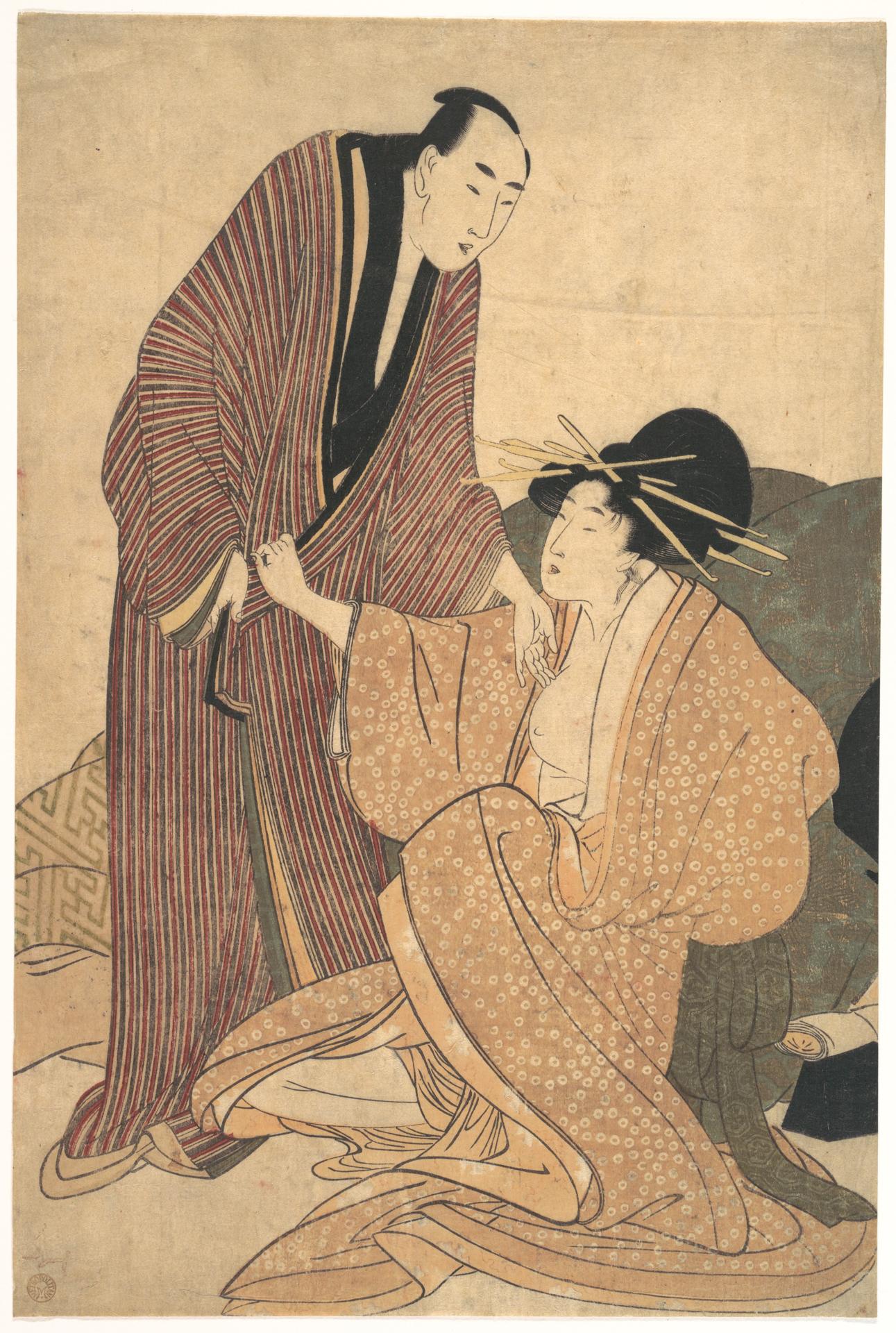
A kneeling woman in front, a standing man behind her, both facing each other: this is how Kitagawa Utamaro staged the farewell of two lovers around 1800. The sheet is a woodblock print in ink and color on paper.
Description
Foreground: a woman kneels in a kimono with a small floral pattern, a traditional Japanese hat on her head; her gaze rests on the man, her posture thoughtful. He stands elevated behind her, wearing a striped top over traditional garments, and leans down toward her as if to touch or embrace her. The layout places the woman below as the central figure, the man above. Earth tones dominate the muted palette, with individual color accents in her kimono. Light is evenly distributed, without hard shadows or highlights.
Context
Utamaro worked in the late Edo period, when prints of courtesans and scenes from the pleasure quarters appeared in great numbers. This sheet belongs to a milieu that took the relationships between courtesans and their clients as its subject. Such motifs were part of ukiyo-e, the art that celebrated the fleeting life and diversions of urban culture. The identities of the two figures are not recorded; the scene follows a common motif type of the era.
Impact
The symmetrical arrangement and restrained colors carry the quiet, intimate mood of the print. From the woman's pensive pose and the man's tender gesture arises an emotional density that draws the viewer into the moment of parting. Clear contours and the precise rendering of clothing give the image a calm elegance.
Technique
For printing, the design was cut into a woodblock and then pulled with color on paper. Ink and color on paper correspond to the Japanese color woodblock print of that time. Sharp contours and flatly applied colors point to multicolor printing, in which each color received its own block.
AI-generated description text
Source: Metropolitan Museum of Art · Public Domain (CC0 1.0)