Poetry, from the illustrated book Flowers of the Four Seasons
Original title: Poetry, from the illustrated book Flowers of the Four Seasons
kurzbeschreibung
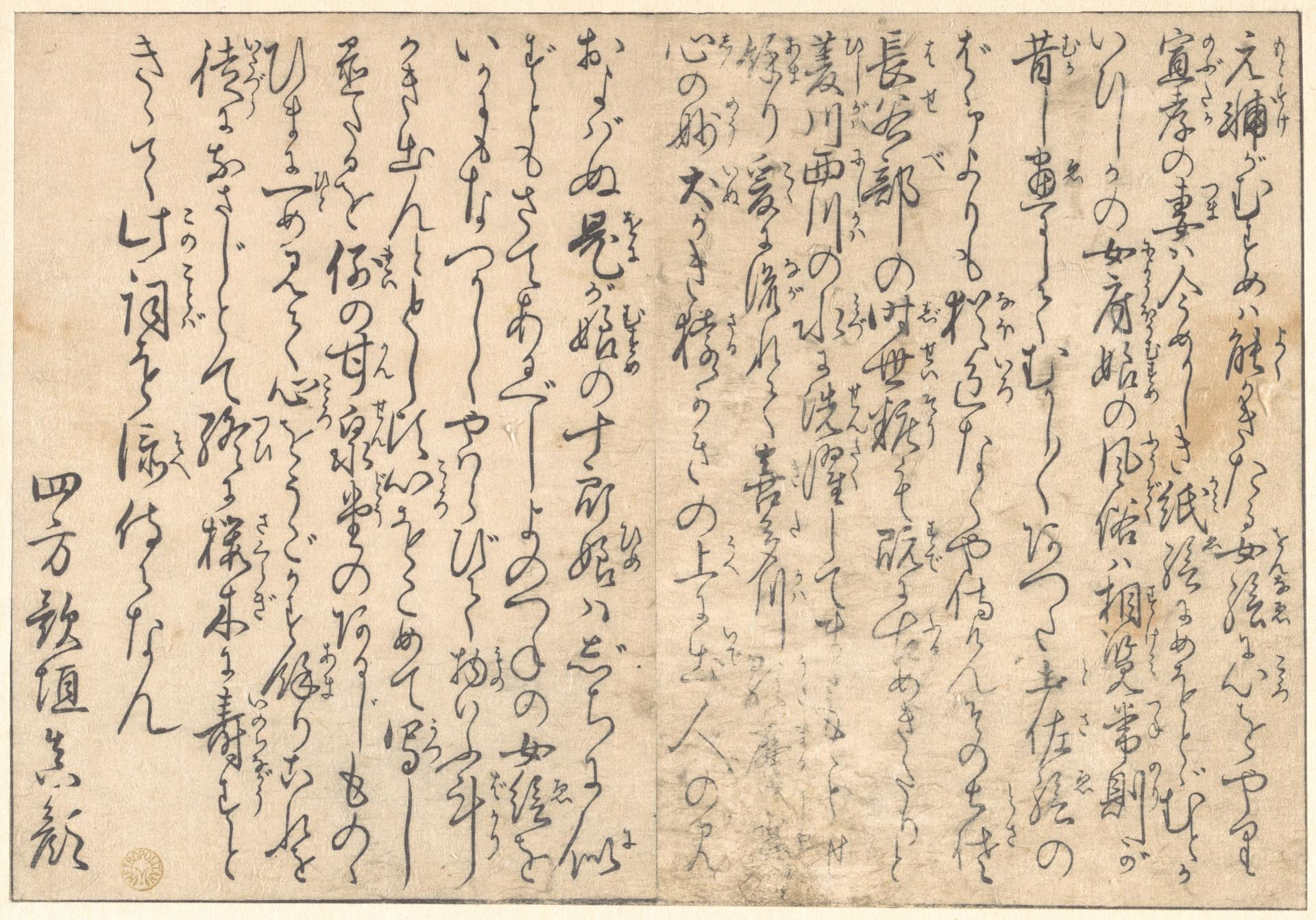
This sheet comes from Kitagawa Utamaro's illustrated book Flowers of the Four Seasons and is dated 1801. It was made as a woodblock print in ink and colour on paper; what we see is a page given over entirely to calligraphic writing.
Description
Dense, unevenly placed Japanese calligraphy covers the page, arranged in two columns that run almost to the edge of the sheet. A small round seal sits at the lower left. Beige dominates the colour, joined by black and blue from ink and pigment. Faint creases and signs of ageing run through the paper and point to its history. Beside the writing there are no figures or objects to be made out.
Context
Flowers of the Four Seasons was published in Japan in 1801, at a time when colour woodblock printing was spreading widely within the ukiyo-e tradition. Utamaro was known for his pictures of women and for his book illustrations. The sheet belongs to the late Edo period, when printmaking had reached a high level of technical refinement. It comes from a setting in which poetry and the visual arts were closely bound together.
Impact
The eye is drawn at once to the structure of the calligraphy, and a quiet, collected mood settles over the page. Beige, black and blue meet in a harmonious chord that brings out the elegance of Japanese writing culture. Standing before the sheet, one lingers over the characters rather than over any told story.
Technique
The sheet was printed as a woodblock print in ink and colour on paper, as was usual for Japanese colour woodblock printing. Separate blocks were used for the individual tones, and these had to be aligned precisely with one another.
AI-generated description text
Source: Metropolitan Museum of Art · Public Domain (CC0 1.0)