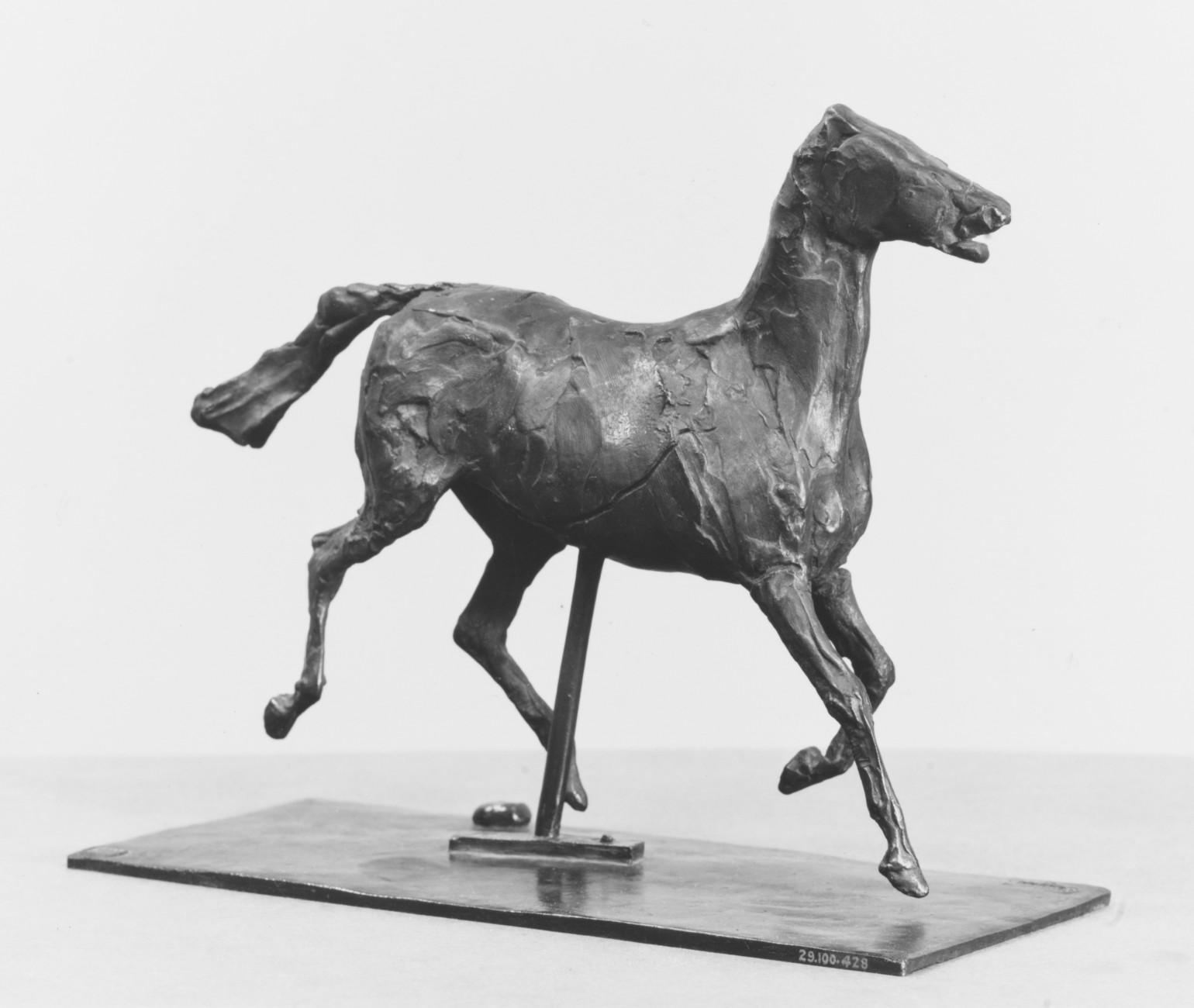
Horse Trotting, the Feet Not Touching the Ground
Original title: Horse Trotting, the Feet Not Touching the Ground
kurzbeschreibung
Unlike related horse depictions, this bronze statuette captures a trotting horse with all four hooves lifted off the ground at once. Edgar Degas modeled the motif after 1878, and the bronze cast was made in 1920. It freezes the suspended moment of the trot when no hoof touches the surface.
Description
A trotting horse whose four legs never meet the ground: the hind legs are extended, the front legs slightly forward. A wavy, flowing pattern runs across the body, making the gait's energy visible. Slightly raised wings emphasize the trotting posture. The figure rests on a plain rectangular base with a small plate, while the surroundings remain uniformly white.
Context
Around 1878 the sculpture took shape during a period when Degas was deeply engaged with horses and their movements. The wax model was cast in bronze only after his death, as was common at the time. Traces of Eadweard Muybridge's photographs, which captured horse motion in individual frames, can be recognized in the work.
Impact
From its hovering pose the statuette draws its immediate dynamism and lightness. Because every contact with the ground is absent, a tension arises between stable stance and fleeting moment.
Technique
The work was cast in bronze, a material that holds fine surface details. The patina lies evenly over the surface and remains without visible ornament. The rectangular base on which the figure is mounted gives the fragile arrangement support.
AI-generated description text
Source: Metropolitan Museum of Art · Public Domain (CC0 1.0)