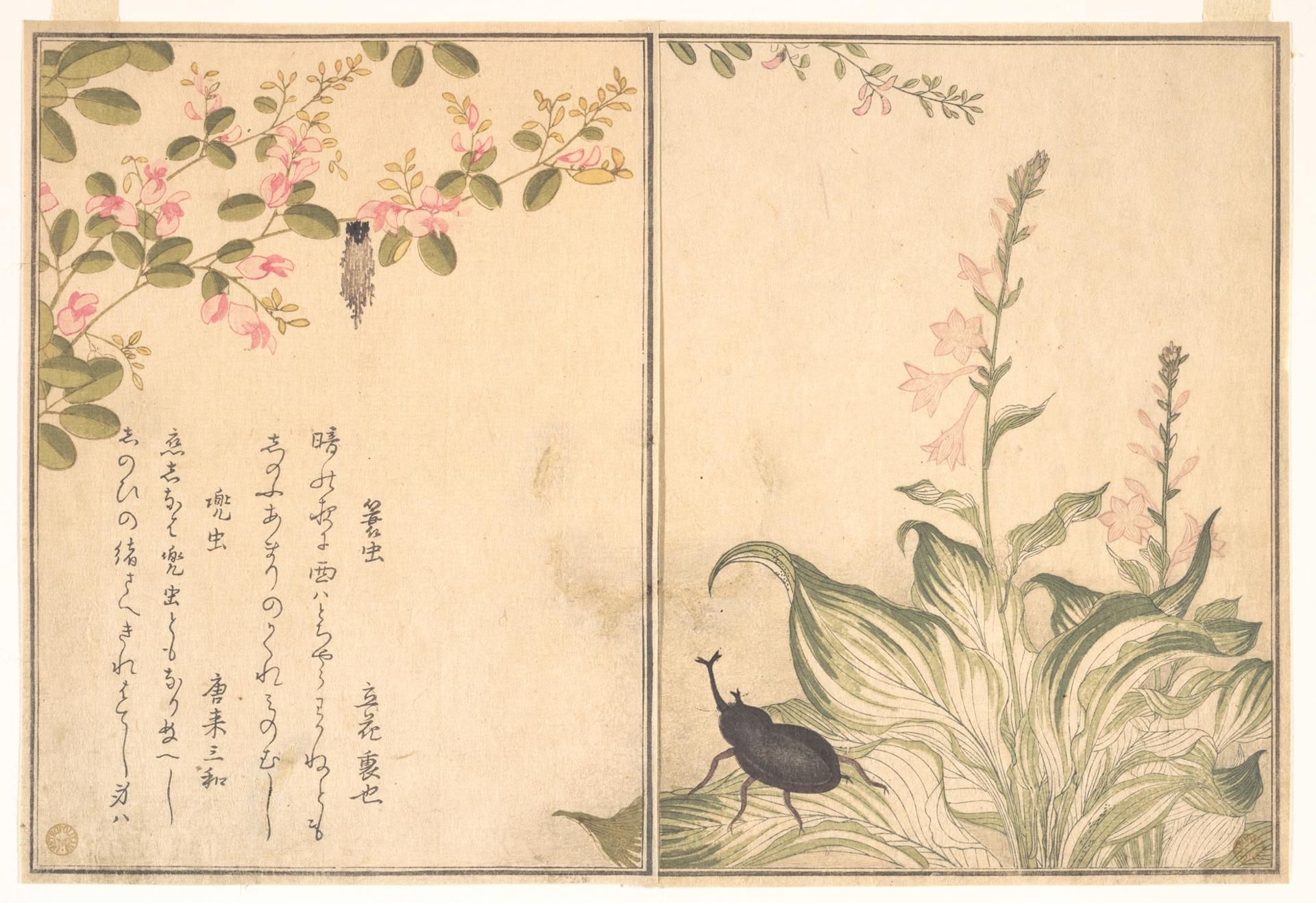
Bagworm (Minomushi); Horned Scarab Beetle (Kabutomushi), from the Picture Book of Crawling Creatures (Ehon mushi erami)
Original title: Bagworm (Minomushi); Horned Scarab Beetle (Kabutomushi), from the Picture Book of Crawling Creatures (Ehon mushi erami)
kurzbeschreibung
This page appeared in 1788 in a woodblock-printed book designed by Kitagawa Utamaro and devoted entirely to insects. Printed in ink and colour on paper, the sheet brings together a bagworm and a rhinoceros beetle in their natural surroundings, with Japanese text accompanying the creatures.
Description
Two zones divide the sheet. On the left a bagworm hangs from a plant with green leaves and pink blossoms, and below it stands a block of Japanese characters. To the right a rhinoceros beetle has settled on a leaf stem, surrounded by similar foliage and pink flowers. Green, pink and brown govern the palette, with white providing accents. Even, shadowless light reinforces the flat, decorative character. Crisp outlines and the precise rendering of insects and plants are consistent with the woodblock technique.
Context
The sheet was made in the late Edo period, when Japanese woodblock printing was at its height. The picture book belonged to a series that linked studies of nature with poetic texts. At that time the observation of nature gained importance in Japanese art, often encouraged by scientific interests.
Impact
Calm and exact, the print meets the viewer with an almost scientific attention to the details of insects and plants. The flat, decorative layout and the delicate colours give the page a harmonious, aesthetically pleasing quality.
Technique
For printing, the drawing was cut into woodblocks and transferred to paper with ink and colour. Clear lines and flatly applied colours characterise the Japanese woodblock technique of the eighteenth century.
AI-generated description text
Source: Metropolitan Museum of Art · Public Domain (CC0 1.0)