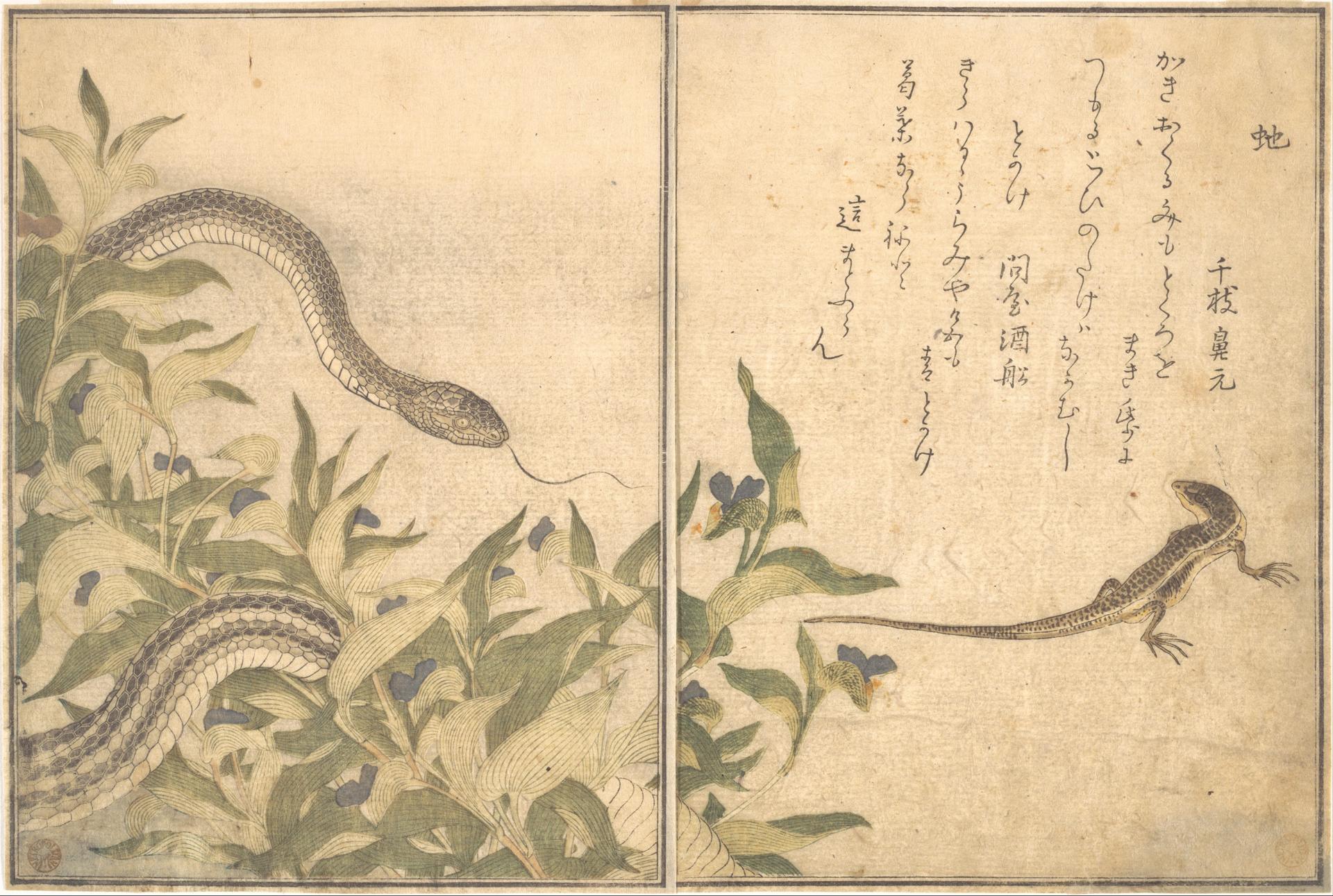
Rat Snake (Hebi); Lizard or Skink (Tokage), from the Picture Book of Crawling Creatures (Ehon mushi erami)
Original title: Rat Snake (Hebi); Lizard or Skink (Tokage), from the Picture Book of Crawling Creatures (Ehon mushi erami)
kurzbeschreibung
A double-page spread from Kitagawa Utamaro's woodblock-printed picture book 'Ehon mushi erami' (1788), showing a snake and a lizard among plants. Printed in ink and colour on paper.
Description
On the left page a snake with a dark, wavy dorsal pattern winds through a plant. On the right a reptile resembling a lizard or skink appears in lighter brown and yellow tones. Both animals are set in a green, natural environment, accompanied by Japanese characters that seem to give names or descriptions. The colour woodblock produces clear, flat colours, and the paper has a slightly yellowish sheen.
Context
The 'Ehon mushi erami' was made in 1788 during the late Edo period, when Japanese woodblock printing flourished. It belongs to the 'mushi-ehon', insect picture books that record small creatures and plants in a natural-history manner. Such natural-history books were popular in urban circles. The exact print run and distribution are not documented, but the work is regarded as evidence of natural-historical observation in Japanese art.
Impact
The layout conveys a calm, observant closeness to nature, supported by clear linework and harmonious colour areas. The subject appears scientifically precise without losing aesthetic appeal. The slightly yellowed paper structure gives the sheet a historical patina.
Technique
Colour woodblock printing involves several blocks that transfer ink and watercolour to paper. Fine lines and flat tones of colour define the sheet and are typical of the ukiyo-e technique of the late eighteenth century. The book from which the page comes was produced by woodblock printing.
AI-generated description text
Source: Metropolitan Museum of Art · Public Domain (CC0 1.0)