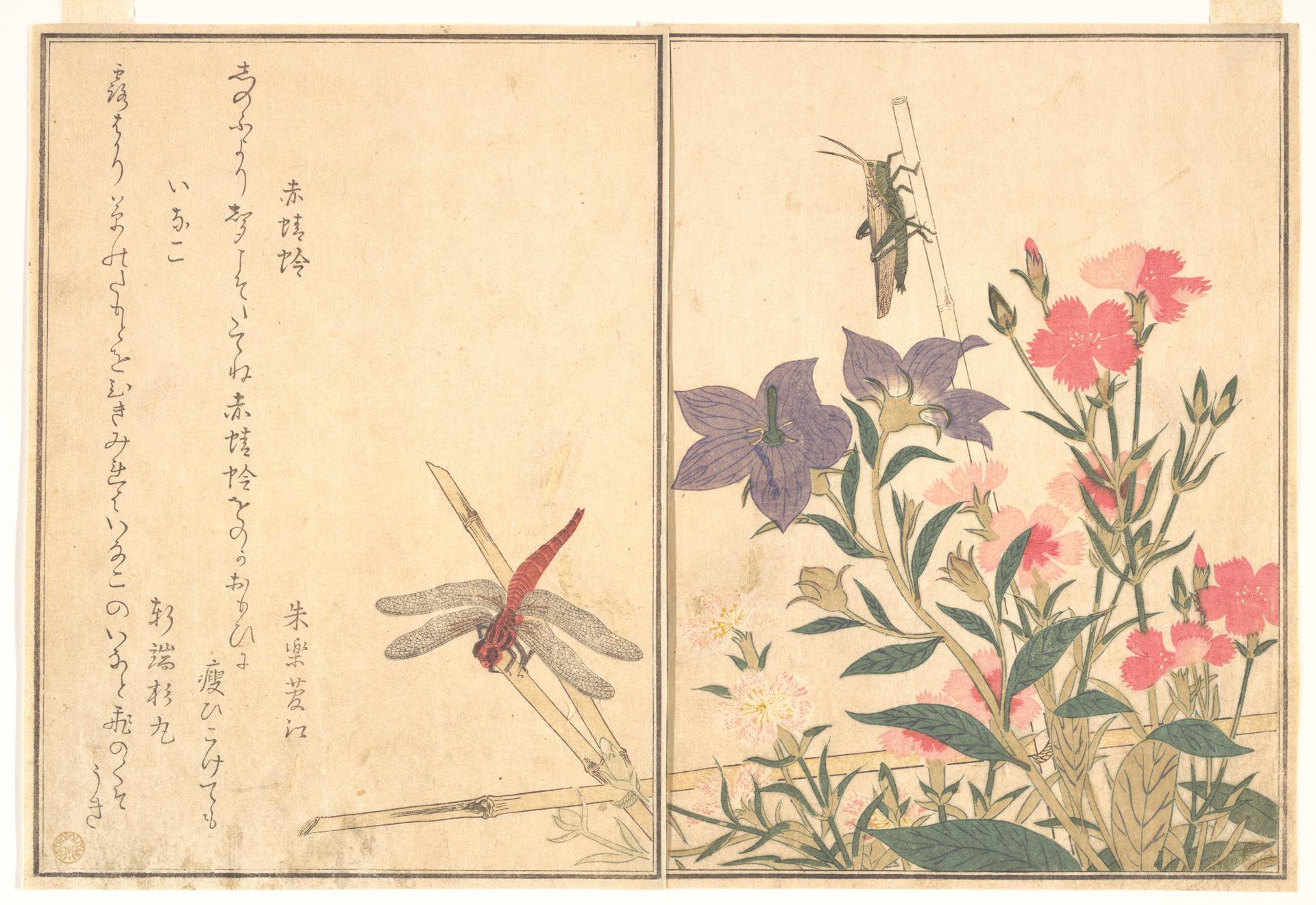
Red Dragonfly (Akatonbo); Locust (Inago), from the Picture Book of Crawling Creatures (Ehon mushi erami)
Original title: Red Dragonfly (Akatonbo); Locust (Inago), from the Picture Book of Crawling Creatures (Ehon mushi erami)
kurzbeschreibung
Kitagawa Utamaro made this page for his Ehon mushi erami (Picture Book of Crawling Creatures), published in 1788. A red dragonfly perches on a bamboo stalk at the left, while a grasshopper sits among flowers at the right. The sheet is a woodblock print, struck in ink and colour on paper.
Description
On the left half a red dragonfly with translucent blue wings rests on a bamboo stem, Chinese characters set beside it. To the right Utamaro has placed purple bellflowers and pink carnations, with a green grasshopper crouched on another bamboo stalk. The leaves are drawn in green and with much detail, while the ground stays restrained. The layout feels balanced: the insect on one side, the flowers and second insect on the other.
Context
The book appeared in the late Edo period, when art turned increasingly toward nature. Utamaro's Ehon mushi erami counts among the early Japanese picture books given over entirely to insects and small creatures. It belongs to a phase of growing interest in nature studies and botanical drawing in Japan. That image and text appear together points to the closeness of art and poetry.
Impact
Precise lines and clear colours give the sheet a quiet, almost scientific tone. The balanced arrangement and close observation of detail produce a harmonious effect that invites careful looking.
Technique
The sheet was printed as a woodblock in ink and colours on paper. Several passes brought the colours onto the paper one after another, with the sharp contours characteristic of Japanese colour woodblock printing. Careful linework and graded colouring attest to the craft precision of the process.
AI-generated description text
Source: Metropolitan Museum of Art · Public Domain (CC0 1.0)