The Palace in the Moon
Original title: The Palace in the Moon
kurzbeschreibung
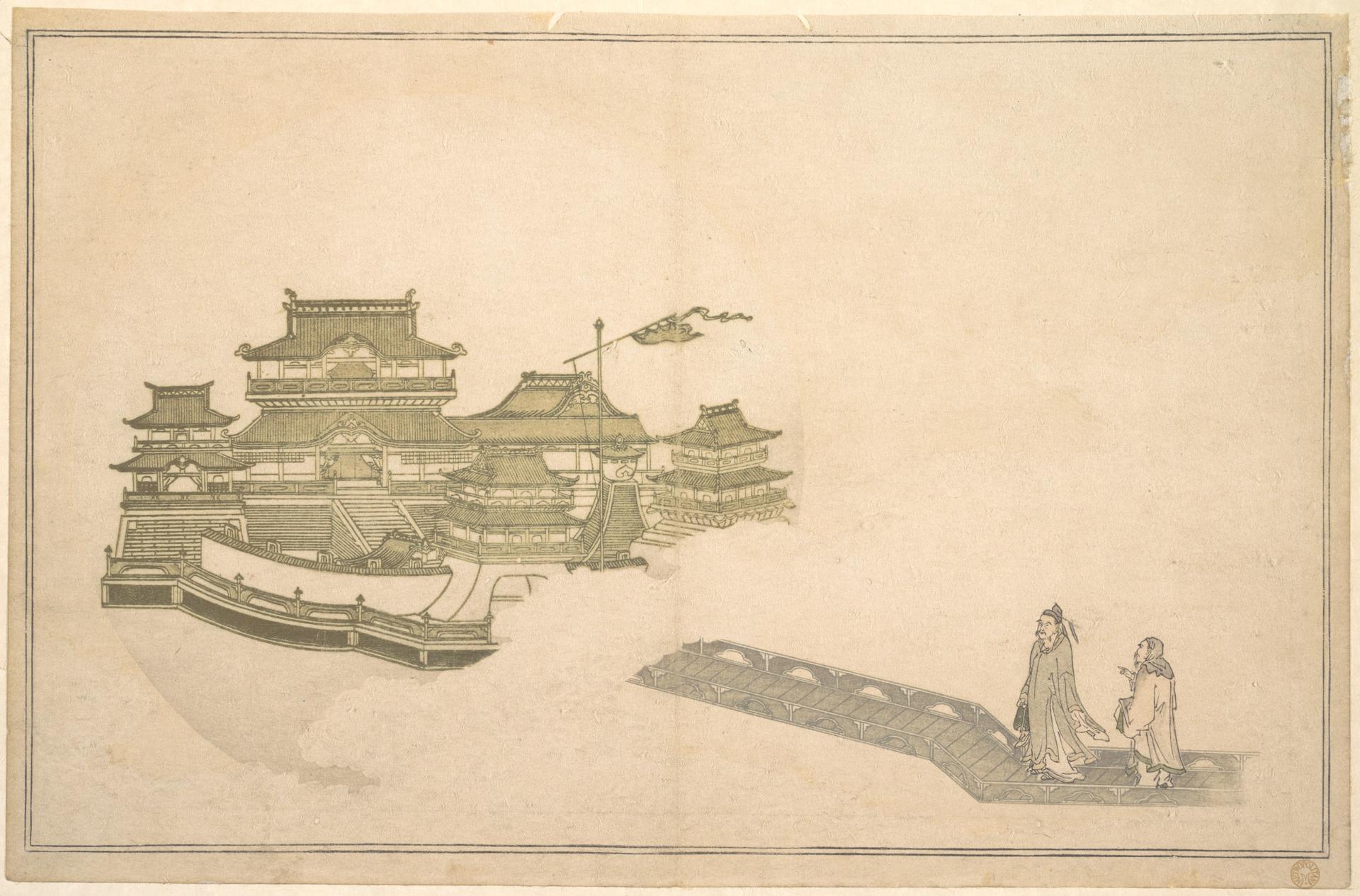
Two figures in traditional dress stand on a bridge, turned toward each other—this pair opens Kitagawa Utamaro's color woodblock print 'The Palace in the Moon,' made in the 8th month of 1789. Behind them rises a multi-storied palace with regularly spaced roofs. The print is ink and color on paper, measuring 23.8 x 37.3 cm.
Description
On a bridge in the foreground, two figures in Chinese-style robes are in conversation. Above them looms a broad palace building whose roofs and roof crests mirror each other. Grays dominate the sheet, with only scattered touches of color on the garments and architectural ornaments. Light falls evenly across the view, leaving open whether daylight or artificial illumination is meant. Crisp contours and the careful rendering of building and figures point to the woodblock art of the 18th century.
Context
Utamaro ranks among the outstanding representatives of Japanese ukiyo-e and is best known for his depictions of women. This sheet dates to the 8th month of 1789, in the late Edo period, when woodblock prints were widely circulated in Japan. 'The Palace in the Moon' likely alludes to Chinese legends or Japanese folk tales popular in the 18th century. The motif may belong to a series or album devoted to fantastic and literary themes.
Impact
The figures stand almost motionless, the palace arranged in strict symmetry—the result is a solemn, detached mood. Because grays prevail and color is used sparingly, linework and details stand out clearly. The sheet feels elegant and restrained; dramatic movement or surging emotion is nowhere to be found.
Technique
The color woodblock print (nishiki-e) employed several woodblocks, each contributing its own color. Ink and printing color were transferred to paper, and the contours came from fine lines of the printing blocks. At roughly 23.8 x 37.3 cm, the format corresponds to oban, as was common for single prints and album leaves.
AI-generated description text
Source: Metropolitan Museum of Art · Public Domain (CC0 1.0)