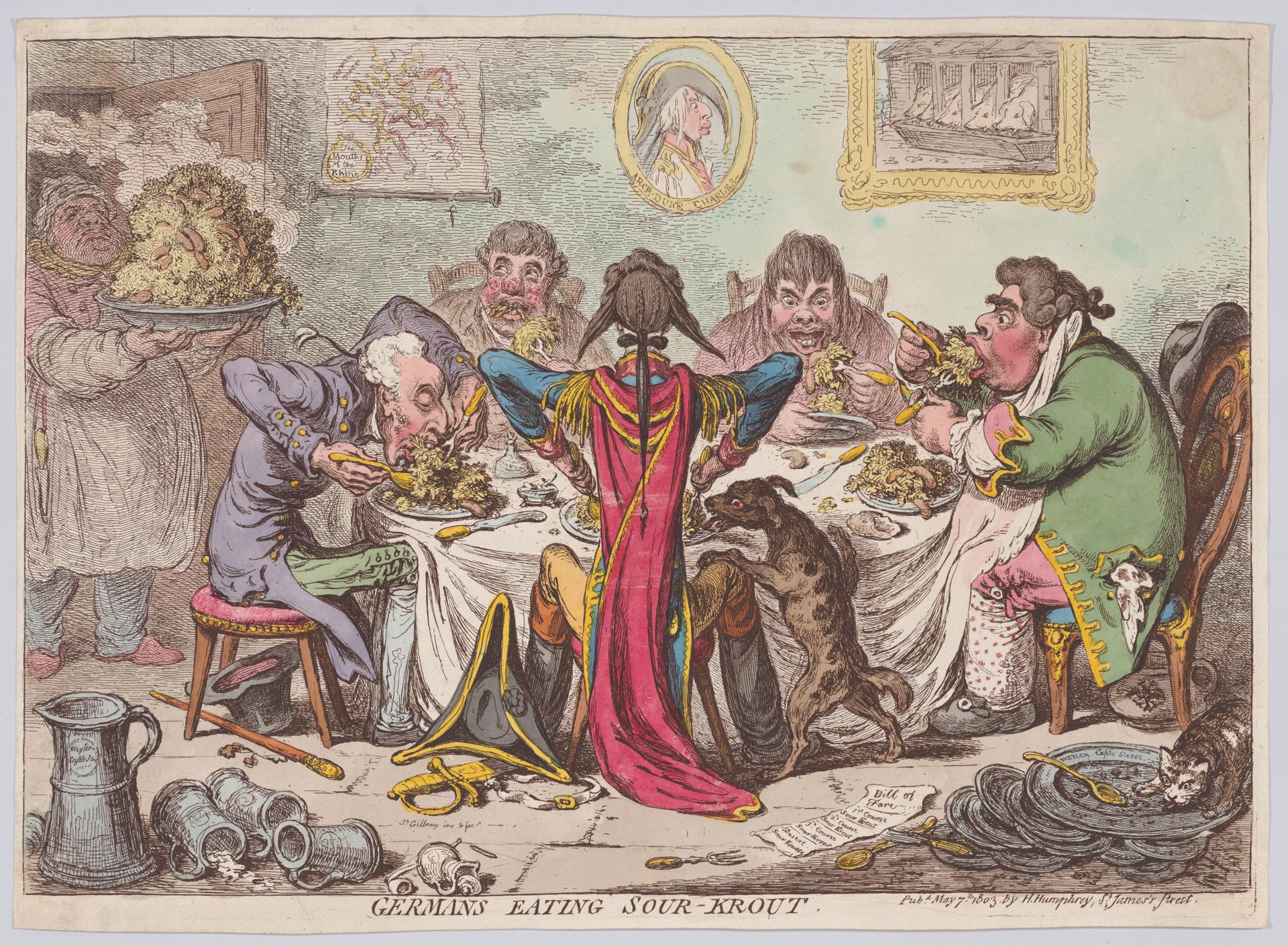
Germans Eating Sour-Krout
Original title: Germans Eating Sour-Krout
kurzbeschreibung
Where comparable food scenes of these years settle into quiet genre observation, James Gillray's hand-coloured etching "Germans Eating Sour-Krout" of 7 May 1803 goes for crowded restlessness at the table instead. A throng of figures in historical dress has gathered to eat, and the title alone pushes the sauerkraut into view.
Description
Around a table clusters an assembly of people in period clothing, heads covered variously with caps and cloths. Earth tones dominate the colouring, broken by red and blue accents. Wall ornaments and a portrait close off the back of the room. Plates, cutlery and jugs stand on the table, while debris and scattered objects lie on the floor; beside a figure in red a dog has settled down.
Context
Behind the print stands James Gillray, a British caricaturist whose satirical sheets were widely known. In 1803, a year of political tension between Britain and France, the German states too were being drawn into the Napoleonic Wars. Gillray liked to seize on national stereotypes, and the cliché of the sauerkraut-eating German was familiar at the time. Its publication on 7 May 1803 most likely referred to the events of the day.
Impact
Exaggerated figures and a restless jumble give the sheet something grotesque that is comic at the same time. Earthy tones with red and blue accents produce a lively, almost carnival mood. The everyday meal and the debris on the floor stand in a tension that both unsettles and amuses.
Technique
The sheet was made as an etching with hand-colouring added afterwards. The etched process allows fine lines and graduated shading, while the red and blue accents come from the hand-colouring. At 26.5 by 36.5 centimetres, the format matches the usual size of satirical prints of the period.
AI-generated description text
Source: Metropolitan Museum of Art · Public Domain (CC0 1.0)