French Liberty – British Slavery (December 21, 1792, Met-Objekt 4395)
Original title: French Liberty – British Slavery
kurzbeschreibung
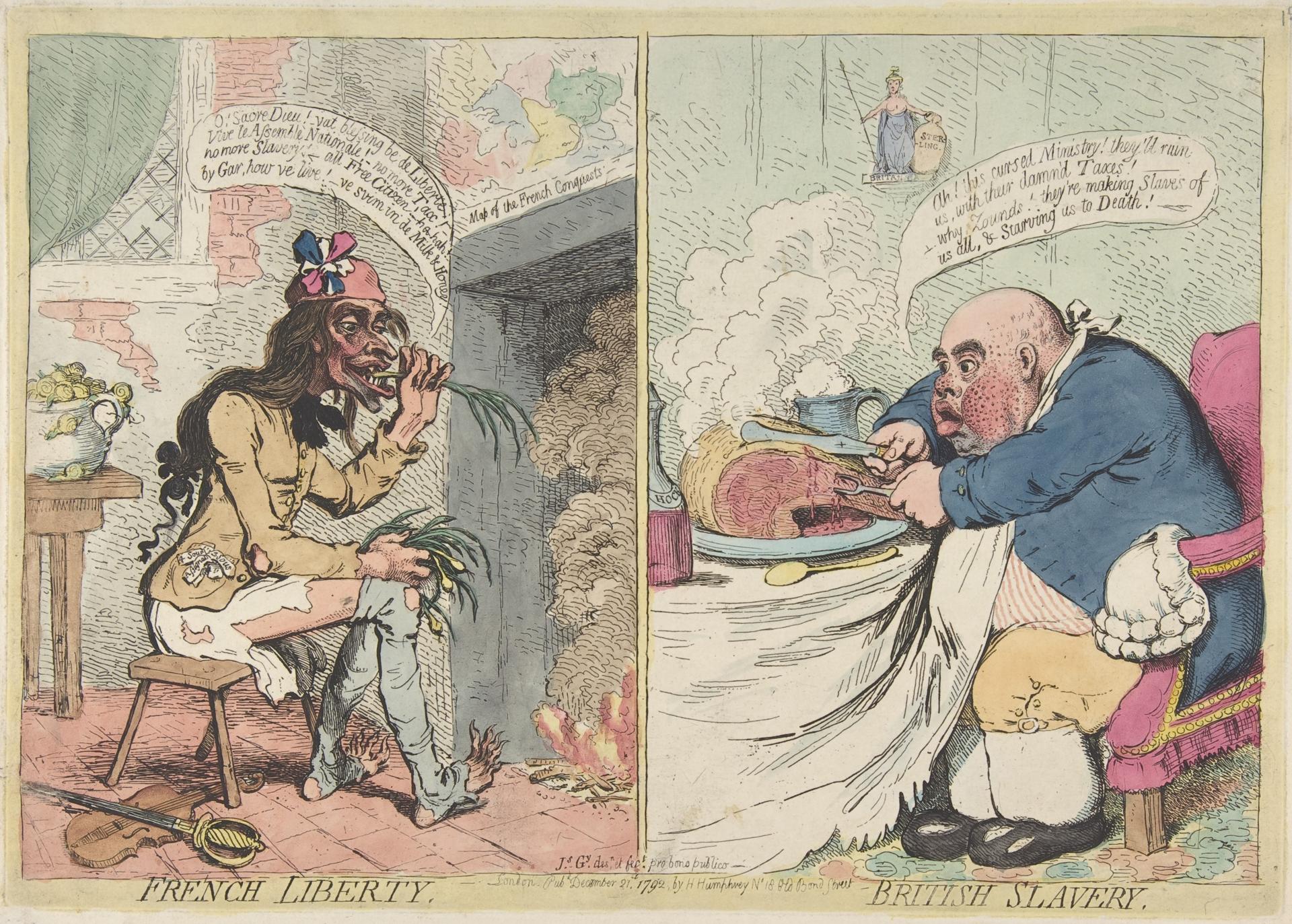
James Gillray's hand-coloured etching of 1792 sets the political conditions of France and Britain side by side. French Liberty appears as an emaciated figure living on raw onions, while British Slavery is shown as a well-fed man with roast meat and wine.
Description
On the left stands a figure in a hat with a flower, eating an onion; behind him hangs a map labelled "Map of the French Conquests", and a bowl of apples sits on a table. On the right a figure in a blue coat, a red scar on his forehead, sits at a table carving a large piece of meat; a woman behind him speaks, her speech bubble complaining of government and taxes. Beneath the scenes run the captions "FRENCH LIBERTY" and "BRITISH SLAVERY".
Context
The print appeared in December 1792, shortly after the proclamation of the French Republic and the execution of Louis XVI. Gillray, a leading British satirist, was intervening in the political debate over the French Revolution. The caricature was directed against radical supporters of the Revolution who sought a reform movement in Britain. Gillray turned the usual revolutionary rhetoric on its head: French liberty appears as deprivation, the British monarchy as abundance.
Impact
The pairing reads ironically: the figure labelled "Liberty" looks wretched and unhealthy, while "Slavery" appears satiated and comfortable. A clear arrangement and vivid colours engage the viewer directly, so the satirical message lands at once.
Technique
Hand-coloured etching, a standard process for political caricature in the eighteenth century. After printing, the fine lines were coloured with watercolour, heightening the contrast between the two scenes. The plate measures 24.9 x 35.5 cm, the sheet 26.8 x 36.9 cm.
AI-generated description text
Source: Metropolitan Museum of Art · Public Domain (CC0 1.0)