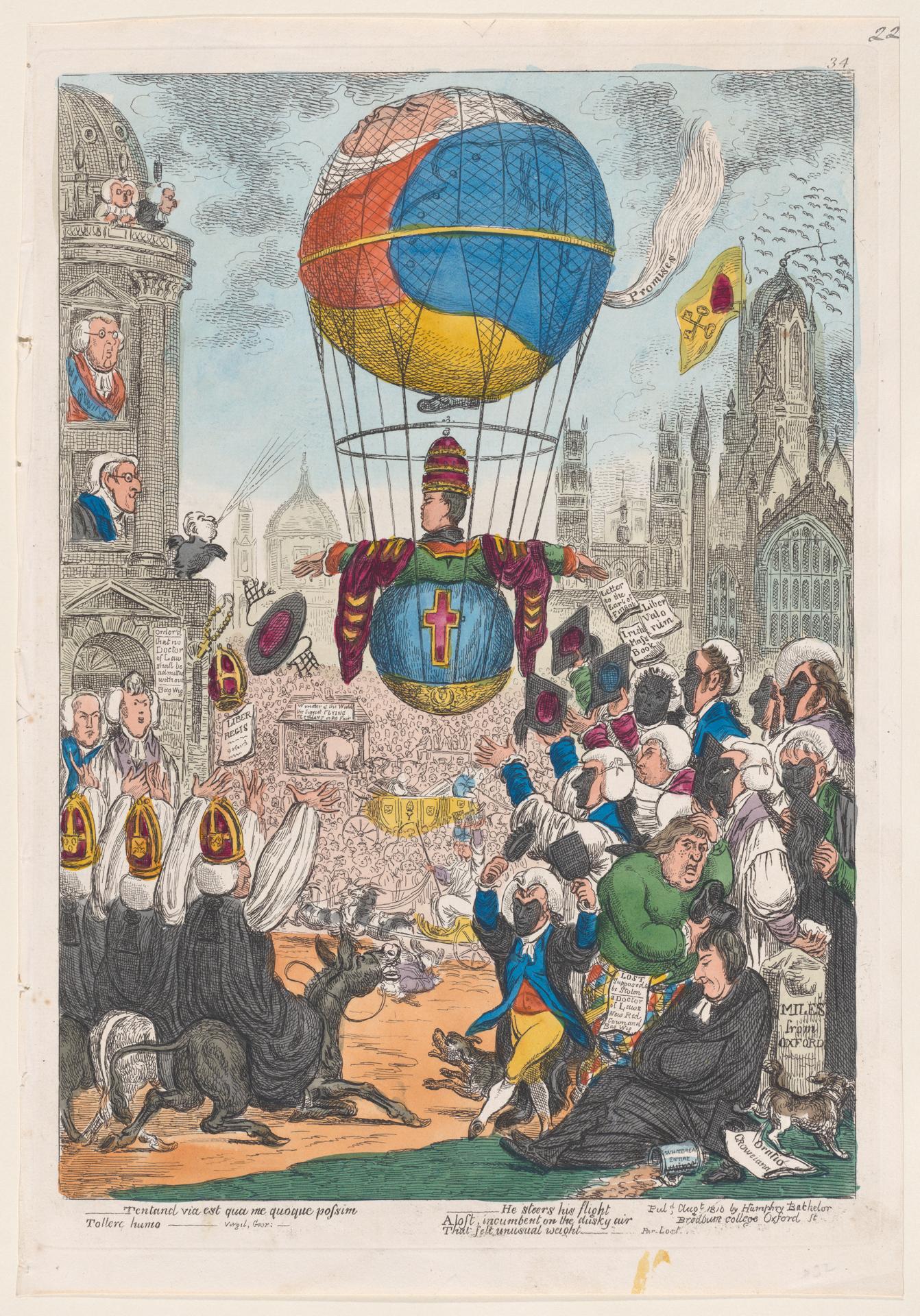
Tendanda via est qua me quoque possim tollere humo–Virgil, Geor:
Original title: Tendanda via est qua me quoque possim tollere humo–Virgil, Geor:
kurzbeschreibung
James Gillray, one of Britain's leading caricaturists around 1800, produced this etching in 1810: a satirical scene in which a crowned figure floats in a coloured balloon, surrounded by gesturing clergymen and a crowd reacting with visible excitement. The print mocks the power relations between politics and the church against the backdrop of the Napoleonic era.
Description
Suspended mid-image, a figure rides in a balloon; a cross marks the chest of the garment while a crown rests on the head. Around the balloon, priests hold documents and wave their hands in gesture, some of them hovering in the air, others standing on the ground. Church towers and a domed building rise behind them, with a few birds scattered between. Blue, red and yellow give the balloon its lively colouring, and the linework stays crisp and exact.
Context
Gillray ranked among Britain's foremost caricaturists around 1800 and was known for his political satires. This sheet dates from 1810, a phase in which Britain was at war with Napoleon and both the Anglican Church and the monarchy stood as central institutions of the country. Gillray often took up the interplay of church and state, using biblical or classical quotations — here Virgil — as ironic commentary.
Impact
The exaggerated figures and strong colours provoke immediate laughter, yet the critical undertone never gets lost. Between the lofty bearing of the balloonist and the agitated bustle of the crowd, a tense, satirical mood takes shape that invites reflection on power and belief.
Technique
For this etching, the drawing was bitten into a copper plate and then printed. The process allows the fine lines and details characteristic of Gillray's precise caricature art. The colours were likely added afterwards by hand in watercolour, as was common for prints of that period.
AI-generated description text
Source: Metropolitan Museum of Art · Public Domain (CC0 1.0)