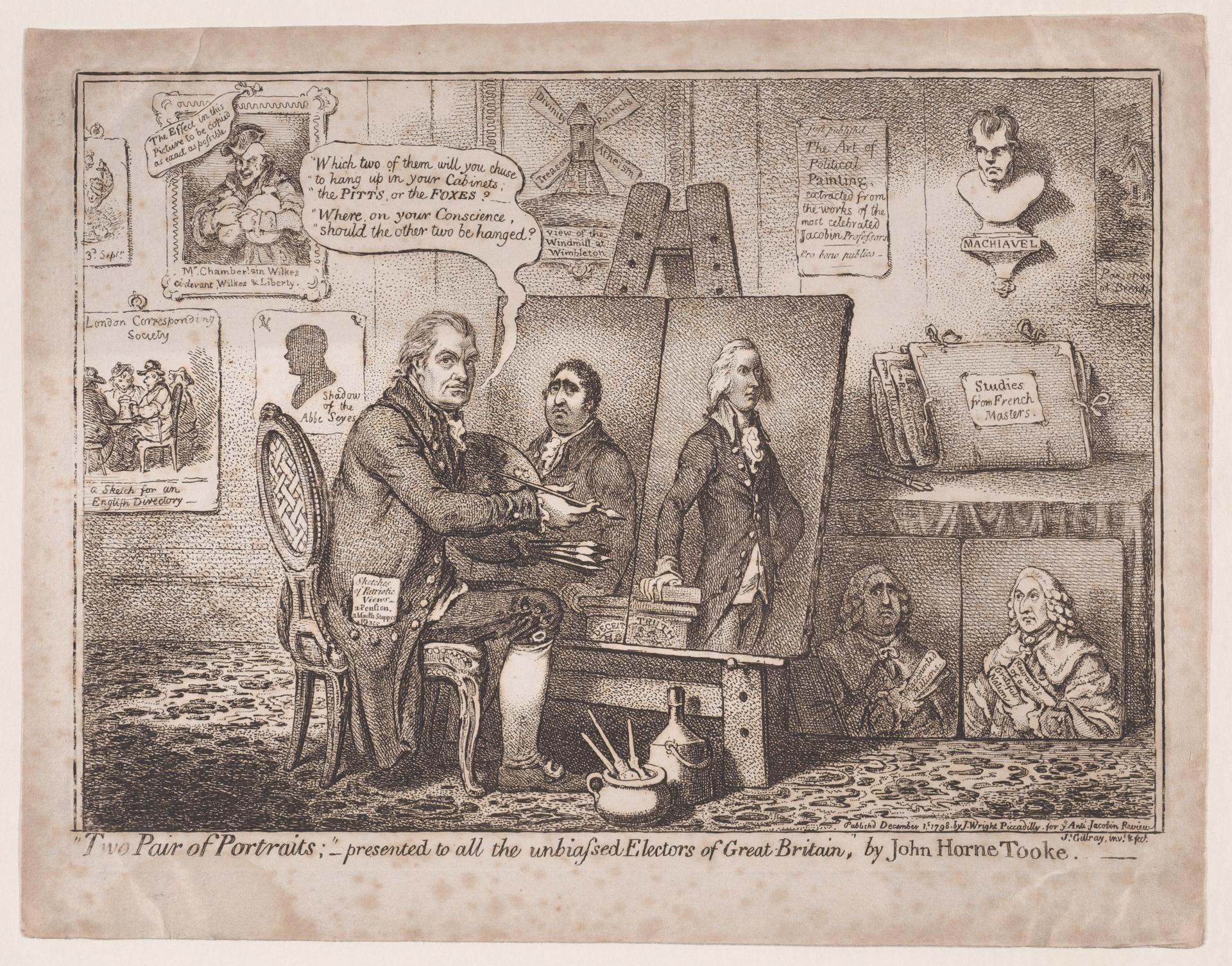
Two Pair of Portraits, presented to all the unbiased Electors of Great Britain by John Horne Tooke
Original title: Two Pair of Portraits, presented to all the unbiased Electors of Great Britain by John Horne Tooke
kurzbeschreibung
Unlike the usual studio scenes of its day, Gillray's 1798 etching Two Pair of Portraits pairs the display of likenesses with a political thrust: an artist holds one portrait and points to a second on an easel, while a companion also presents a portrait. The print thus takes a satirical look at late-eighteenth-century British politics.
Description
On the left a man, presumably the painter, sits with a portrait in his hand; he gestures toward another picture on the wall. On the right stands a second man, who likewise shows a portrait. Further paintings and drawings fill the background, among them a likeness inscribed 'M. Chamberlain Wilkes' and a work titled 'The Art of Political Painting'. A windmill and a sketch of a reading figure can also be made out. Grey tones dominate, the light is evenly distributed, and the figures are arranged symmetrically.
Context
Gillray published the sheet on 1 December 1798, during the Napoleonic Wars and mounting domestic tension in Britain. John Horne Tooke, named in the title, was a radical politician and philologist who campaigned for electoral reform. The caricature takes up disputes between Whigs and Tories; Gillray often skewered both camps. The reference to 'M. Chamberlain Wilkes' points to John Wilkes, a well-known figure of the radical movement.
Impact
Precise lines and the ironic exaggeration of the figures produce a humorous touch that makes the viewer smile. The symmetrical layout and the scattered captions convey a clear yet layered message that prompts reflection on political propaganda.
Technique
Gillray used etching with added engraving, yielding fine lines and detailed hatching. The sheet was printed on paper; the plate measures 19.5 x 26.5 cm, the sheet 21.9 x 28.6 cm. The grey tones result from the printing process, in which the etched lines hold the ink.
AI-generated description text
Source: Metropolitan Museum of Art · Public Domain (CC0 1.0)