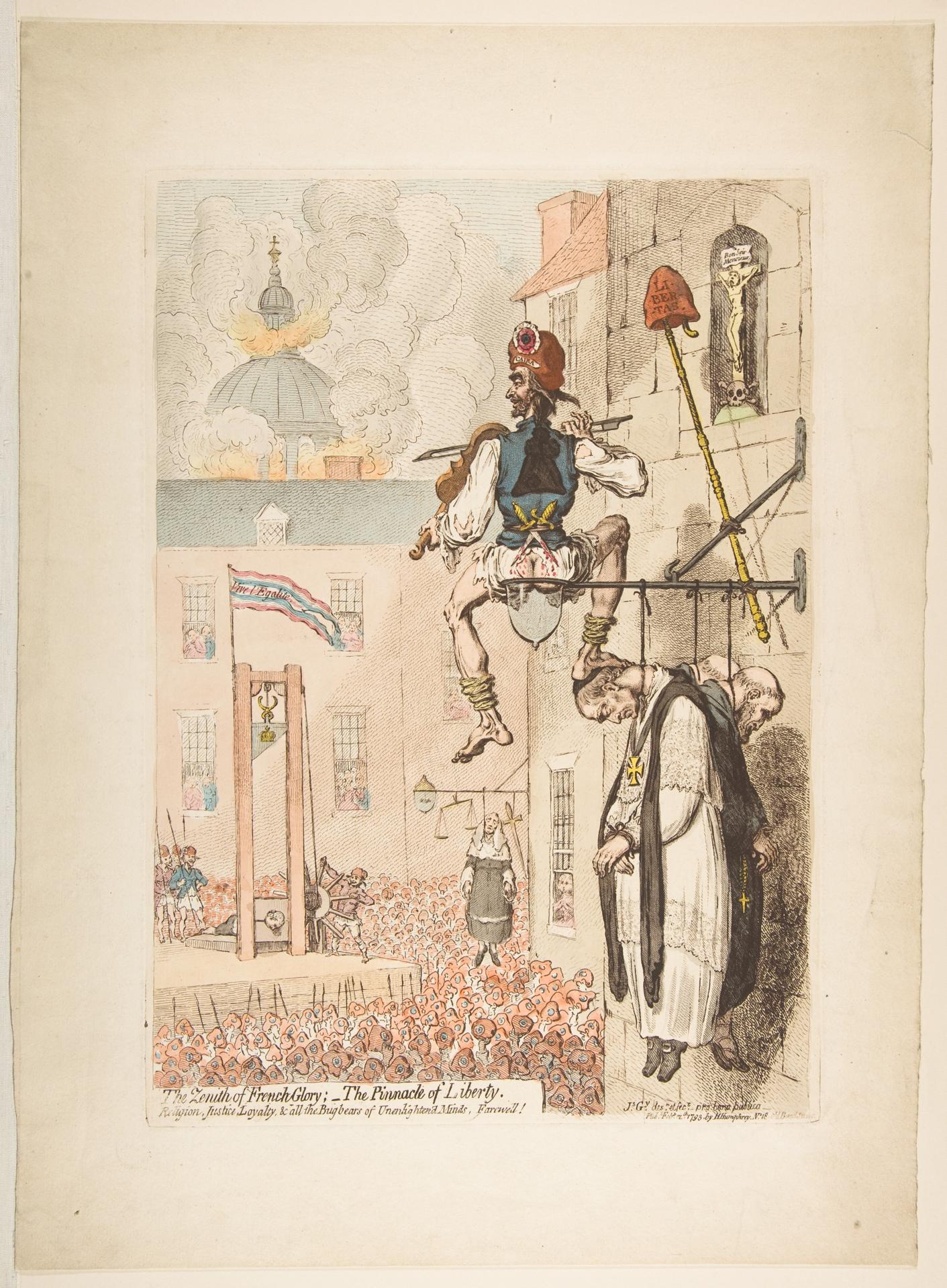
The Zenith of French Glory; – The Pinnacle of Liberty. Religion, Justice, Loyalty, & all the Bugbears of Unenlightened Minds, Farewell!
Original title: The Zenith of French Glory; – The Pinnacle of Liberty. Religion, Justice, Loyalty, & all the Bugbears of Unenlightened Minds, Farewell!
kurzbeschreibung
Unlike most depictions of the Revolution from those years, James Gillray's hand-coloured etching of 1793 does not build on a single scene of horror but on a crowded tableau of outrages. Executions, a guillotine and a burning church are packed into one sheet that sharpens the excesses of the French Revolution into satire.
Description
Near the middle a figure dangles from the gallows while still blowing on a flute; beneath him a crowd jostles under the watch of soldiers. The guillotine rises on the left, and on the right a priest hangs from a rope. A church spire blazes in the distance, and a crucifix can be made out at the upper right. Muted tones dominate, with only the uniforms and a flag standing out more brightly.
Context
The execution of Louis XVI in January 1793 and the revolution's hardening radicalism prompted this caricature. It was published in London on 12 February 1793, when the British public wavered between sympathy and revulsion at events in France. Contemporary reports of violence and of the persecution of the church supplied the imagery.
Impact
Grotesque details sit beside realistic scenes of violence, producing an oppressive effect. Gillray's exaggerated satire brings the horror of the Revolution close without sliding into mere comedy.
Technique
The sheet was made as a hand-coloured etching with engraving, as was usual for Gillray. The engraving sharpens the lines of the etching, and the colour applied afterwards sets deliberate accents.
AI-generated description text
Source: Metropolitan Museum of Art · Public Domain (CC0 1.0)