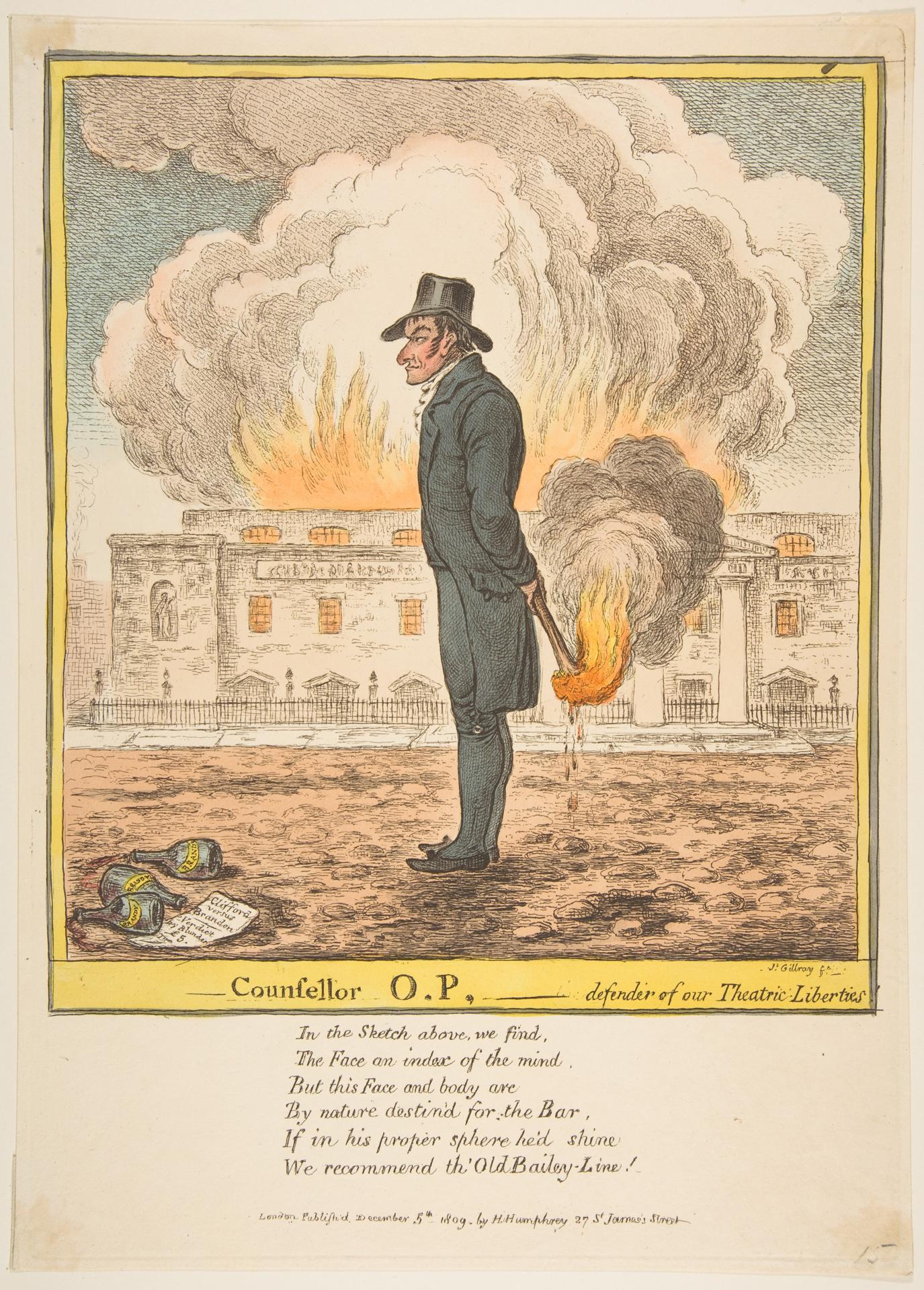
Counsellor O.P.–Defender of our Theatric Liberties (December 5, 1809, Met-Objekt 4344)
Original title: Counsellor O.P.–Defender of our Theatric Liberties
kurzbeschreibung
A man in a dark suit and black hat holds a burning flame in his hand. Behind him stands a building in flames, and two bottles lie on the ground. This hand-colored etching by James Gillray from 1809 refers to the O.P. riots in London.
Description
A figure in dark clothing and a black hat presents a striking yellow-orange flame in his right hand. Behind him rises a building whose windows and roof are engulfed in smoke and fire. Two labeled bottles, apparently alcoholic drinks, lie on the ground. Grays and browns dominate the palette, broken by the bright flames and a yellow border line. Below the image are a caption and a poem identifying the man as 'Counsellor O.P.' and 'Defender of our theatrical freedoms.'
Context
The caricature was made in December 1809, during the O.P. (Old Price) riots in London. These protests opposed higher ticket prices and the introduction of private boxes at Covent Garden Theatre. Gillray, a leading British caricaturist, often addressed political and social events in his work. The term 'Ratsherr' (councillor) alludes to the role of lawyers and politicians in this conflict.
Impact
The contrast between the calm, dark figure and the glaring flames gives the image immediate dynamism and a sense of threat. The satirical exaggeration of the 'defender' as an arsonist creates an ironic distance from the event depicted. The detailed execution invites close looking and conveys the excitement of the theatrical debate of the time.
Technique
The work was made as a hand-colored etching: the lines were first etched and then colored with watercolors. The coloring is limited to selected elements such as flames and border, while the rest of the scene is kept in grays and browns. The sheet was trimmed to the plate edge and measures about 32.4 x 25.4 cm.
AI-generated description text
Source: Metropolitan Museum of Art · Public Domain (CC0 1.0)