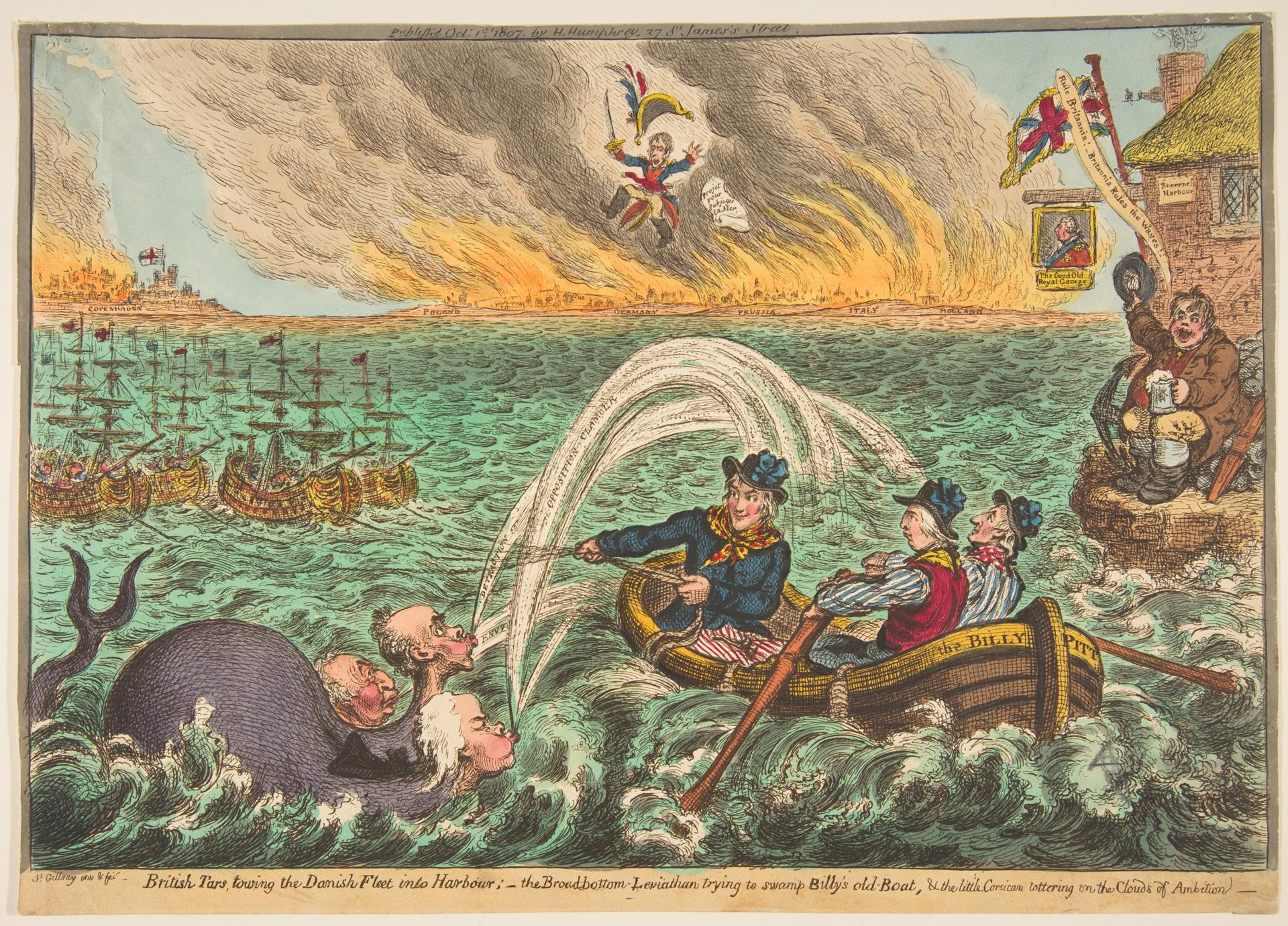
British Tars Towing the Danish Fleet into Harbour; the Broad-Bottom Leviathan trying Billy's Old Boat, and the Little Corsican tottering on the Clouds of Ambition
Original title: British Tars Towing the Danish Fleet into Harbour; the Broad-Bottom Leviathan trying Billy's Old Boat, and the Little Corsican tottering on the Clouds of Ambition
kurzbeschreibung
This hand-coloured etching from 1807 by James Gillray takes a satirical swipe at British sea power and the Napoleonic Wars. A scene on the water unfolds with a boat, several figures, and a sea turtle that could never exist in nature.
Description
A boat in the foreground is beset by a large two-headed turtle that spouts water. Its occupants include a woman in traditional dress with a floral wreath and two others in historical costume, one holding a paddle. Behind them a town or fortress is in flames, while several sailing ships of a fleet lie on the water. On the right stands a building with a roof, flag, and portrait; from the fire a figure dressed as a soldier leaps with a document in hand. The colours are strong, with a sharp contrast between the blue-green water and the warm tones of the fire; shadows and tonal differences create dramatic lighting.
Context
The backdrop is the British fleet's bombardment of Copenhagen in September 1807, during which the Danish fleet was seized. Gillray, one of the leading British caricaturists of his day, published the print on 1 October 1807 through Hannah Humphrey's shop. The satire targets British policy under Prime Minister William Cavendish-Bentinck, 3rd Duke of Portland, and Napoleon Bonaparte, mocked as the 'little Corsican'.
Impact
The exaggerated figures and the absurd sea turtle give the sheet a humorous and grotesque quality typical of Gillray. Fire and water drive the tension in the dynamic arrangement and make the political explosiveness of the subject palpable.
Technique
The lines of the etching were bitten into a copper plate with acid; colour was then applied by hand in watercolour, so brushstrokes remain visible. What survives is a clipped impression measuring 9 3/4 x 13 5/8 inches (24.8 x 34.6 cm).
AI-generated description text
Source: Metropolitan Museum of Art · Public Domain (CC0 1.0)