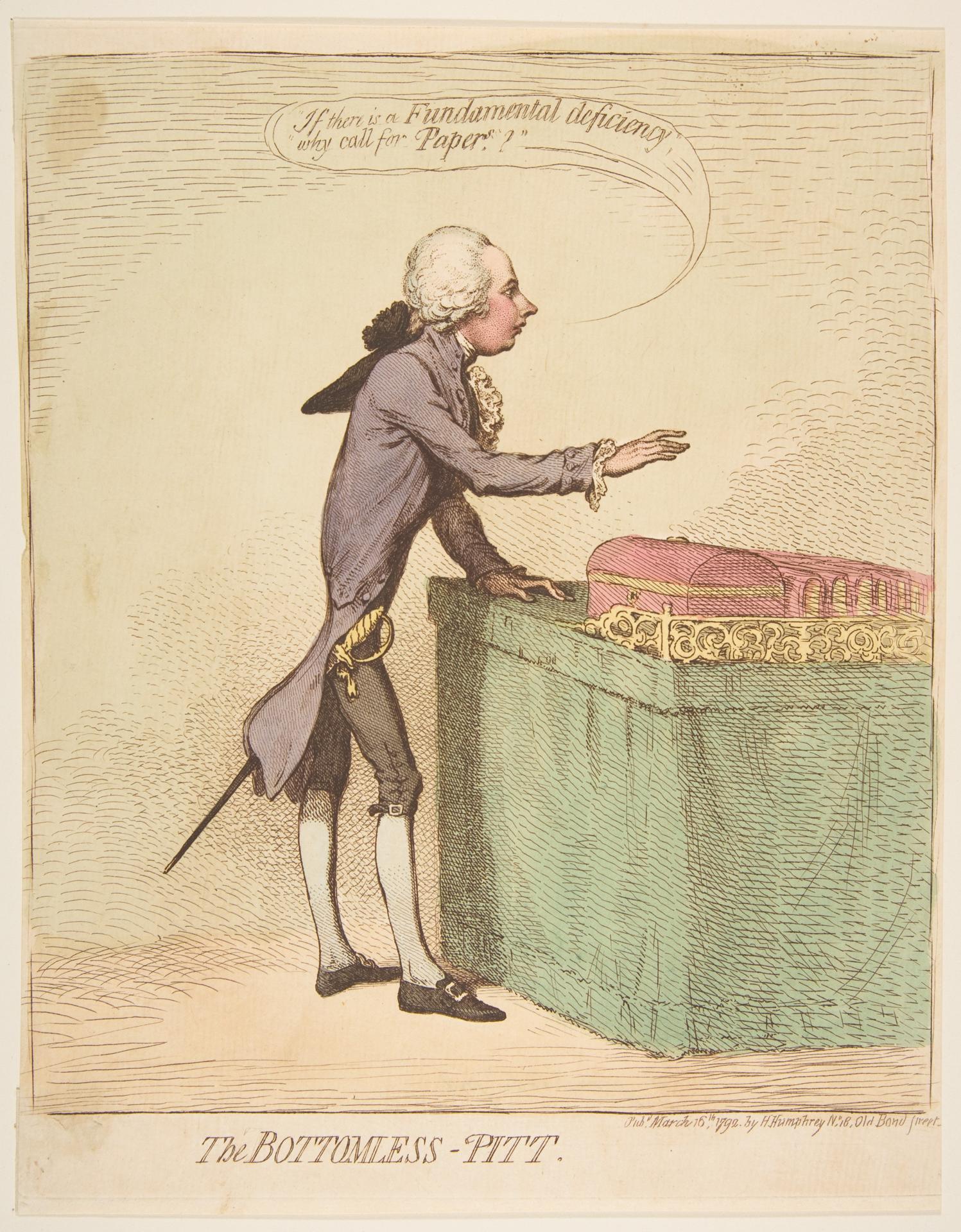
The Bottomless-Pitt
Original title: The Bottomless-Pitt
kurzbeschreibung
Issued on 16 March 1792, James Gillray's hand-coloured etching "The Bottomless-Pitt" bends the British prime minister William Pitt the Younger over a large green box trimmed in gold with a pink lid. The sheet measures 27.6 by 21.7 cm and comes from an open-letter state.
Description
A man in formal dress — white shirt with sleeves rolled up, dark coat, breeches with braces and white stockings — stands before the box, his hair curled, a sash or sword at his side. Above the box floats a thought bubble reading: "If there is a Fundamental deficiency, why call for Paper?" The setting stays bare, marked only by a flat, wave-like pattern of lines.
Context
The print appeared in March 1792, a moment of political tension in Britain after the French Revolution. Pitt had been prime minister since 1783 and faced criticism over his financial and foreign policy. Gillray, one of the leading caricaturists of the day, used the box to allude to Pitt's handling of the national finances; the words in the bubble probably parody Pitt's statements on paper money and credit.
Impact
The exaggerated posture and the symbolic box give the satire its immediate bite. Delicate etched lines and bold hand-colouring lend the sheet a lively, almost theatrical presence. The thought bubble draws the political subtext into view, turning the caricature into sharp commentary.
Technique
Etching produces fine lines and the depth of an intaglio print. After printing, the sheet was coloured by hand, which accounts for the varied shades and tones. This is an impression in the open-letter stage — that is, before the final inscription was added.
AI-generated description text
Source: Metropolitan Museum of Art · Public Domain (CC0 1.0)