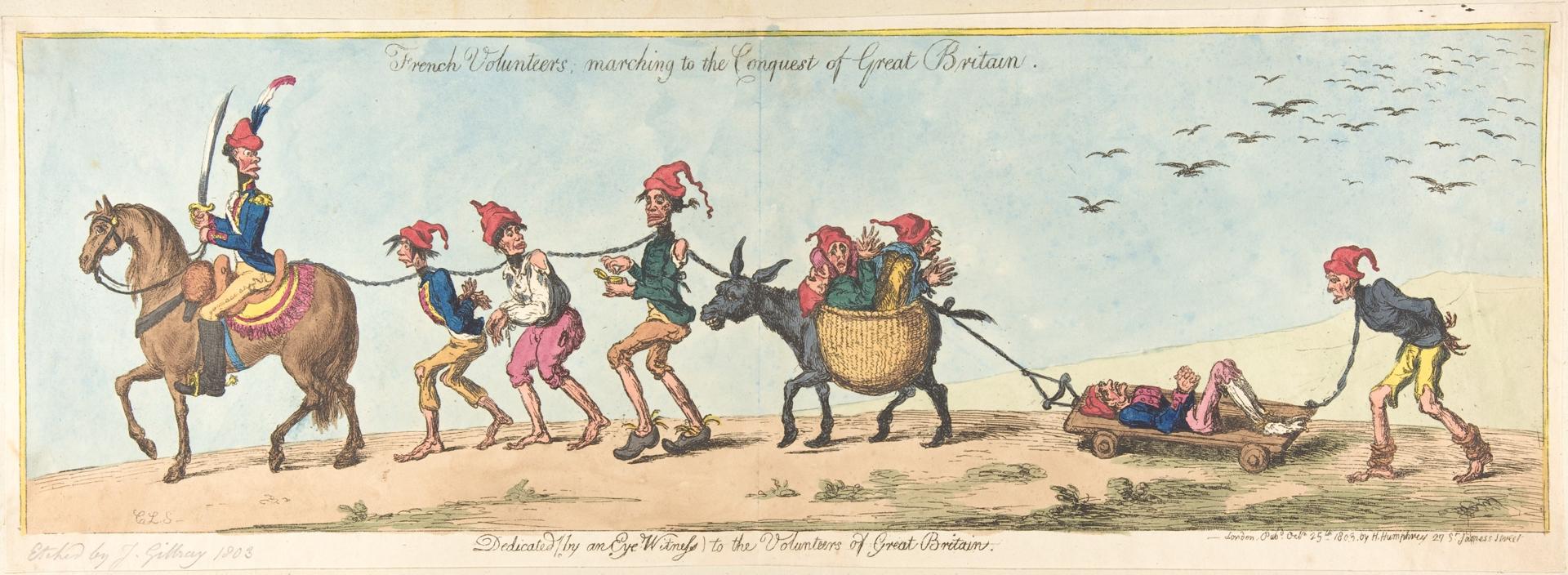
French Volunteers Marching to the Conquest of Great Britain
Original title: French Volunteers Marching to the Conquest of Great Britain
kurzbeschreibung
James Gillray's 1803 caricature depicts a column of French volunteers setting off to invade Britain, but with a heavy dose of comedy. This hand-colored print is one of Gillray's satirical etchings that turns the threat posed by Napoleon into ridicule.
Description
A long line of figures in French uniforms and red caps stretches into the distance. Some are mounted on a donkey that is being carried in a basket, while others are towed behind on a cart. At the front, a leader on horseback brandishes his sword, and birds circle over the sandy beach beyond. The figures are exaggerated and utterly impractical, which is exactly where the caricature finds its ironic humor.
Context
The print appeared in October 1803, when Britain and France were at war again after the Peace of Amiens collapsed. Napoleon Bonaparte was preparing to land in England, and volunteers were being assembled in France for the invasion force. Gillray seized on these preparations and portrayed them as a ridiculous, doomed enterprise. The print belonged to a series of political sheets that circulated in London shop windows and helped shape public opinion.
Impact
Because the French troops are so absurdly overdone that they resemble a chaotic procession rather than a serious army, the effect is comic. With this imagery, Gillray strips the threat of its terror and gives the British public a sense of superiority. The satirical bite remains immediately legible today.
Technique
Etching needle and fine hatching shape this print, with cross-hatching modeling the tones of the figures and their garments. After printing, the colors were applied by hand, which makes the characters and details lively but also somewhat flat. Aquatint and fine line etching allowed for delicate shading, while the coloring brings the satirical details into clear relief.
AI-generated description text
Source: Metropolitan Museum of Art · Public Domain (CC0 1.0)