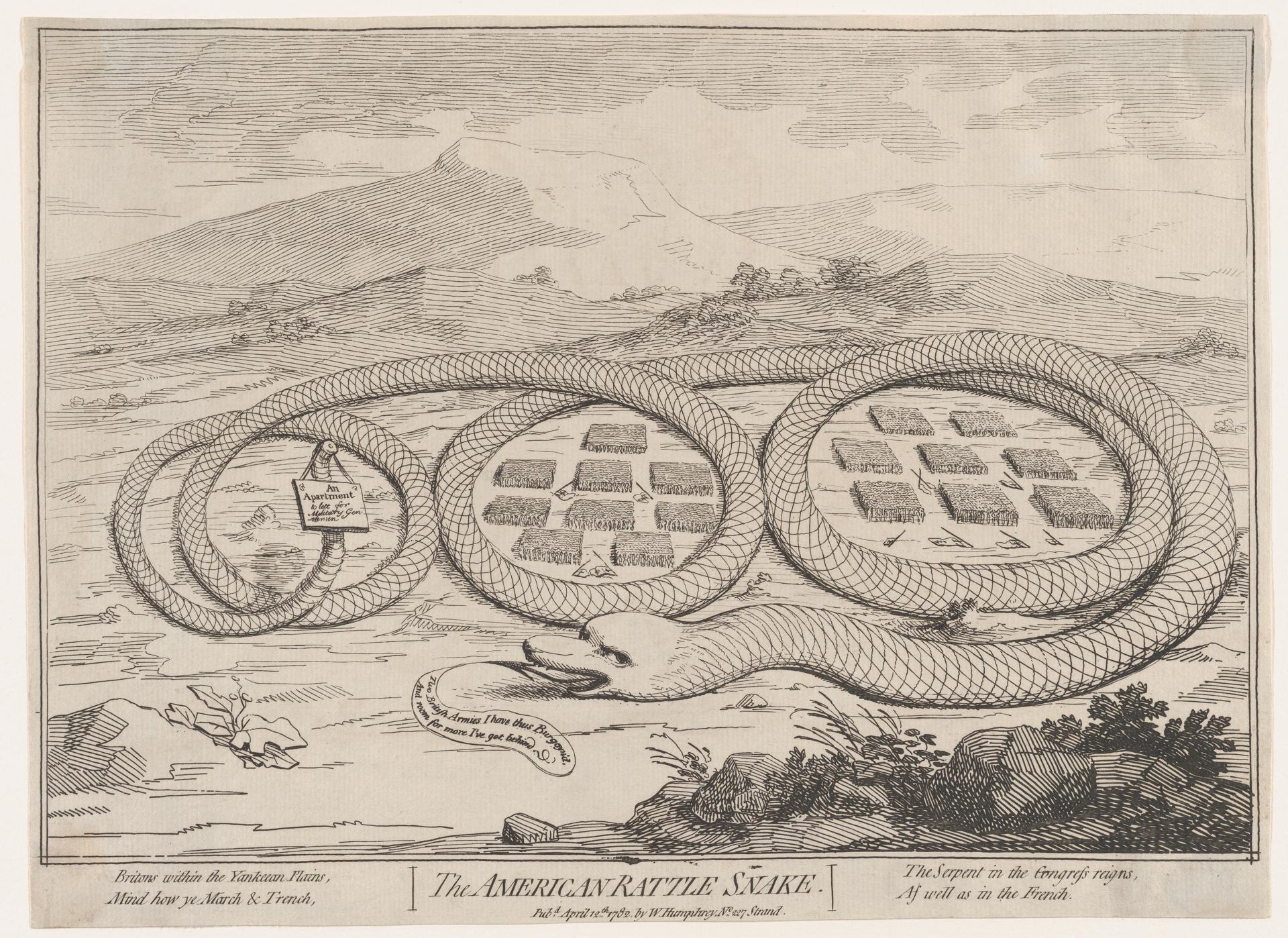
The American Rattle Snake (April 12, 1782, Met-Objekt 4326)
Original title: The American Rattle Snake
kurzbeschreibung
A snake broken into separate segments coils around a country house and its fields: that is how James Gillray pictured 'The American Rattle Snake' in an etching dated 12 April 1782. The print works as a political satire on the American colonies.
Description
An upturned serpent's body winds between a country house and cultivated fields. The creature's frame falls apart into several labelled sections; on the left segment run the words 'An Apartment / Is here / For you / To stay in'. To the right the fields lie as rectangles hinting at farm produce such as maize. Trees and hills frame the setting. Cleanly drawn etching lines pick out the scales of the snake's body in particular.
Context
Gillray made the print in 1782, in the middle of the American War of Independence, as Britain's defeat by the colonies was coming into view. The British caricaturist commented on events from his own country's side. At the time the snake was widely taken as a symbol of the American colonies, as it already had been in Benjamin Franklin's 'Join or Die' cartoon. The inscriptions along the lower edge refer to relations with the United States and to the French Revolution.
Impact
The precise etching technique and the snake raised to an emblem are what stick in the mind on looking. Idyll and threat sit side by side, producing the satirical tension that carries the political comment. The clear layout draws the eye to the labelled segments, which gives the message more force.
Technique
The sheet is an etching on paper, an intaglio process in which the lines are bitten into a metal plate. Fine hatching and sharply set contours reveal Gillray's characteristic hand. The monochrome print measures 27.6 x 41.5 cm, which underlines its graphic effect.
AI-generated description text
Source: Metropolitan Museum of Art · Public Domain (CC0 1.0)