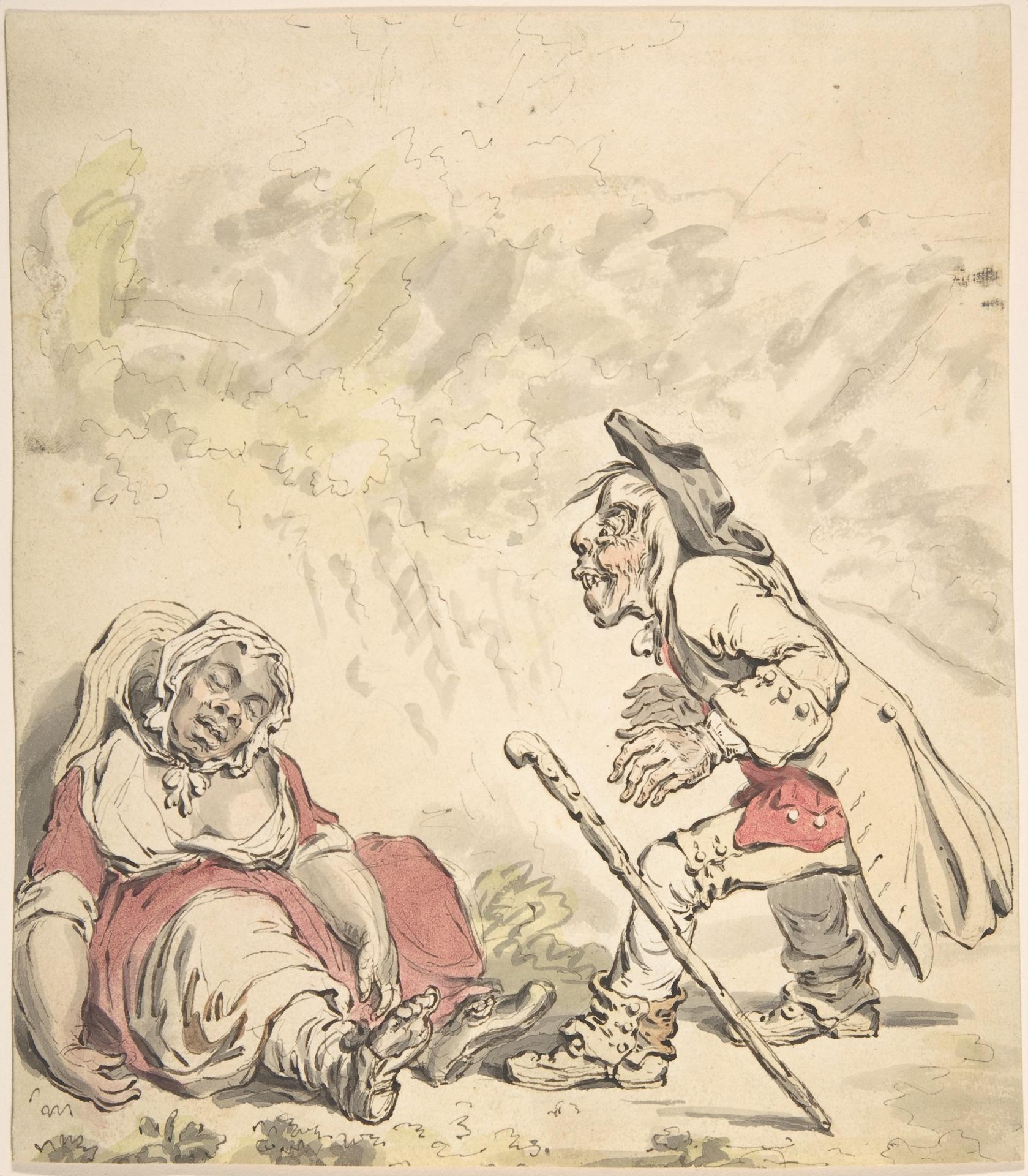
Cymon and Iphigenia (1796)
Original title: Cymon and Iphigenia
kurzbeschreibung
In James Gillray's 1796 watercolour Cymon and Iphigenia, the shepherd Cymon comes upon the sleeping Iphigenia and is transformed by the sight. Executed in pen and black ink with watercolour over graphite, the sheet measures 21.5 x 24.5 cm. It presents a woman seated on the ground and a man standing over her with a stick, set within a landscape.
Description
The layout feels asymmetrical: the seated woman dominates the foreground while the standing man is placed slightly further back; both occupy the centre. The woman appears to weep or pray, while the man regards her with a threatening or questioning expression and holds a stick. Both figures wear simple garments with red accents, and the woman's hair is tied in a knot. A loosely sketched landscape with trees and bushes forms the backdrop. The palette remains mostly muted and earthy, the light diffuse and without hard shadows, which creates a sombre mood.
Context
The subject derives from Giovanni Boccaccio's Decameron, where love for Iphigenia refines the crude shepherd Cymon and turns him into an educated man. James Gillray (1756–1815), a British caricaturist, became known chiefly for his satirical prints. The date of 1796 falls within a period in which he addressed both political and literary subjects. That the work is executed as a watercolour, a technique Gillray used less often, suggests a private or presentation-oriented piece.
Impact
The dark palette and the man's menacing posture generate a tense, almost eerie atmosphere. Clear lines and the reduced landscape bring the figures into focus and heighten the emotional intensity of the moment.
Technique
A mixed technique of pen and black ink, watercolour and graphite is present. The pen drawing provides clear contours, while the watercolour adds areas of colour in muted, earthy tones. Through the interplay of line and colour, the sheet acquires a draughtsmanlike, classicising quality.
AI-generated description text
Source: Metropolitan Museum of Art · Public Domain (CC0 1.0)