The Last Drop
Original title: The Last Drop
kurzbeschreibung
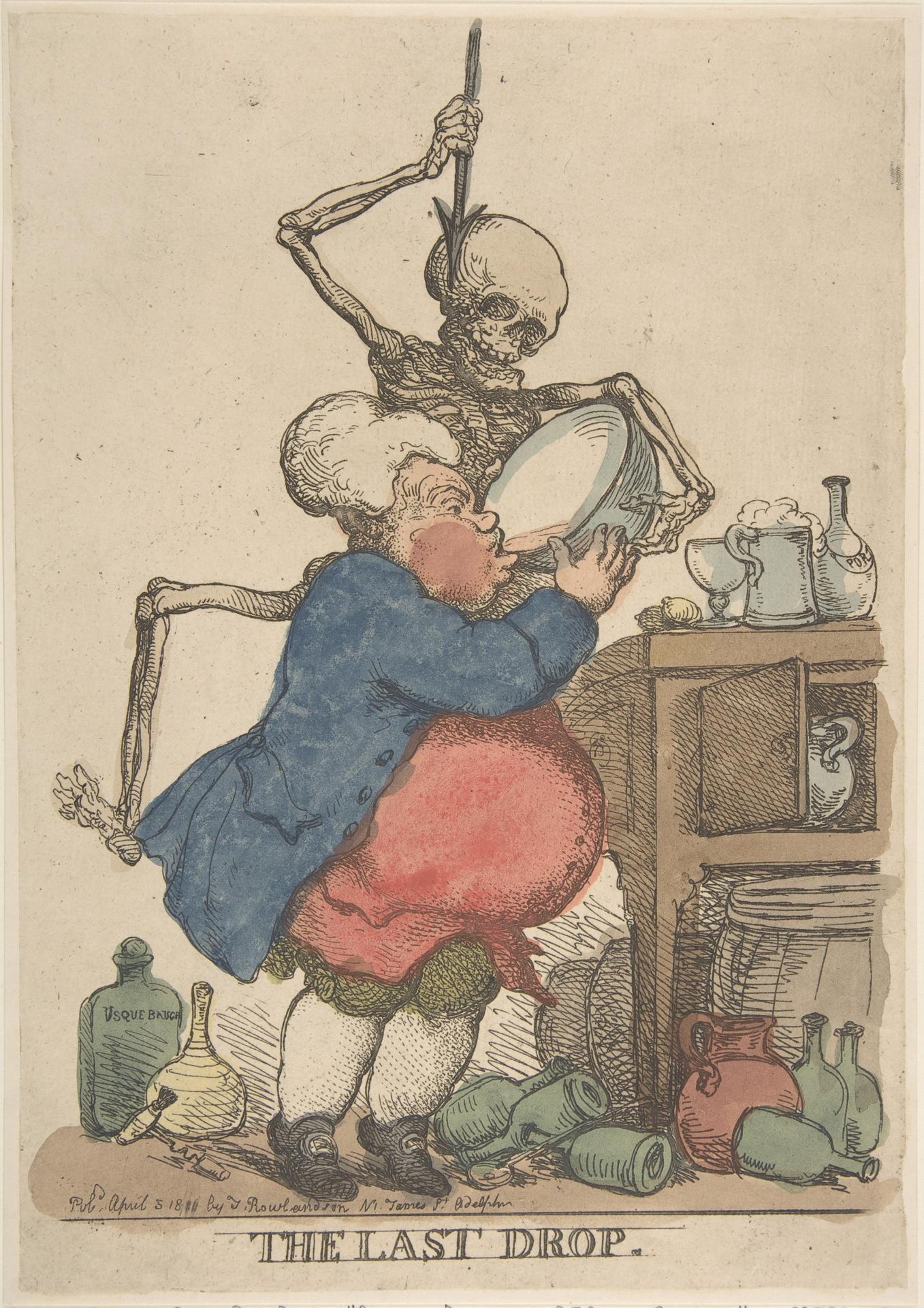
A skeleton snatches the last bottle from a drunkard in Thomas Rowlandson's etching 'Der letzte Tropfen' of April 5, 1801. The hand-colored print pairs caricatured figures with a moralizing message.
Description
A skeleton holds a bottle aloft and tips it to its mouth to catch the final drop. Beside it sits a man with a flushed face, red breeches and blue shirt, struggling in vain to empty another bottle. Scattered across the background are numerous bottles and vessels, pointing to excessive drinking. Grey and brown tones dominate the palette, with red and blue accents. The light falls evenly, without noticeable shadows.
Context
Rowlandson made the print in England in 1801, when caricature was widely used as a tool of social criticism. Drunkenness and its consequences were a popular satirical subject, addressing the social problems of alcoholism among the working class. Rowlandson often worked for print publishers and sold his works as single sheets or in series. This sheet belongs to his extensive graphic oeuvre, known for its pointed observation.
Impact
The etching thrives on the contrast between vitality and death: the drunkard looks grotesque and comic, while the skeleton radiates an eerie calm. Clear outlines and restrained color accents sharpen the satire and draw the eye to the main figures. The result is a mix of amusement and reflection on mortality.
Technique
In etching, the drawing is scratched into an acid-resistant layer on a copper plate and then bitten by acid. After printing, contours and areas were colored by hand with watercolors, giving the sheet a lively effect. The paper size of 28.3 × 19.9 centimeters matches that of single-sheet prints of the period.
AI-generated description text
Source: Metropolitan Museum of Art · Public Domain (CC0 1.0)