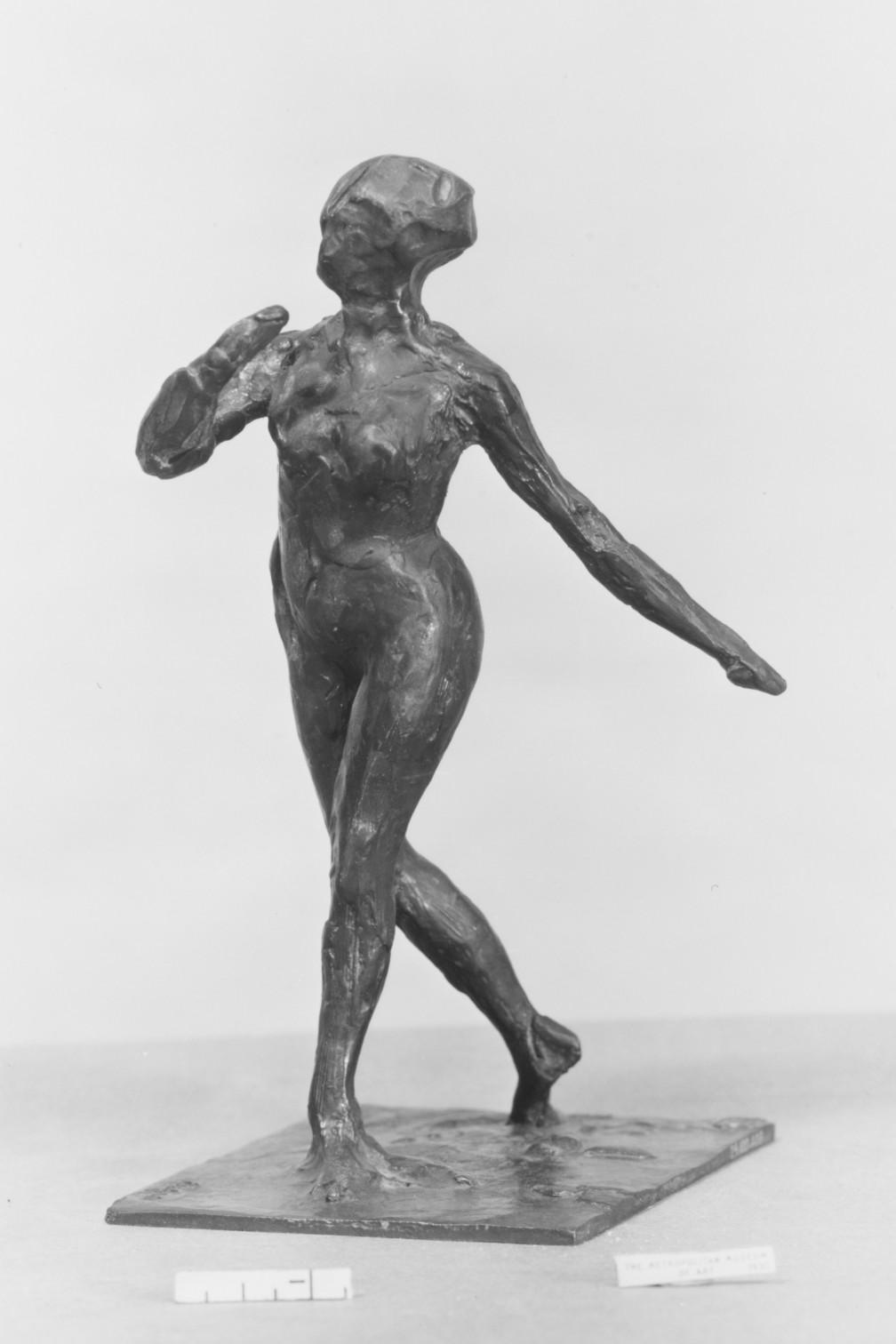
Dancer Bowing (First State)
Original title: Dancer Bowing (First State)
kurzbeschreibung
Edgar Degas's bronze statue "Sich verbeugende Tänzerin (Erster Zustand)" was modelled possibly between 1878 and 1880 and cast in bronze in 1920. It presents a nude dancer caught in a lively bow. The piece belongs to Degas's sustained engagement with the world of ballet, fixing a moment full of movement and grace.
Description
A nude dancing figure leans forward, one arm extended behind her. The legs hold a pose that conveys both grace and strength. Resting on a square base, the arrangement gains stability. A neutral background pulls the sculpture fully into focus. The surface reads uniformly in bronze tones, without contrasting colour accents or striking highlights.
Context
This sculpture emerged during a phase in which Edgar Degas was studying ballet closely and portraying numerous dancers in varied poses. Although the model was probably made around 1878–80, the bronze was cast only after his death in 1920. Degas used wax and clay to investigate movement, and many of his sculptures were transferred to bronze posthumously.
Impact
The work radiates immediate liveliness and captures the fleeting quality of a movement. The union of anatomical precision and dynamic pose creates an aesthetic tension between realism and idealisation of the human figure.
Technique
Bronze was chosen for the execution, a material valued for its durability and precision of detail. The cast was made posthumously from a wax or clay model Degas had prepared during his lifetime. The surface shows an even patina typical of bronze casts from this period.
AI-generated description text
Source: Metropolitan Museum of Art · Public Domain (CC0 1.0)