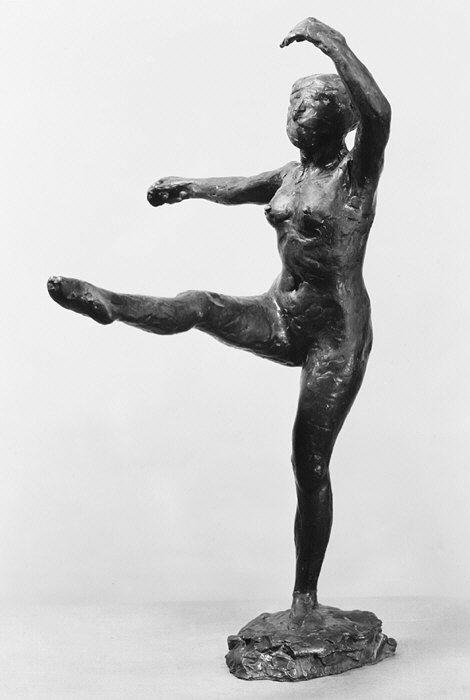
Arabesque Devant (modeled probably before 1890, cast 1920, Met-Objekt 413)
Original title: Arabesque Devant
kurzbeschreibung
Edgar Degas's bronze sculpture 'Arabesque Devant' was probably modeled before 1890 and cast in 1920. It shows a nude dancer in a dynamic arabesque and belongs to Degas's series of dancer sculptures. Its dimensions are roughly 58.1 x 37.1 x 37.5 cm.
Description
A nude dancer balances in an arabesque: one leg is lifted high, the other slightly raised. Her arms are extended, underscoring the movement and elegance. The figure rests on a flat, irregular base that provides support. The bronze has a uniform tone, and the lighting is even, with no visible shadows, which emphasizes the clear silhouette.
Context
During this creative period, Degas was deeply engaged with ballet and captured dancers in various media. The sculpture was probably modeled before 1890 but was only posthumously cast in bronze in 1920—a sign of the later appreciation of his sculptural work. During his lifetime, Degas's sculptures were barely seen in public; the posthumous bronze casts made his three-dimensional works better known.
Impact
The sculpture radiates an immediate, lively movement, heightened by the extended limbs and the fragile balance. The nudity brings muscular tension and anatomical precision into focus, emphasizing the intensity of the dance. The uniform bronze surface gives the figure a timeless, classical grace.
Technique
Originally modeled in wax, the sculpture was posthumously cast in bronze in 1920, probably using the lost-wax method, which preserves fine surface details. The bronze color is even and without visible texture features, suggesting a smooth surface treatment.
AI-generated description text
Source: Metropolitan Museum of Art · Public Domain (CC0 1.0)