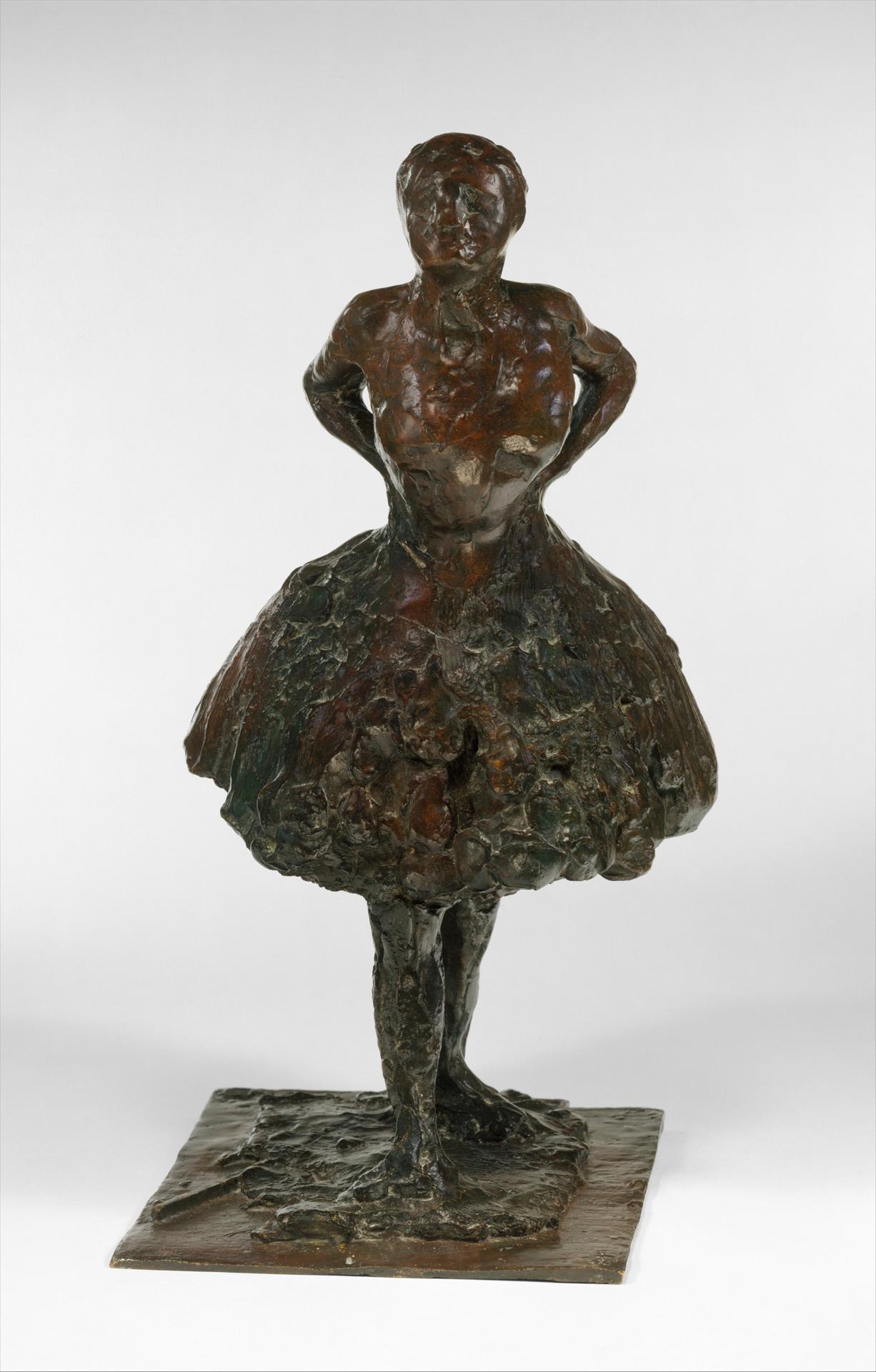
Dressed Dancer at Rest, Hands Behind Her Back, Right Leg Forward (Second State)
Original title: Dressed Dancer at Rest, Hands Behind Her Back, Right Leg Forward (Second State)
kurzbeschreibung
Edgar Degas's bronze figure of a clothed dancer who pauses, hands clasped behind her back and right leg set slightly forward. The work was likely modeled around 1895 as a wax sculpture and cast in bronze in 1920. The dancer wears a loose dress that absorbs her movement.
Description
A girl stands upright, arms crossed behind her back, right leg placed a little ahead. Her dress fits tightly at the waist and falls in wide folds below. The figure rests on a flat, square base that lifts it slightly. The surface is unevenly textured; one can make out the folds of the fabric and the muscles of the body. The bronze tone appears slightly altered by the patina. The light is even and diffuse, so no distinct shadows form.
Context
The wax model probably dates from around 1895; the bronze cast came only in 1920, after Degas's death. The sculpture belongs to a series of dancers that Degas formed in wax and that were transferred to bronze posthumously. The resting pose with crossed arms and forward leg reflects his interest in casual poses from the ballet world.
Impact
A quiet, almost familiar mood emanates from the figure—evoked by the relaxed posture and the soft modeling of the dress. The structured surface and the patina give the work a lively, almost physical presence that draws the viewer closer.
Technique
The bronze casting was carried out after Degas's death by his founder. The surface shows a fine grain resulting from the wax modeling and the transfer into metal. The greenish-brown patina was created by chemical treatment and highlights the details of folds and muscles.
AI-generated description text
Source: Metropolitan Museum of Art · Public Domain (CC0 1.0)