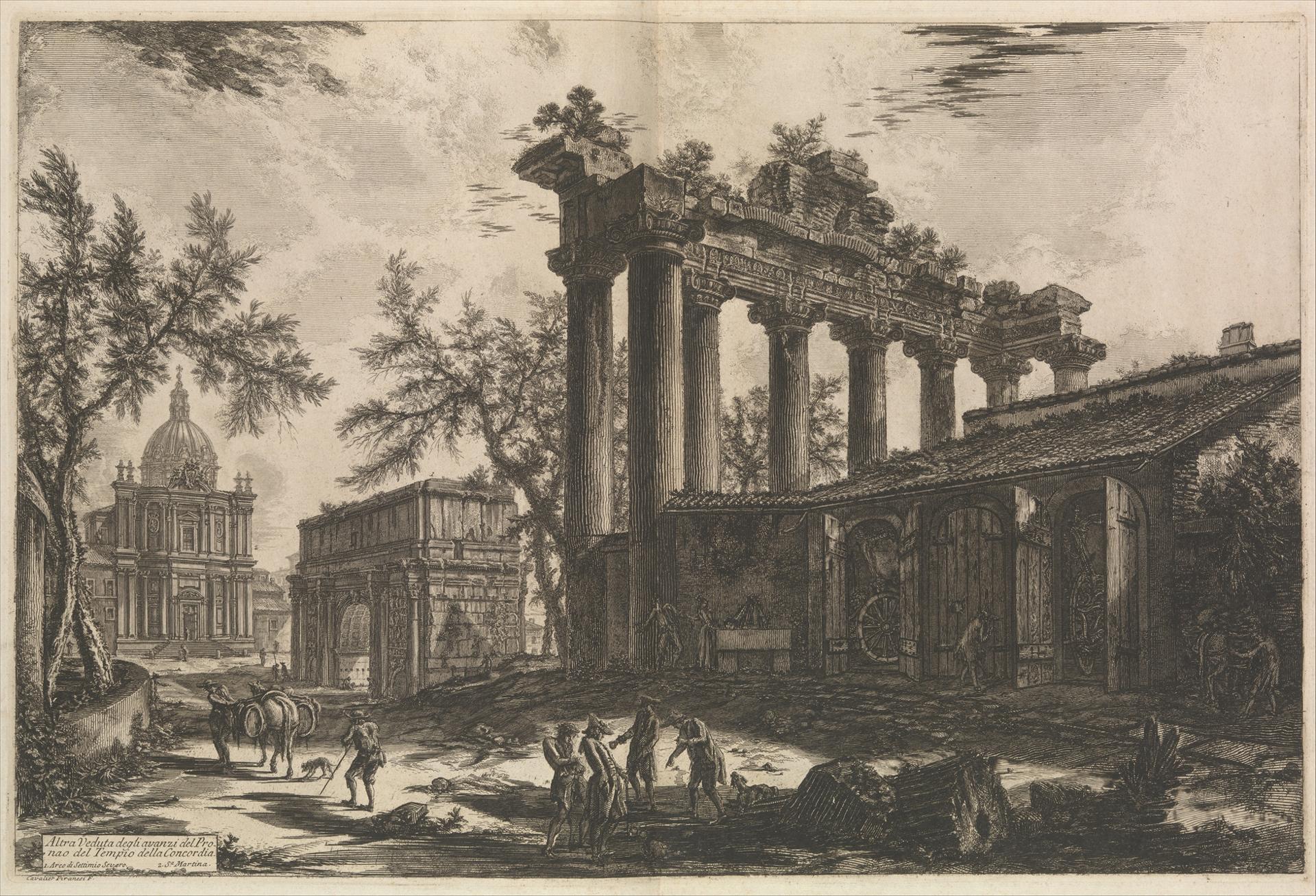
Another view of the remains of the Pronaos of the Temple of Concord (The Temple of Saturn with Arch of Septimius Severus in left background), from "Vedute di Roma" (Views of Rome), part I
Original title: Another view of the remains of the Pronaos of the Temple of Concord (The Temple of Saturn with Arch of Septimius Severus in left background), from "Vedute di Roma" (Views of Rome), part I
kurzbeschreibung
Giovanni Battista Piranesi etched the remains of the pronaos of the Temple of Concordia in Rome between about 1750 and 1778. Behind the broken columns rise the Arch of Septimius Severus and a domed church. The print belongs to the series 'Vedute di Roma' and reveals how precisely and yet powerfully the artist could present ancient buildings.
Description
Several columns of the pronaos stand in the foreground, some broken off, with surviving capitals and architraves overgrown by plants. Beyond them stretches the Arch of Septimius Severus, topped by a domed church. Trees and bushes frame the ruins and partly block the view. Among the stones, scattered figures appear: some walk, others stop and talk. The ruins occupy the middle of the picture, the arch closes the background, and light falling from above brings out shadows and contours.
Context
For decades, from the 1740s onward, Piranesi worked on the 'Vedute di Roma' and issued them in several parts. The series records the ancient buildings of Rome and their surroundings in the eighteenth century. The artist was known for accurate yet dramatically heightened views that met the growing interest in Roman antiquity during the Enlightenment. The Temple of Concordia, also called the Temple of Saturn, was among the important buildings of ancient Rome; Piranesi drew its remains several times.
Impact
Sublimity and melancholy lie close together in this etching, as so often with Piranesi. The enormous ruins gain force through the precise rendering and the direction of light, while vegetation and tiny figures make decay and transience palpable. Viewers are transported into the historical landscape of Rome and gain a sense of the grandeur of antiquity.
Technique
Piranesi worked in etching: the drawing is scratched into a wax layer on a copper plate, the plate then etched, inked, and pulled on paper, producing fine lines and shading. The present example is the first of three states, which points to an early impression from the plate and its high quality.
AI-generated description text
Source: Metropolitan Museum of Art · Public Domain (CC0 1.0)