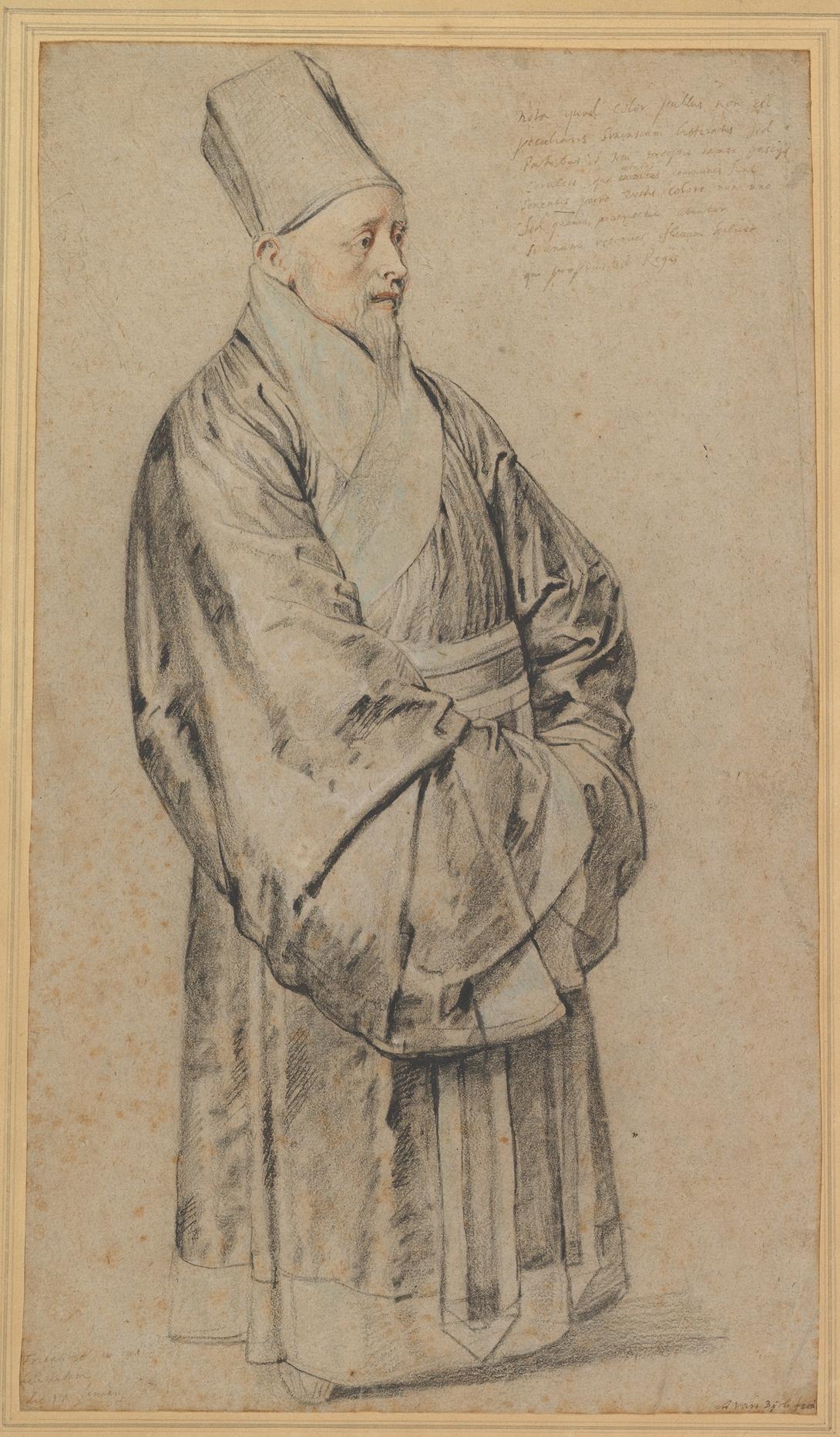
Portrait of Nicolas Trigault in Chinese Costume
Original title: Portrait of Nicolas Trigault in Chinese Costume
kurzbeschreibung
Peter Paul Rubens drew this portrait of the Jesuit missionary Nicolas Trigault in 1617, capturing him in Chinese attire. The sheet is executed in black, red, and white chalk, blue pastel, and pen with brown and black ink on light brown laid paper.
Description
A man stands upright, wearing a long-sleeved robe with a broad collar; on his head is a headpiece that recalls Chinese headwear. His gaze turns slightly to the side. The background remains empty, which makes the figure stand out. In the upper right there is a handwritten note in Latin. The tones are muted and grey, produced by chalk, pastel, and ink.
Context
Nicolas Trigault (1577–1628) served as a Flemish Jesuit in China, where he conveyed European knowledge. Rubens likely made the portrait during Trigault's stay in Europe, when he was promoting the Jesuit mission. It is among the rare surviving portraits by Rubens that show Asian dress and testifies to cultural exchange between Europe and China in the early 17th century.
Impact
The calm posture and the sidelong glance give the sitter dignity and presence. The interplay of chalk, pastel, and ink makes the sheet appear lively and sketch-like, bringing Trigault's personality to the fore. The restrained colouring emphasizes the historical distance and the serious character of the portrait.
Technique
Rubens combined black, red, and white chalk with blue pastel and pen in brown and black ink. Through this mixture of dry and liquid media, fine transitions of light and shadow could be achieved. The light brown paper used dates from the early 17th century and has aided the work's preservation.
AI-generated description text
Source: Metropolitan Museum of Art · Public Domain (CC0 1.0)