Tendu Derrière
Original title: Tendu Derrière
kurzbeschreibung
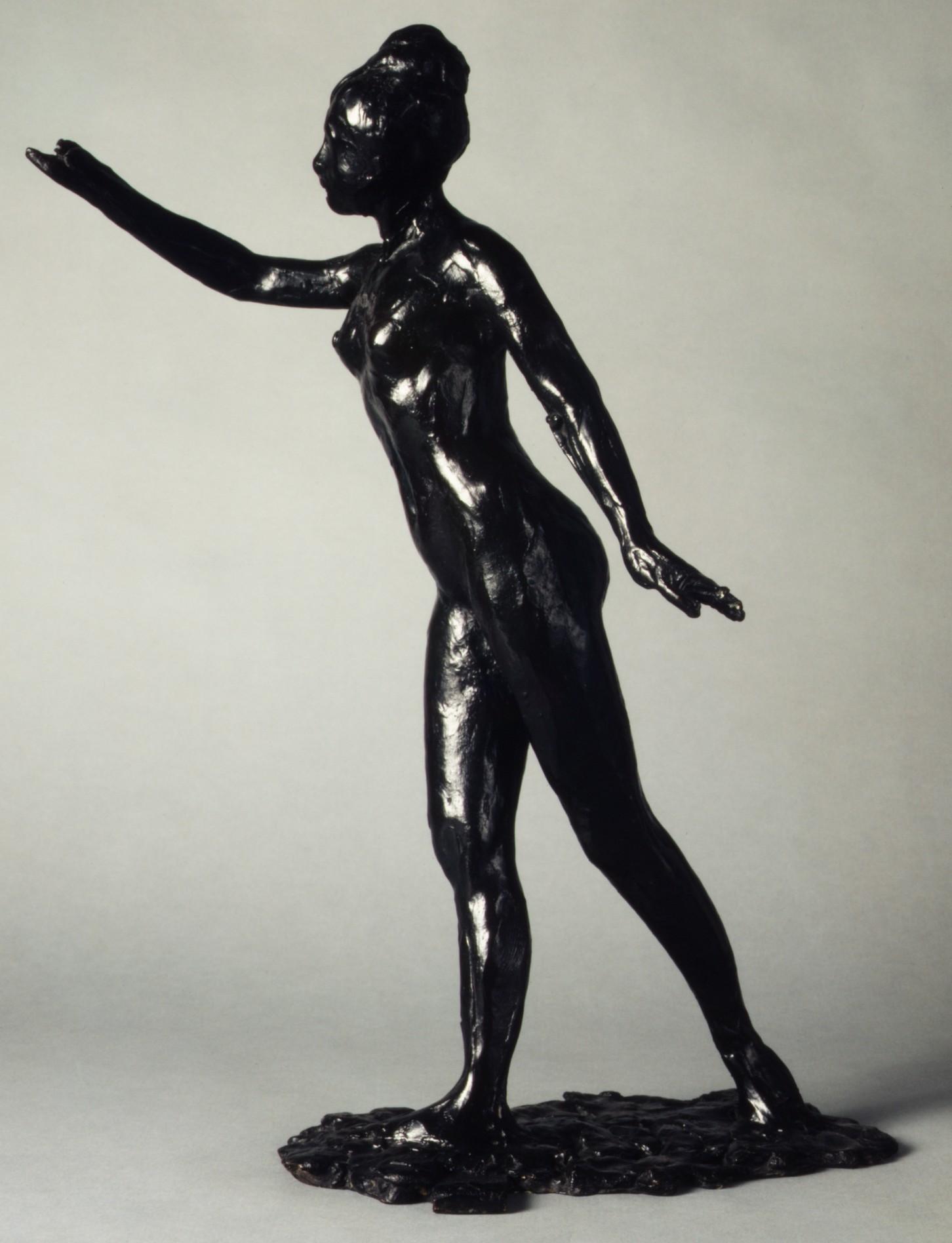
Unlike many of Degas's other dancer figures, which often appear static, this bronze captures a moment of peak tension. Modeled probably between 1882 and 1895, Tendu Derrière shows a nude dancer in an extended pose, part of his extensive series of ballet sculptures.
Description
A naked woman is seen in a dance position: one arm points forward, the other is drawn slightly back. Her legs are in a stride, left foot forward, right foot back—an arrangement reminiscent of a ballet exercise. The figure is slender and toned, typical of Degas's dancers. An irregular, rocky base suggests a natural setting. The shiny bronze surface reflects light, making the body's contours stand out.
Context
This sculpture emerged during a period when Degas was deeply engaged with ballet and produced numerous studies of dancers. Most of his sculptures were cast in bronze only after his death, as he worked primarily in wax and clay during his lifetime. The exact dating remains uncertain, but it falls in his late career, when he increasingly turned to sculpture. The work belongs to a group of about 150 sculptures found in his studio.
Impact
The figure conveys an immediate presence and liveliness characteristic of Degas's innovations in sculpture. The dynamic pose and emphasis on bodily movement create a tension that holds the viewer's attention. The glossy surface enhances the sensuality of the material and underscores the elegance of the figure.
Technique
The bronze was cast after Degas's death by his founder Adrien-Aurélien Hébrard. The original model was likely made of wax, reinforced with wire and other materials. The surface has a fine patina, resulting from the bronze technique, which accentuates the details of the musculature.
AI-generated description text
Source: Metropolitan Museum of Art · Public Domain (CC0 1.0)