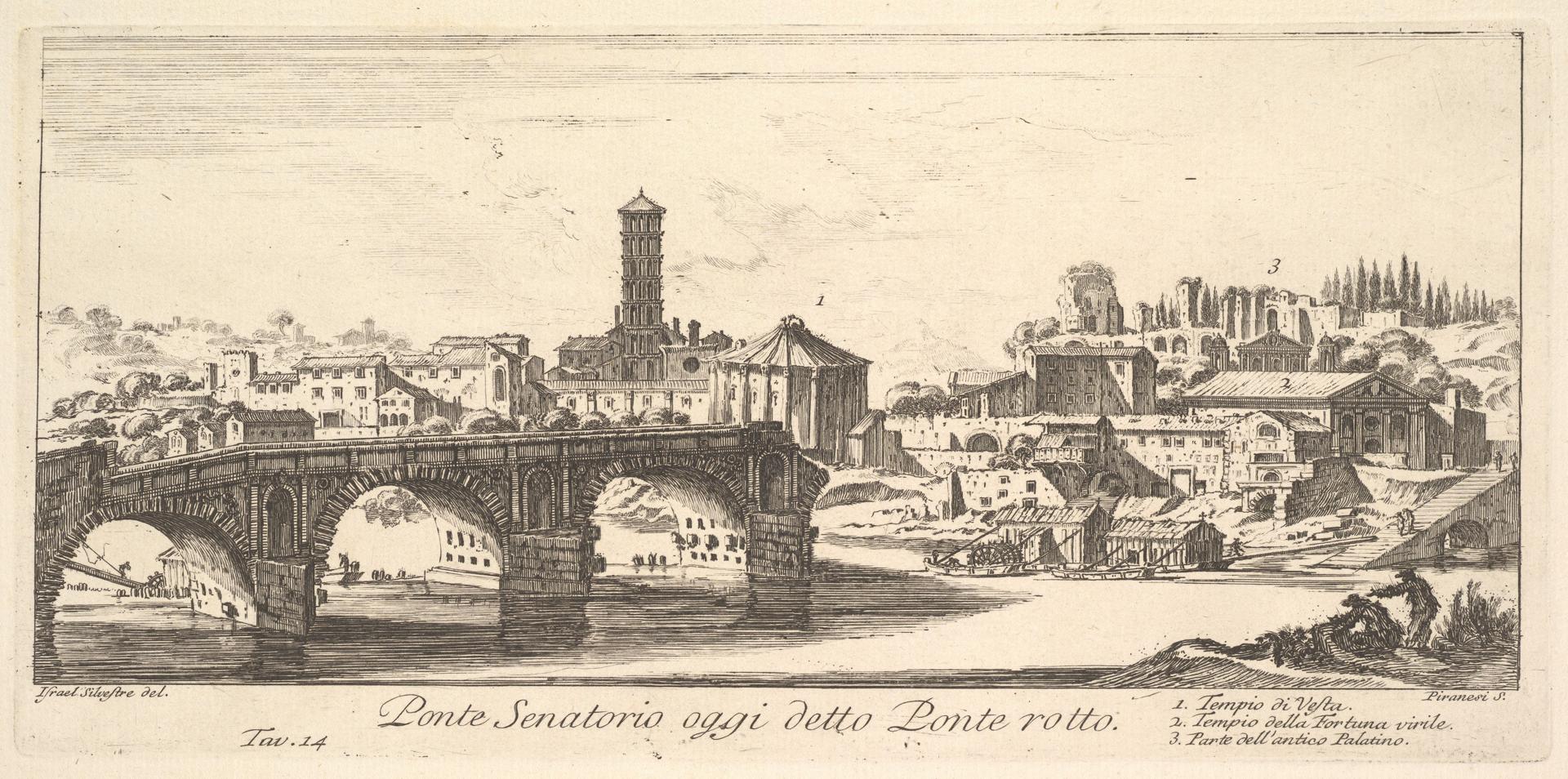
Plate 14: Senatorial Bridge, today called the Ponte Rotto (Broken Bridge). 1. Temple of Vesta. 2. Temple of Fortuna Virilis. 3. Part of the ancient Palatine.
Original title: Plate 14: Senatorial Bridge, today called the Ponte Rotto (Broken Bridge). 1. Temple of Vesta. 2. Temple of Fortuna Virilis. 3. Part of the ancient Palatine. (Ponte Senatorio oggi detto Ponte rotto), from "Antichità Romane de' Tempi della Repubblica, e de' primi Imperatori"
kurzbeschreibung
Around 1748, Giovanni Battista Piranesi recorded the Senatorial Bridge, known today as the Ponte Rotto, with ancient structures rising behind it. The sheet belongs to the series Antichità Romane de' Tempi della Repubblica, e de' primi Imperatori and measures 12.4 × 15.7 cm (plate). Closely observed topography meets a quiet mood steeped in history.
Description
A Roman stone bridge with several arches spans a river and draws the eye into depth. On the left rises the round Temple of Vesta, its roof crowned by a tower; on the right stands the Temple of Fortuna Virilis with a flat roof and a row of columns. Scattered walls and columns behind them are the remains of the ancient Palatine. The bridge forms the middle of the layout, and the buildings settle symmetrically on either side.
Context
The etching was made within a series in which Piranesi recorded Roman antiquity, intended for travelers and collectors. In those years Rome was a sought-after destination of the Grand Tour. Archaeological observation and artistic shaping go hand in hand in Piranesi's work, honoring the traces of the Republic and the early emperors. What appears is real architecture that in the eighteenth century partly still stood and partly had already fallen into ruin.
Impact
From the first glance a quiet, historical mood prevails, deepened by the monochrome gray and white. The clear structure of the architecture and the balanced arrangement evoke a solemn, almost wistful feeling. Viewers are invited to see the grandeur of antiquity precisely in its decay.
Technique
In etching, the drawing is scratched into a wax layer on a copper plate and then bitten with acid. Delicately placed lines and hatching render stone textures and light in detail. The plate is then inked with printer's black and pulled on paper; the gray tones arise from the varying density of the strokes.
AI-generated description text
Source: Metropolitan Museum of Art · Public Domain (CC0 1.0)