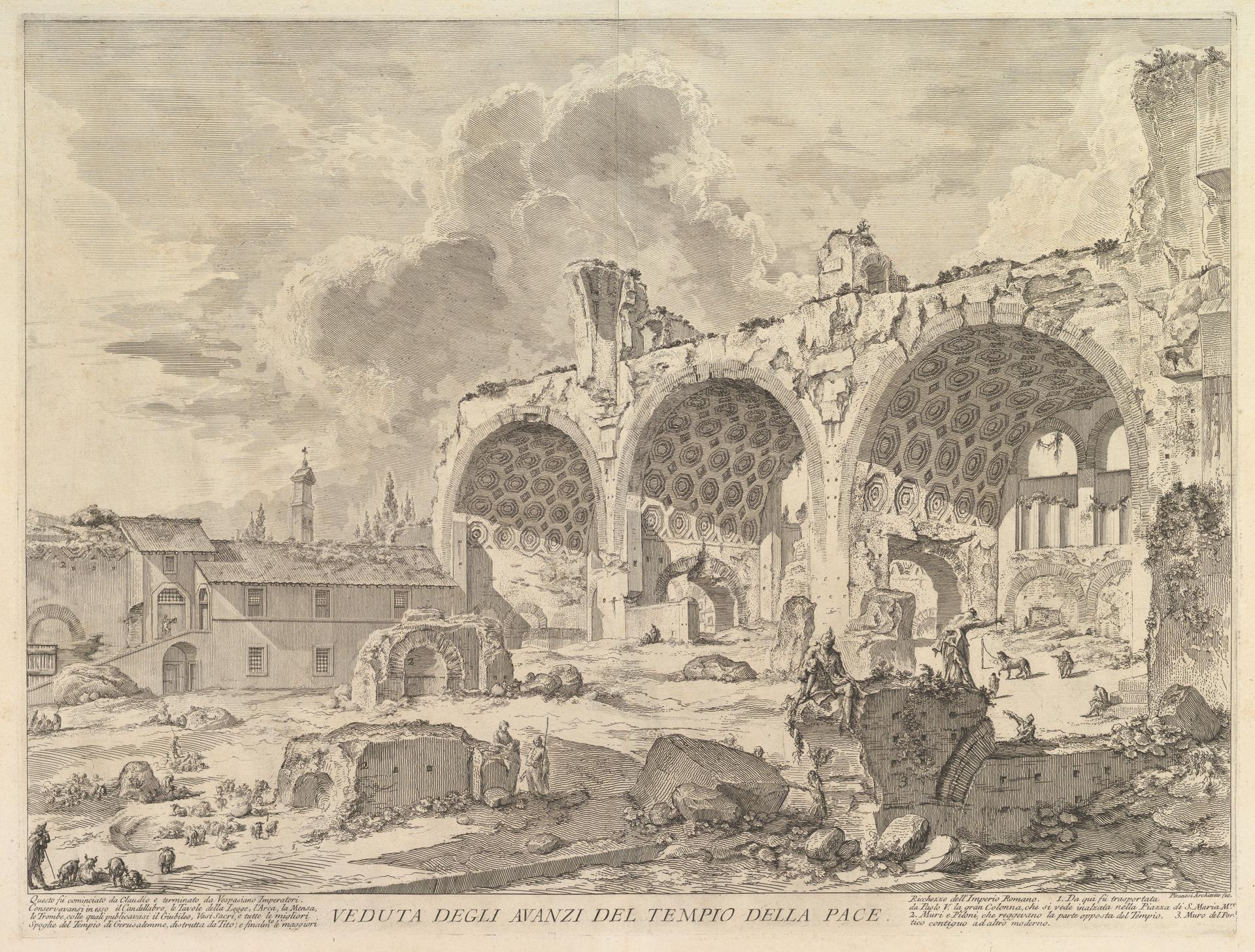
The Basilica of Constantine (Veduta degli avanzi della Casa aurea di Nerone, detti volgarmente il Tempio della Pace), from "Vedute di Roma"
Original title: The Basilica of Constantine (Veduta degli avanzi della Casa aurea di Nerone, detti volgarmente il Tempio della Pace), from "Vedute di Roma"
kurzbeschreibung
Giovanni Battista Piranesi made this etching around 1757, showing what was commonly called the Tempio della Pace in Rome—actually the remains of Nero's Golden House. The print belongs to the series 'Vedute di Roma' and combines archaeological recording with picturesque dramatization.
Description
Massive ruined walls with arches and columns fill the foreground, their surfaces covered in elaborate decorative patterns. Ivy and other greenery have spread over the ruins, while small figures convey the enormous scale of the architecture. Behind, more buildings and a wooded area rise in tiers, and a cloud-filled sky adds tension. Clear, highly detailed lines define the monochrome image.
Context
From the 1740s onward, Piranesi published the 'Vedute di Roma', a series of views of ancient and contemporary Roman monuments. This print was made during a period of active archaeological research and growing enthusiasm for antiquities among travelers to Rome. Piranesi combined topographical accuracy with artistic heightening to emphasize the grandeur of ancient buildings. The name 'Tempio della Pace' comes from a popular label for the ruins, which actually include parts of Nero's Domus Aurea.
Impact
A sublime, melancholic mood emanates from the print, carried by the overgrown remains and dramatic clouds. The tiny staffage figures make the ancient structures appear even more monumental and encourage quiet reflection on transience.
Technique
In etching, the drawing is incised into a copper plate, which is then etched with acid. Piranesi used fine, precise lines and varying hatching to render light and shadow as well as the texture of stone and plants. This process allowed for large editions and wide distribution of the vedute.
AI-generated description text
Source: Metropolitan Museum of Art · Public Domain (CC0 1.0)