The Temple of Vespasian and Titus (Veduta del Tempio di Giove Tonante)
Original title: The Temple of Vespasian and Titus (Veduta del Tempio di Giove Tonante)
kurzbeschreibung
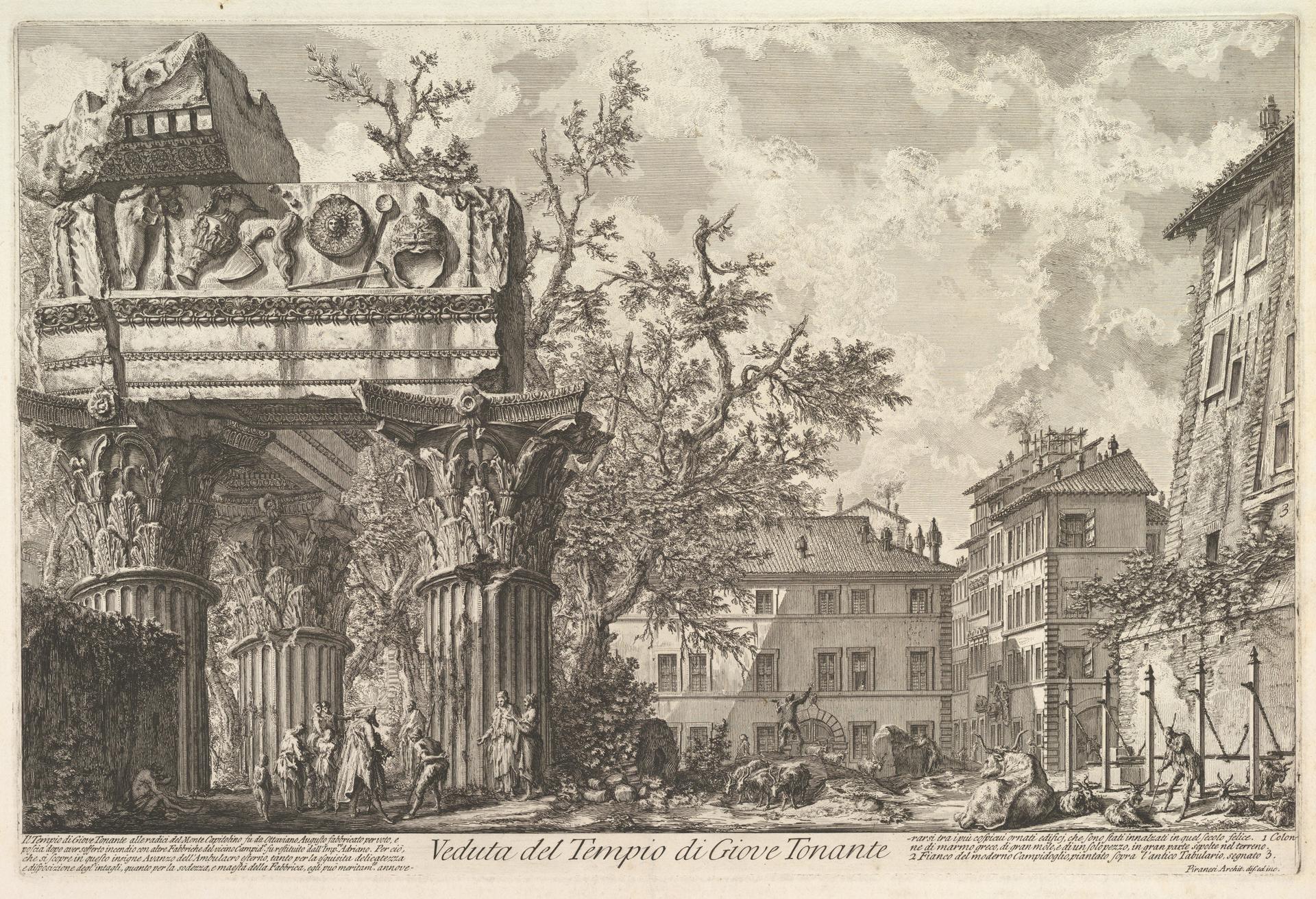
Around 1756, Piranesi made this etching as a veduta of the so-called Tempio di Giove Tonante in Rome. It belongs among the views of ancient Roman buildings that the artist published in his collection 'Le Antichità Romane'. In the foreground are the remains of a Corinthian temple with columns and reliefs, while contemporary houses behind form a contrast to the ancient past.
Description
The layout feels balanced, with the temple placed centrally, its Corinthian columns and ornate entablature standing out clearly. A large tree in the foreground dominates the sheet and seems to frame the architecture. On the left, figures move around the temple, lending the view liveliness. Light comes from above, bringing out the sculptural details of the reliefs and capitals, while the etching's grays carry the historical mood.
Context
In the mid-eighteenth century, when Rome became a center for antiquarian research and the Grand Tour, Piranesi was working on this etching. He recorded Roman ruins with archaeological precision, yet also with artistic drama. The name 'Tempio di Giove Tonante' was common at the time but incorrect, for the building was actually dedicated to Vespasian and Titus. The print appeared in 'Le Antichità Romane', a collection that expanded knowledge of ancient Rome.
Impact
The sheet conveys a mood both sublime and wistful, characteristic of Piranesi. Thanks to the light and careful linework, the massive ruins feel almost tangible and draw the viewer into the scene. The juxtaposition of ancient architecture and present-day life creates a tension that has lost none of its relevance.
Technique
For this print, Piranesi used etching: the drawing is scratched into a wax layer on a copper plate and then bitten with acid. Fine lines and hatching produce graduated gray tones that model the temple's sculptural forms. In this way he could produce highly detailed yet atmospheric prints in large numbers.
AI-generated description text
Source: Metropolitan Museum of Art · Public Domain (CC0 1.0)