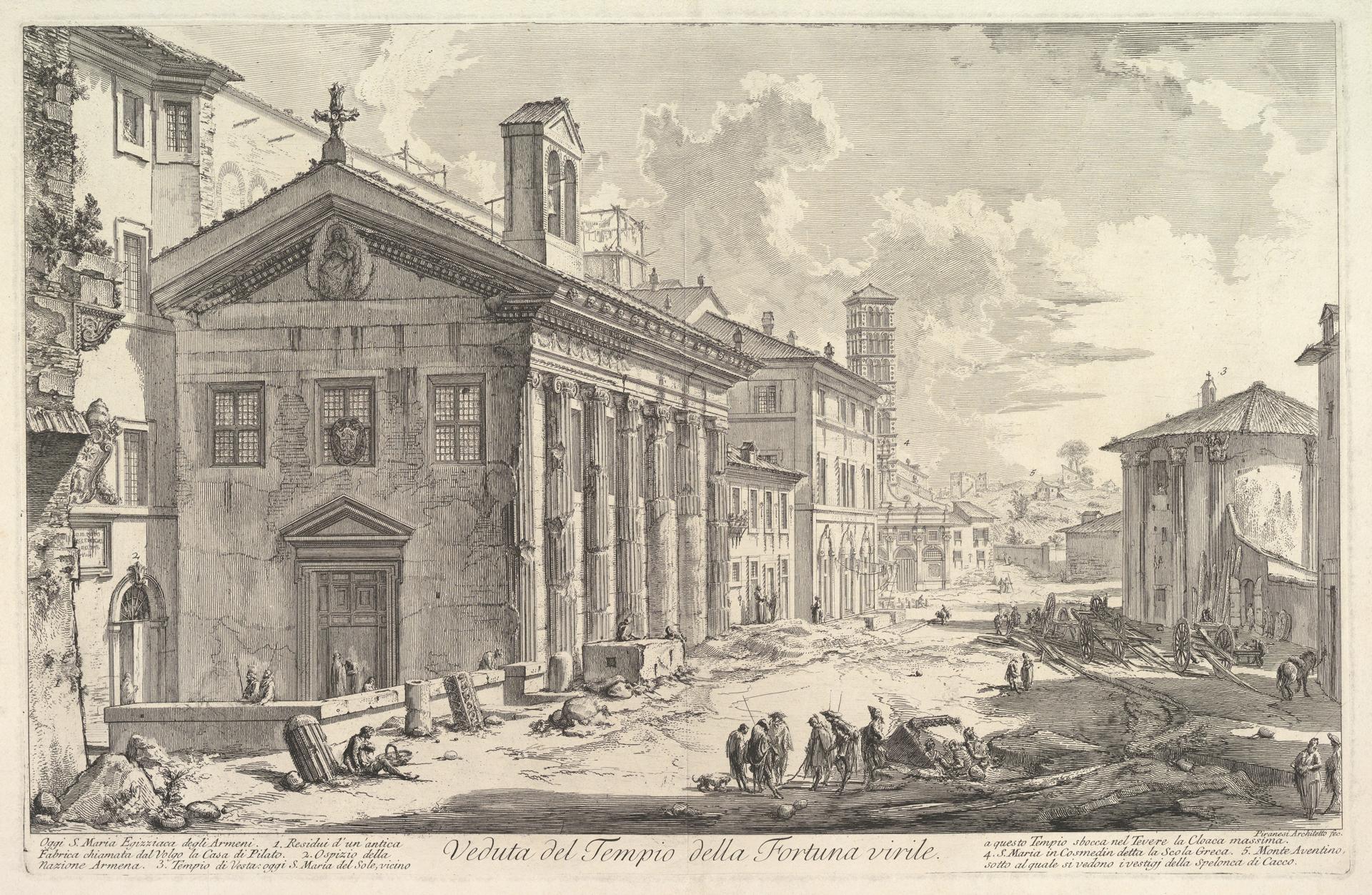
The so-called Temple of Fortuna Virilis (now Church of S. Maria Egizziaca) (Veduta del Tempio della Fortuna Virile)
Original title: The so-called Temple of Fortuna Virilis (now Church of S. Maria Egizziaca) (Veduta del Tempio della Fortuna Virile)
kurzbeschreibung
Unlike many of Piranesi's vedute, which look upon grand buildings and fields of ruins, this 1758 print focuses on a comparatively modest temple: the so-called Temple of Fortuna Virilis, long since serving as the church of S. Maria Egizziaca. The etching belongs to Piranesi's series of Roman views recording the city's ancient and contemporary buildings. It shows the temple with its Ionic columns, enclosed by a wall, with a fountain to the left, and behind it a busy street with houses and a domed church.
Description
A symmetrical layout governs the print: the temple with its Ionic columns stands at the centre, framed on either side by buildings. A wall runs around the structure in the foreground, with a small fountain to its left. A street with passers-by and further historic buildings leads toward a church with a domed roof in the distance. The sky is clouded, the view is rendered in shades of grey, and the light falls evenly, without strong shadows.
Context
The etching was made around 1758 in Rome, where Piranesi had lived since 1740 and had specialised in vedute and architectural views. The Temple of Fortuna Virilis in the Forum Boarium, a well-preserved Roman building from the 2nd century BC, had been converted into a church in the Middle Ages. With such prints Piranesi recorded buildings in order to emphasise their ancient grandeur while also showing their condition in his own time. The veduta falls into a period when Rome was regarded as the centre of the Grand Tour and European collectors sought out works like his.
Impact
The symmetrical arrangement and calm lighting give the print a clear, almost monumental effect that lends the ancient architecture a sense of dignity. Scenes of everyday life in the background provide a contrast: the timeless building and the lively bustle of the city pull apart from each other and yet draw the viewer into the view.
Technique
As an etching, the print was made by scratching the drawing into a wax layer on a copper plate and then biting it with acid. Piranesi worked with fine lines and hatching to create texture and depth, as is typical of his prints. The shades of grey and the even distribution of light come from the intaglio process, in which ink settles in the incised lines.
AI-generated description text
Source: Metropolitan Museum of Art · Public Domain (CC0 1.0)