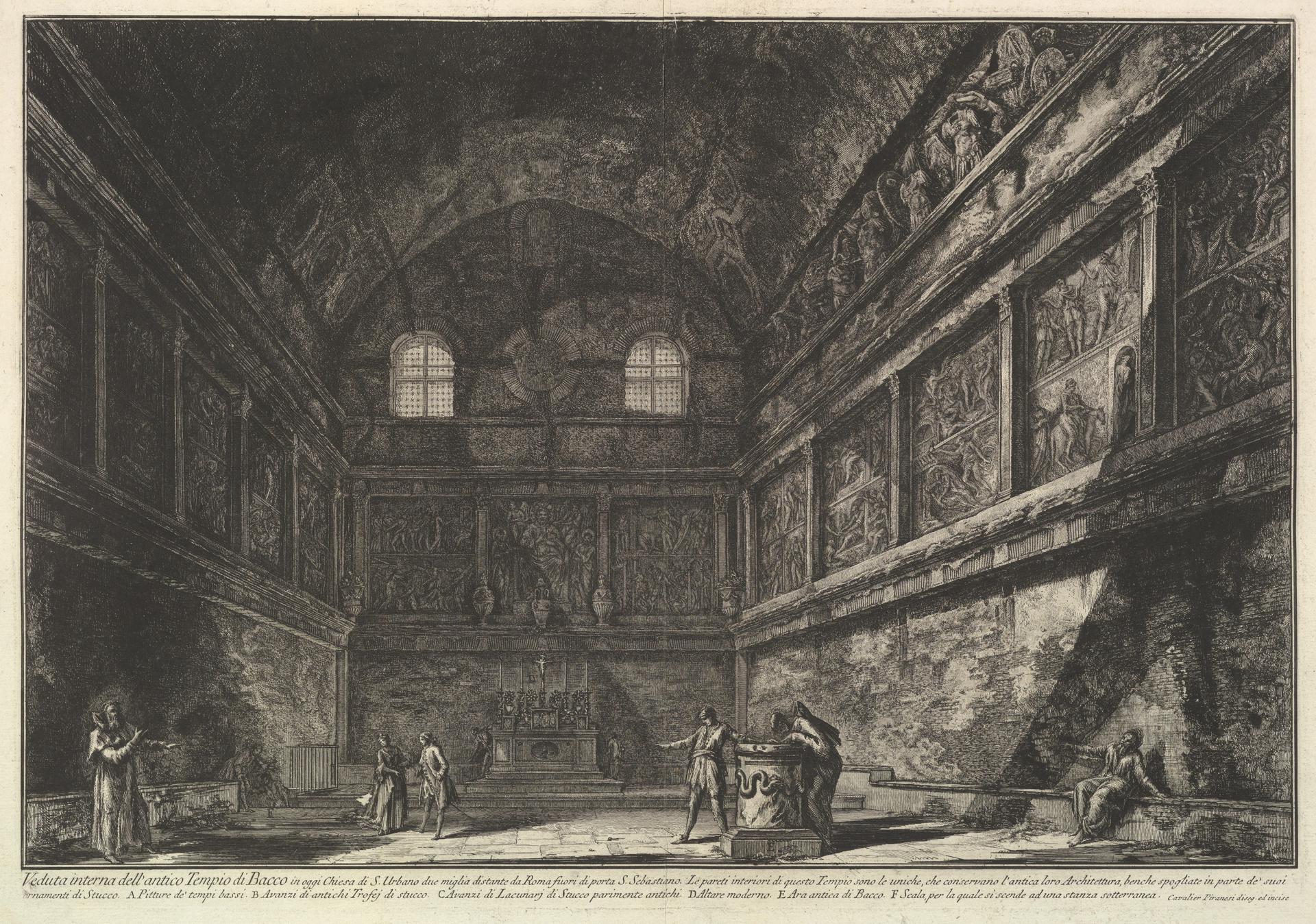
Interior view of the ancient Temple of Bacchus, now the church of S. Urbano, two miles from Rome..., from Vedute di Roma (Roman Views)
Original title: Interior view of the ancient Temple of Bacchus, now the church of S. Urbano, two miles from Rome..., from Vedute di Roma (Roman Views)
kurzbeschreibung
Unlike many vedute that capture the exteriors of Roman ruins, this etching by Giovanni Battista Piranesi (ca. 1750) leads viewers into the interior of the ancient Temple of Bacchus, later used as the church of S. Urbano. Part of the Vedute di Roma series, the print exemplifies how Piranesi fused Rome's architecture and history into a single image.
Description
A tall, column-supported space opens up before the eye; the ceiling is richly ornamented and adorned with sculptures. Reliefs and pictures with figures and scenes decorate the walls. Several people—some standing, others seated—populate the foreground, giving a sense of the room's dimensions. Through windows in the ceiling, soft, diffuse light falls and spreads evenly across the scene. The layout feels clear and symmetrical; architectural details and the wall and ceiling decorations are clearly the focus.
Context
The Vedute di Roma began in the 1740s as a series of etchings documenting ancient and modern buildings of Rome. As such, it became an important means of spreading Roman classicism throughout Europe. The Temple of Bacchus, used in the 18th century as the church of S. Urbano, was a popular subject for artists recording Rome's ancient architecture. In his rendering, Piranesi combined archaeological accuracy with dramatic staging that highlights the grandeur of the ruins.
Impact
A solemn yet melancholic mood emanates from this etching, characteristic of Piranesi's vedute. The precise description of the architecture and the inserted human figures make its scale and historical depth palpable. The monochrome gray-scale technique heightens the effect of light and emphasizes the sculptural qualities of the depicted architecture.
Technique
An etching, this print is in the second of four states. Drypoint and etching were used to create fine lines and shading that capture the texture of stone and the details of the ornaments. The large format of the sheets allowed for a detailed rendering typical of Piranesi's vedute.
AI-generated description text
Source: Metropolitan Museum of Art · Public Domain (CC0 1.0)