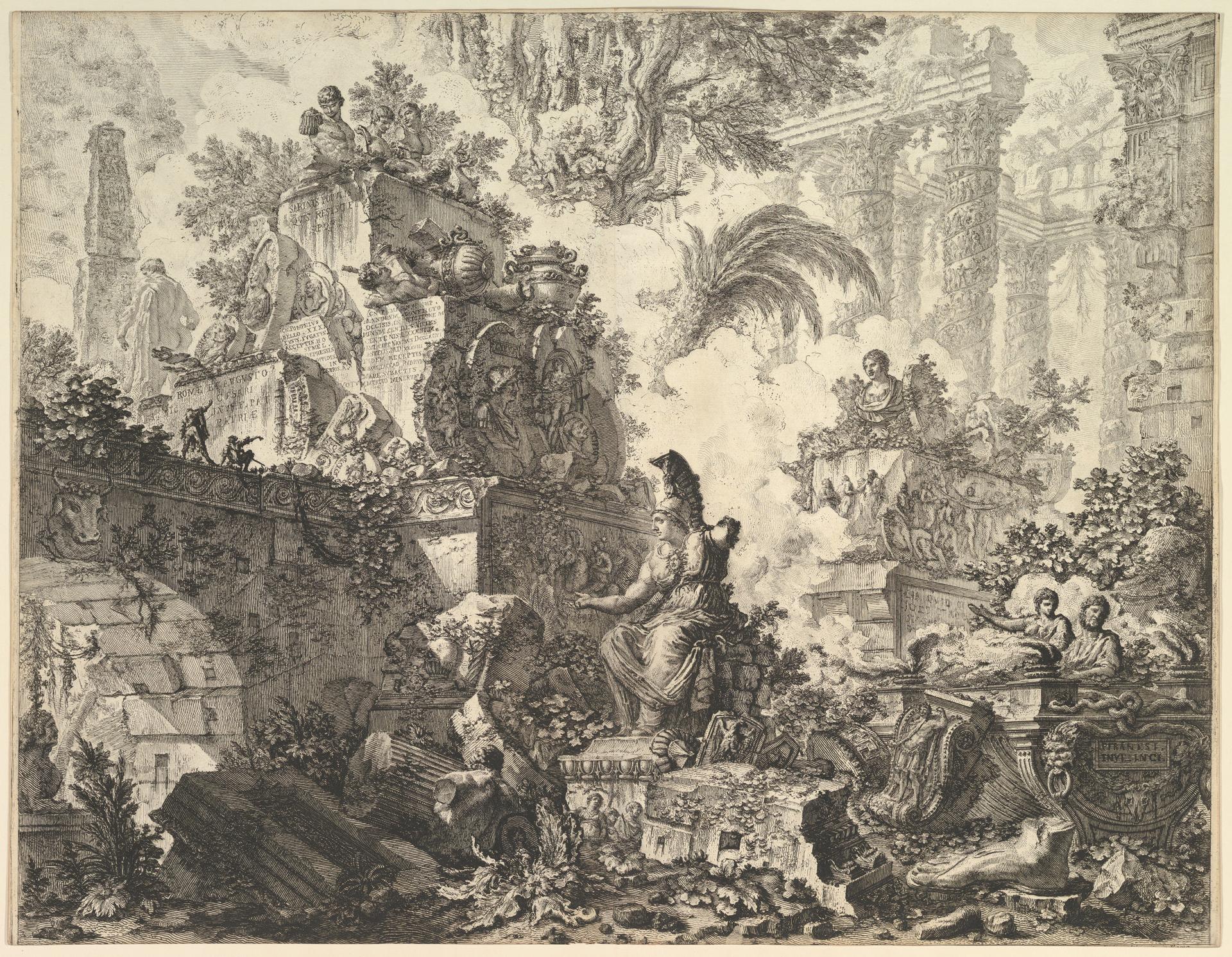
Frontispiece, with Statue of Minerva, from 'Vedute di Roma'
Original title: Frontispiece, with Statue of Minerva, from "Vedute di Roma"
kurzbeschreibung
Minerva, hewn in stone, presides as the title image over Piranesi's "Vedute di Roma" of about 1748. The etching places the goddess amid a landscape of ancient ruins, thus linking architecture and sculpture into an exalted view of Rome. As the opening sheet, it stands at the beginning of the famous series of Roman views.
Description
Minerva has taken her place on a pedestal, with other statues standing around her on columns and platforms. The layout appears symmetrically ordered and is densely packed with architectural details such as columns, capitals, and remains of walls. Behind the group of figures rise further ancient buildings and rows of columns, while trees, shrubs, and boulders loosen up the landscape. Gray tones dominate the sheet, with fine lines and hatching bringing out details and surfaces. The light is evenly distributed, and strong contrasts are absent.
Context
With the "Vedute di Roma," Piranesi produced a series of etchings that recorded the ancient and Baroque buildings of Rome. The frontispiece appeared around 1748, at a time when the artist was already established as a draftsman of vedute. The figure of Minerva alludes to Roman antiquity, which Piranesi glorified in his works. The series was published in several editions and shaped the European image of Rome for a long time.
Impact
The symmetrical arrangement and the elevated position of Minerva give the sheet a ceremonial, dignified character. The atmosphere feels calm and even, thanks to the fine linework that draws the viewer into the ancient world. Ruins and an intact statue appear side by side, thus emphasizing the timeless sublimity of Roman antiquity.
Technique
For this etching, the drawing was incised into a copper plate that had previously been coated with an acid-resistant ground. The etching process produced fine, even lines, which create gradations of light and dark through hatching and stippling. The sheet was printed on laid paper, which brings out the clear contours and the monochrome effect.
AI-generated description text
Source: Metropolitan Museum of Art · Public Domain (CC0 1.0)