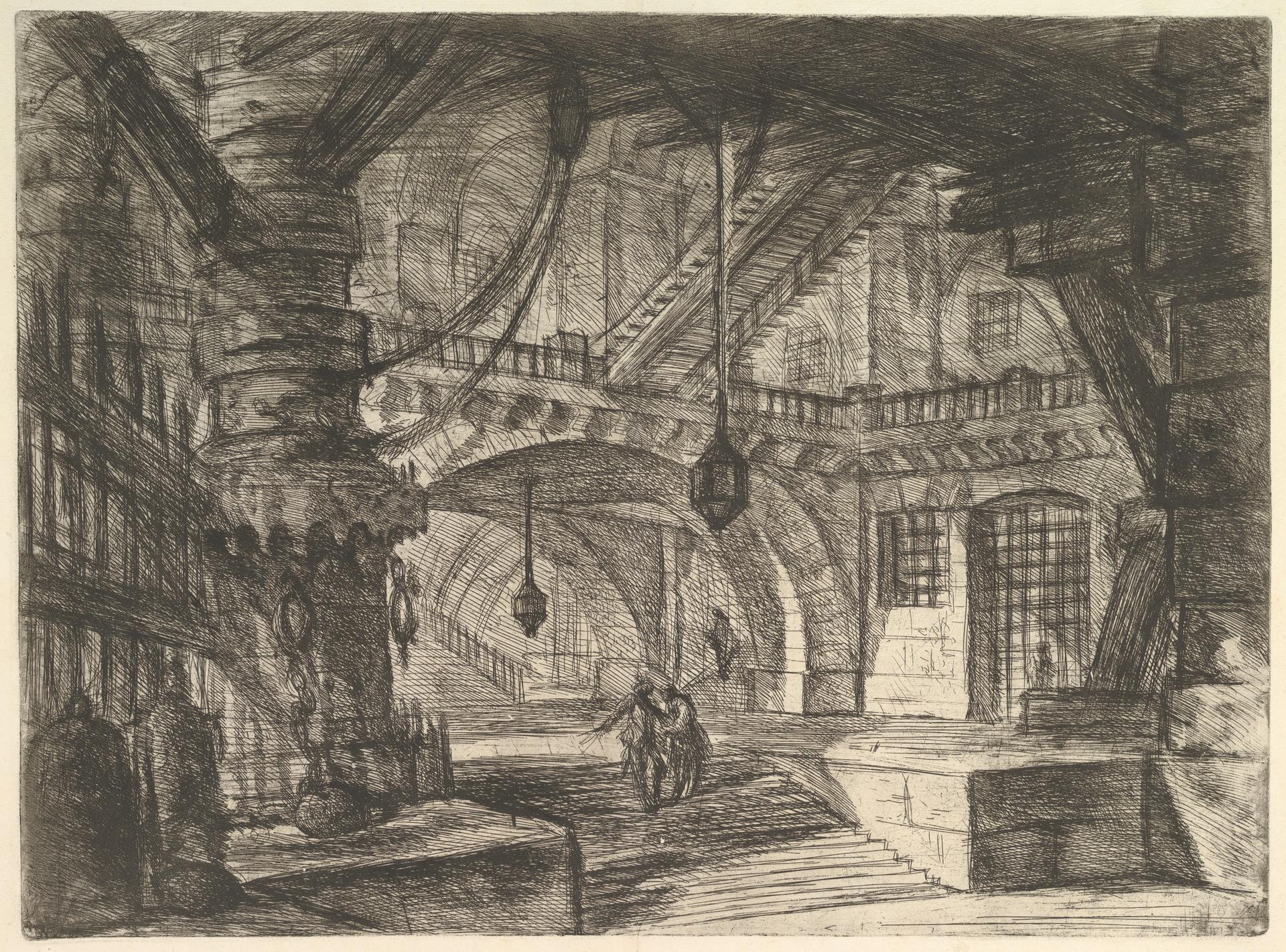
The Pier with Chains, from "Carceri d'invenzione" (Imaginary Prisons)
Original title: The Pier with Chains, from "Carceri d'invenzione" (Imaginary Prisons)
kurzbeschreibung
Created around 1749–50, this etching by Giovanni Battista Piranesi belongs to the first series of his 'Carceri d'invenzione'. It presents a vast subterranean architecture in which a bridge is supported by chains. The print combines etching, engraving, sulphur tint and burnishing. Two figures on the bridge add narrative tension to the image.
Description
A wide bridge spans a deep, vaulted opening; several chains hang from the ceiling and hold it. The chains run in various directions and emphasize the height of the space. On the bridge stand two dark-clad figures in agitated poses, apparently engaged in a quarrel. Tall arches and columns frame the symmetrical arrangement. Sparse light enters from above and through windows. Dense, careful hatching creates a dark, mysterious mood in predominantly grey tones.
Context
The 'Carceri' comprise 14 etchings and were first published in Rome around 1749–50. At that time Piranesi was engaged both with the architecture of ancient Rome and with contemporary stage designs. The 'Carceri' do not show real prisons but invented, monumental spaces that sprang from the artist's imagination. The first edition was lighter than the later revisions that Piranesi undertook in the 1760s.
Impact
Monumental architecture and sparse light produce an oppressive yet captivating atmosphere. The symmetrical layout and the agitated figures draw the eye into the depth of the space and heighten the sense of threat and sublimity. The contrast between fine lines and dark areas gives the print graphic power.
Technique
For this print Piranesi used a mixed technique of etching, engraving, sulphur tint or open bite, and burnishing. This allowed him to combine fine lines with deep, dark areas. The paper size measures 49.5 x 64 cm, the plate 40.8 x 54.8 cm—a generous format typical of the series.
AI-generated description text
Source: Metropolitan Museum of Art · Public Domain (CC0 1.0)