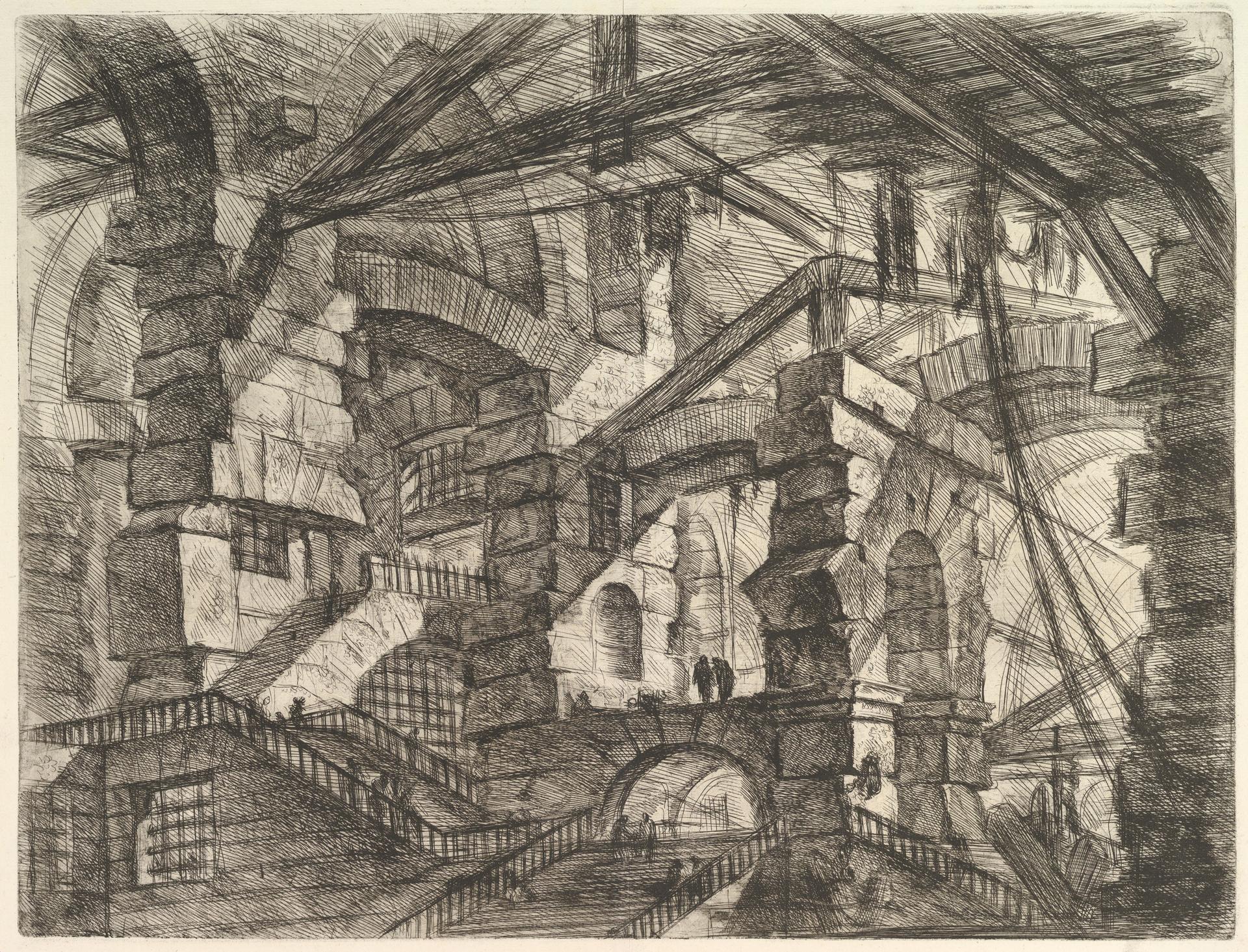
The Gothic Arch, from "Carceri d'invenzione" (Imaginary Prisons)
Original title: The Gothic Arch, from "Carceri d'invenzione" (Imaginary Prisons)
kurzbeschreibung
A colossal Gothic arch opens into a prison architecture that is almost impossible to take in at a glance—this motif comes from Giovanni Battista Piranesi's series 'Carceri d'invenzione' and was made around 1749–50. The sheet is an etching with engraving, sulphur tint and burnishing, and it is the first state of six (according to Robison).
Description
A large Gothic arch spans the image, flanked by massive columns and further archways. Staircases and bridges run through several levels and interweave into a labyrinthine structure. Small figures are scattered across the architectural framework, making the gigantic scale legible. Light enters from above and traces the edges of arches and columns. The whole is kept monochrome in graduated shades of grey.
Context
The 'Carceri' were first created around 1745–50 in Rome, where Piranesi worked as an architect and etcher. In those years he was deeply engaged with Roman architecture and the idea of an idealised antiquity. Yet the series does not depict real prisons; these are imagined architectural fantasies that likely drew inspiration from stage sets and Roman ruins. Piranesi later reworked the early version, to which this sheet belongs, and republished it.
Impact
A sense of oppression and fascination merge here: the overpowering architecture and interlocking spaces leave hardly any vanishing point. In the monumental structure the small figures seem lost, oscillating between the sublime and the threatening. Clear lines and harsh contrasts of light and shadow give the sheet a dramatic presence.
Technique
The work was done in etching: the drawing is scratched into a wax layer on the copper plate and the metal then etched. Engraving, sulphur tint and burnishing were added to create fine gradations between light and dark. This allowed the architectural details and the lighting to be rendered precisely.
AI-generated description text
Source: Metropolitan Museum of Art · Public Domain (CC0 1.0)