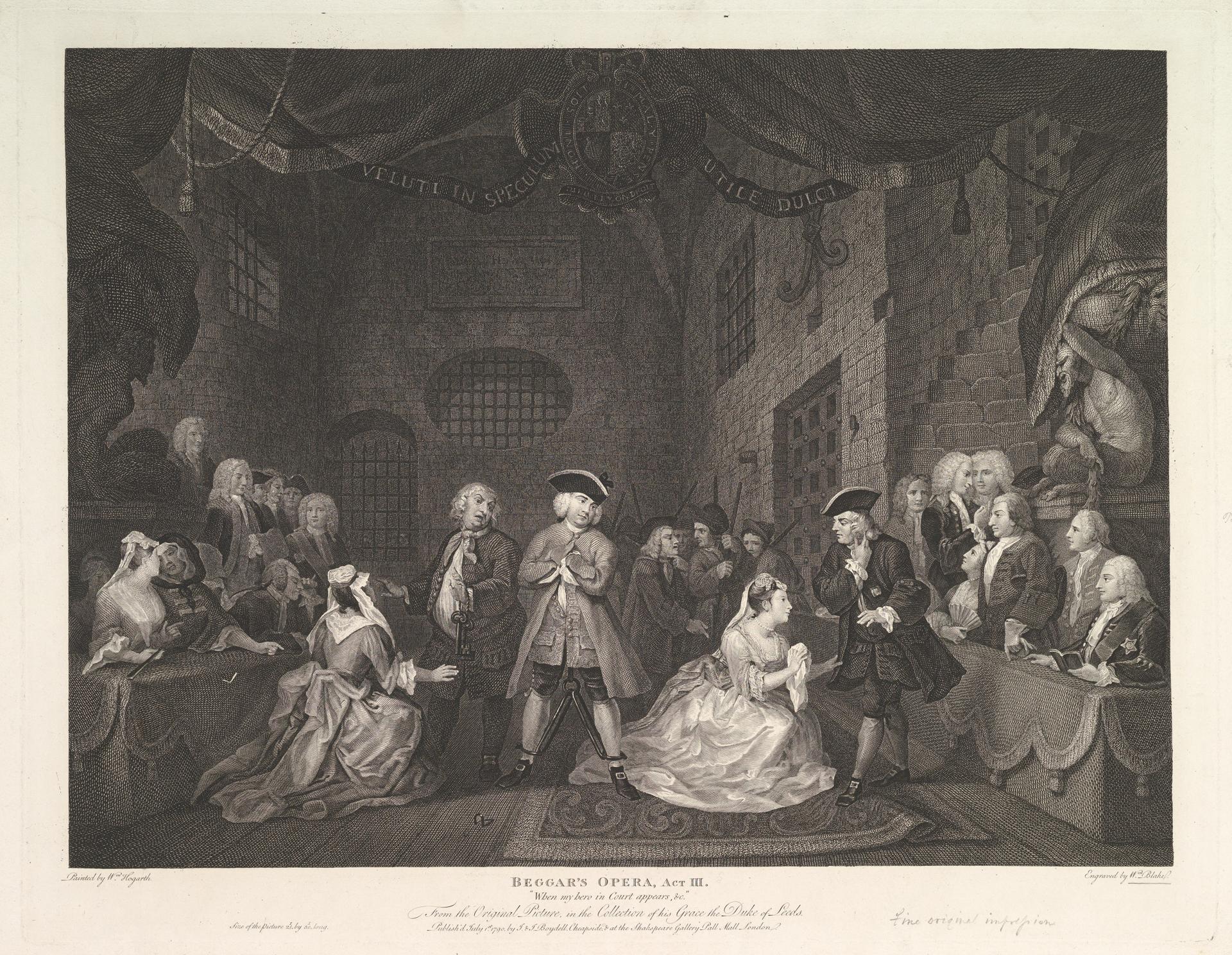
The Beggar's Opera, Act III (July 1, 1790, Met-Objekt 3909)
Original title: The Beggar's Opera, Act III
kurzbeschreibung
On July 1, 1790, William Blake issued an etching and engraving after John Gay's opera: the third act of The Beggar's Opera survives as a printed sheet based on a painting by William Hogarth. A group of figures occupies a room that resembles a courtroom. Black and white dominate the image, and the tension among those present is plainly visible.
Description
A man in a coat stands at the center, addressing a kneeling woman who prays, with a stick in his hand. Other figures arrange themselves to his right and left, their expressions shifting between curiosity and horror. More people sit and stand farther back. Above everything hangs a banner inscribed VELUTI IN SPECULUM UTILE DULCI. Light falls from above, defining shadows and the outlines of the figures; the layout feels balanced and ordered toward the middle.
Context
Blake's model was a Hogarth painting that reproduces scenes from Gay's The Beggar's Opera; the opera had premiered in 1728 and was a popular subject in eighteenth-century art. For his 1790 etching Blake turned to another artist's work. The motto on the banner alludes to the Horatian principle of prodesse et delectare, to be useful and to delight at once.
Impact
The symmetrical arrangement and the sharp contrast of light and shadow pull the eye immediately. Historical costumes are rendered precisely, the gestures of the figures remain expressive; together they create a dense, stage-like atmosphere. That only black and white is available sharpens the serious, almost moralizing tone of the sheet.
Technique
Etching and engraving on paper, with Blake combining etched line and direct engraving. The lines are precise and rich in detail, as was usual for late eighteenth-century printmaking. The plate measures 18 x 23 1/8 inches (45.7 x 58.8 cm), the sheet 19 5/16 x 26 9/16 inches (49 x 67.5 cm).
AI-generated description text
Source: Metropolitan Museum of Art · Public Domain (CC0 1.0)