Mourir C'est Renaitre (Death and Immortality)
Original title: Mourir C'est Renaitre (Death and Immortality)
kurzbeschreibung
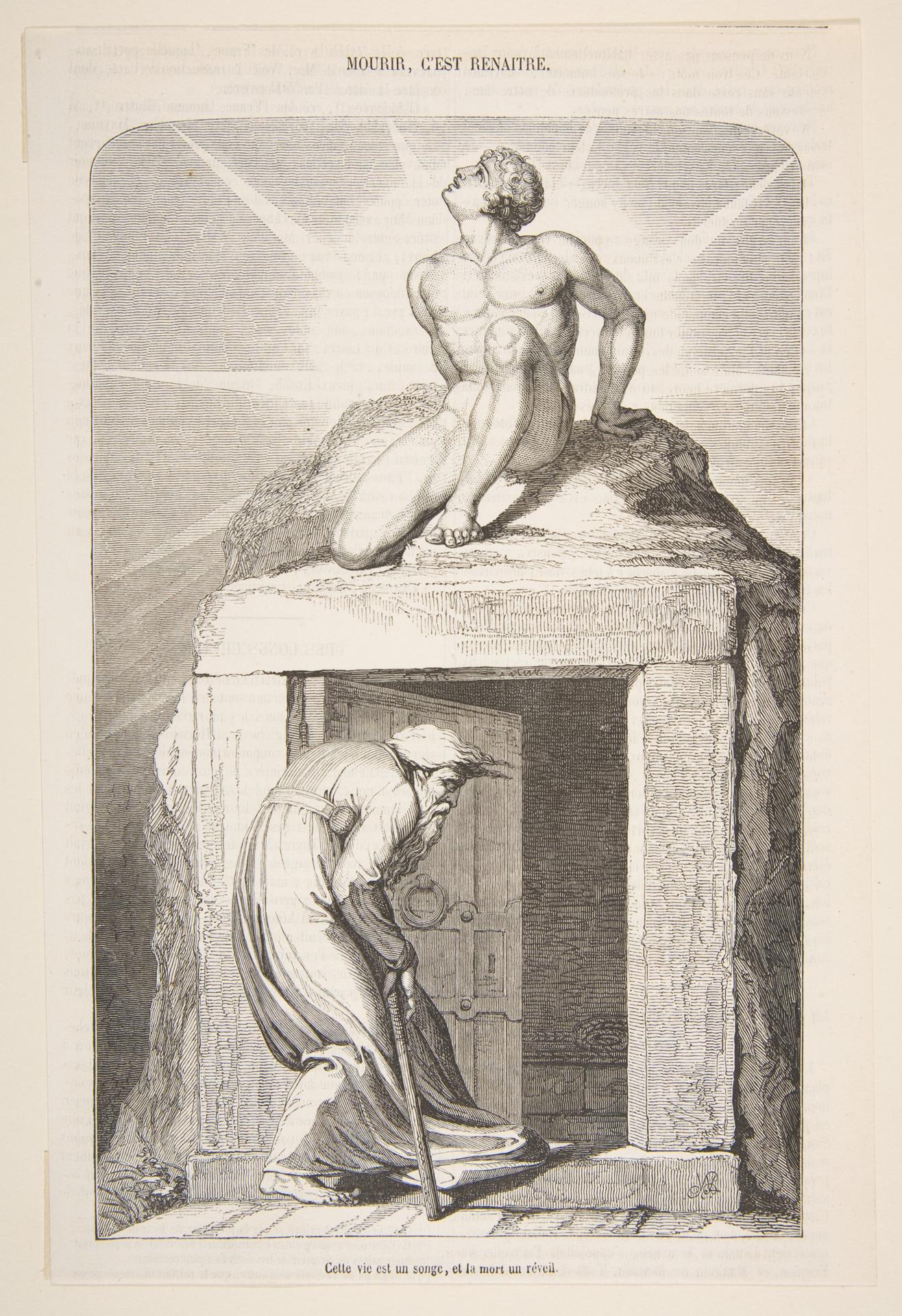
William Blake’s wood engraving “Death is Rebirth” (Death and Immortality), made in the 19th century, presents an allegorical scene about dying and being born again. At the top a powerful figure sits enthroned on a rock, bathed in brilliant light; below, an old bearded man bends before a dark doorway that recalls the entrance to a tomb.
Description
A muscular, almost idyllic body sits on a rock in the upper part of the image, gazing upward while a bright shaft of light surrounds him. In the lower area an old bearded man in a long robe and head covering, leaning on a stick, bows before an almost black door that looks like the way into a grave or a cave. Grey rock or cave walls form the backdrop. The drawing depends on delicate lines and hatching, as is characteristic of wood engraving. The title appears at the top, and at the bottom the sentence: “Cette vie est un songe, et la mort un rêve.”
Context
The illustration arose in the context of Blake’s engagement with the “thoughts” or “aphorisms” of the Swiss theologian and physiognomist John Caspar Lavater, whose aphorisms Blake translated and illustrated in 1788. The dating to the 19th century remains uncertain, since Blake’s wood engravings are often undated and he worked until his death in 1827. In this print a recurring motif of Blake’s is sounded: death as a transition to a higher form of existence—a thought that runs through his poetry and visual work as well.
Impact
The layout lives from the tension between the bright, sublime upper part and the dark, enigmatic door below; both prompt reflection on life and death. The delicate linework and the contrast-rich distribution of light and shadow give the print a quiet, meditative mood in which Blake’s mystical view of the world can be felt.
Technique
For this wood engraving the motif was cut into a woodblock and subsequently printed. The delicate lines and hatching are typical of the process, which Blake preferred in his later years. The dimensions of the print are 22.5 x 14.3 cm (plate) and 25.4 x 16.8 cm (sheet).
AI-generated description text
Source: Metropolitan Museum of Art · Public Domain (CC0 1.0)